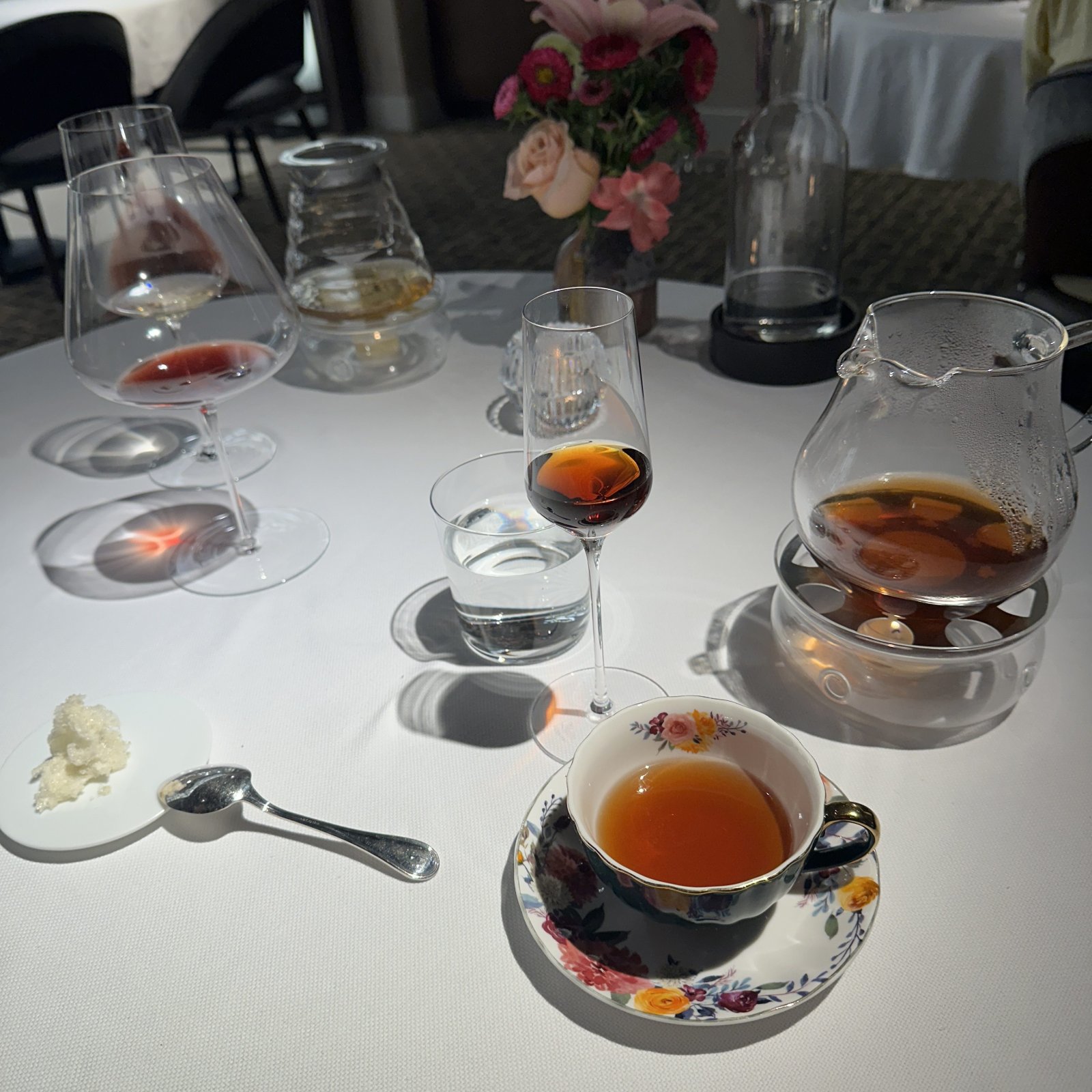
Tea pairings are easy to underestimate because the word tea sounds gentle. In a tasting-menu room, that gentleness can become a liability. If the restaurant treats tea as a polite soft option for guests skipping wine, the pairing usually tastes like an apology: warm liquid, perfume, sugar, and little structural tension with the food.
The better version is much sharper. Tea belongs in fine dining when the kettle joins the pass. The leaf has to be chosen for oxidation, roast, bitterness, sweetness, aroma, and body. The water has to be hot enough to extract flavor without making tannin shout. Cold steeps have to be planned hours ahead. Glassware has to decide whether the drink should behave like wine, broth, perfume, or a reset. Service has to land each cup while temperature is still part of the flavor.
That is why the current tea-pairing turn is more interesting than a simple non-alcoholic trend. Eater New Orleans reported that Emeril's introduced a dedicated tea pairing from Rare Tea Cellar alongside its six-course tasting menu, with teas served hot, chilled, in china, and in stemware rather than kept in one polite format.[1] The restaurant's official materials frame Emeril's as a two-Michelin-starred New Orleans dining room built around Louisiana produce and modern tasting-menu service, which makes the tea program a serious pairing claim rather than a tea-room novelty.[2]
Tea has structure before it has romance
Wine people have a useful advantage: they already talk about acid, tannin, sugar, alcohol, body, age, and temperature as structure. Tea often gets trapped in softer language: floral, calming, delicate, ceremonial. Those words can be true, but they are not enough for pairing.
Real tea has architecture. The UK Tea & Infusions Association's tea-type guide gives the foundational frame: major tea families come from Camellia sinensis, while processing choices such as oxidation and firing push leaves toward green, black, oolong, white, or pu-erh identities.[6] Oolong sits between categories, black tea can bring malt and grip, green tea can carry grass, umami, and bitterness, roasted teas can echo coffee or smoke, and aged teas can bring earth, wood, dried fruit, or cellar-like depth. That is not a beverage footnote. It is a pantry.
For a chef or beverage director, the useful question is not "what tea do we like?" The useful question is "what job does this course need the drink to do?" A rich seafood course may need a chilled, aromatic tea that lifts fat without adding citrus. A mushroom dish may want a darker oolong or aged tea that deepens the forest note without making the plate heavier. A dessert may need roast, bitterness, or tannin more than sweetness. Tea becomes compelling when it refuses to mimic wine and instead uses its own tools.
Temperature is a service decision
The most revealing thing about Emeril's tea pairing is not simply that the restaurant has one. It is that the service changes format. Eater's account describes a pairing that can move between hot tea, chilled tea, stemmed glasses, and more tactile cup service, including long cold extraction and even a beef-tallow-inflected tea alongside savory cooking.[1] That range matters because tea's flavor is unusually dependent on extraction.
Bon Appetit's steeping guide gives the practical baseline: white, green, oolong, black, and pu-erh teas ask for different water temperatures and steeping times, and loose leaves need room to expand.[7] In a dining room, those are not home-kitchen tips. They are production constraints. If the water is too hot, a green tea can turn harsh. If a black tea is under-extracted, it may smell good but fail against fat. If a cold brew is needed, the pairing was decided long before the guest sat down. If the cup is too large, the drink may cool before the course does its work.
That is the hidden labor in a strong tea pairing. Wine can be pulled from a cellar and poured at a controlled temperature, but tea often has to be made in real time. The restaurant is not just pairing liquid to food. It is pairing extraction to service rhythm.
The glass changes the argument
The old dining-room instinct is to serve tea in cups. That can be beautiful, especially when warmth, scent, and hand-feel are part of the course. But the most useful contemporary tea pairings are not precious about vessels. A wine glass can make volatile aromas easier to read. A small cup can make heat intimate. A chilled pour can let tea behave closer to white wine or sake. A sparkling tea can take the place normally reserved for Champagne without pretending to be Champagne.
This is where the broader non-alcoholic movement has matured. SevenFifty Daily's reporting on pairing menus tracks how restaurants are building alcohol-free pairings from teas, juices, infusions, ferments, and other composed drinks rather than treating them as afterthoughts beside wine.[3] Tea Squirrel makes a compatible argument from the tea side through a fine-dining chef interview focused on tea and food pairings: tea is not just a beverage add-on, but an ingredient and pairing medium with origin, temperature, texture, aroma, and food interaction to manage.[4]
Sparkling tea shows why the vessel question matters. Vogue's report on the sparkling-tea trend points to producers and restaurants using tea's tannin, aroma, and bubbles to create an adult-feeling alternative for celebratory service.[5] The important word is not "alternative." It is "adult." A good sparkling tea can bring bitterness, fragrance, pressure, and dryness. It gives the toast a shape instead of turning the non-drinking guest into someone holding sweet juice in a flute.
The best pairings sharpen, not soothe
Tea's great dining advantage is that it can move across sweetness, smoke, bitterness, roast, florality, grain, seaweed, fruit, bark, and broth without alcohol. Its great risk is that restaurants mistake breadth for softness. Too many tea pairings fail because they are pleasant in isolation but passive beside food.
The strongest pairings have a verb. They cut, lengthen, echo, cool, darken, perfume, reset, or grip. A roasted hojicha can make a grilled or caramelized course taste calmer and deeper. A high-mountain oolong can stretch floral vegetables without adding sugar. A Japanese green tea can bring a marine edge to shellfish. A black tea can behave almost like a sauce reduction if its tannin and malt are placed against fat. A pu-erh or aged tea can make a mushroom or game course feel older without adding smoke from the kitchen.
This is why tea pairing is not merely a sobriety accommodation, though it is certainly valuable for guests who do not drink alcohol. Its larger hospitality value is that it expands the dining room's grammar. The beverage team gets to ask a more precise question: does this course need lift, grip, aroma, warmth, or silence?
Where the idea goes wrong
Tea pairing fails when it is treated as wellness theater. Fine dining already has enough soft-focus language around purity, balance, ritual, and calm. A serious tea program has to stay closer to the pass: what leaf, what water, what extraction, what vessel, what temperature, what course, what sequence?
It also fails when sweetness becomes the default answer. Some dishes need sweetness, and some teas or tea-based drinks can carry it elegantly. But if every non-alcoholic pairing leans sweet, the menu loses contrast. Tea is valuable because it can be dry, bitter, savory, roasted, mineral, or tannic. The restaurant has to trust those less obvious pleasures.
The final risk is over-explanation. Tea has deep cultural and agricultural histories, but a dining room is not a lecture hall. The best service gives enough context to make the pairing legible, then lets the cup do its work. A guest should know why the tea is there, not feel trapped in a seminar before the course gets cold.
Why the kettle belongs there now
The fine-dining pairing used to divide too cleanly: wine for pleasure, non-alcoholic drinks for restraint. That division is fading because the best non-alcoholic programs now demand real craft, inventory, mise en place, and service judgment.[3][4][5] Tea is one of the strongest tools in that shift because it already contains a culinary spectrum. It can be fresh or aged, green or dark, still or sparkling, hot or cold, quiet or muscular.
The kettle belongs on the pass because modern tasting menus need more than another bottle logic. They need drinks that can respond to texture, season, abstinence, pacing, and memory without flattening those needs into a single category. Tea can do that, but only when the restaurant stops treating it as background comfort.
The best tea pairing is not a softer meal. It is a more exacting one. Water, leaf, time, temperature, vessel, aroma, and course all have to agree before the cup reaches the table. When they do, the drink does what any great pairing should do: it makes the food clearer, the room more generous, and the next bite more interesting.
Sources
- Eater New Orleans, "Emeril's New Orleans Debuts a New Tea Pairing" - report on Emeril's tea pairing, Rare Tea Cellar collaboration, service formats, course examples, and the photograph used as the article image.
- Emeril's, official restaurant site - current restaurant positioning, Michelin-star context, tasting-menu frame, and Louisiana-product focus.
- SevenFifty Daily, "Why Non-Alcoholic Pairing Menus Are Key to the Future of Fine Dining" - beverage-industry reporting on restaurant non-alcoholic pairings using teas, juices, infusions, ferments, and other composed drinks.
- Tea Squirrel, "Tea and Food Pairings and Tea-Infused Dishes from a Fine Dining Chef" - interview with a fine-dining chef about tea as pairing medium and ingredient.
- Vogue, "Why Sparkling Tea Is the Buzzy New Nonalcoholic Beverage Taking Over Tables" - trend report on sparkling tea, fine-dining adoption, and celebratory alcohol-free service.
- UK Tea & Infusions Association, "Tea Types" - guide to tea families, Camellia sinensis, oxidation, firing, oolong, white tea, and pu-erh.
- Bon Appetit, "Everything You Need to Know to Make the Perfect Cup of Tea" - practical guide to loose-leaf tea, water temperature, steeping time, and broad tea-style handling.