
Beef Wellington is one of those restaurant dishes that can look old-fashioned until you notice how unforgiving it is. It asks a kitchen to make a roast behave like pastry, make pastry protect rather than smother beef, and make mushroom duxelles taste rich without turning into steam. The glamour is obvious: fillet, mushroom, ham or crepe, puff pastry, egg wash, a clean slice at the end. The craft is less decorative. Everything has to be dry enough, cold enough, tight enough, and timed enough before the oven gets a vote.[2][3]
That is why Gordon Ramsay's official video is useful as an annotated viewing rather than only as a recipe clip.[1] Ramsay has turned Beef Wellington into one of his most recognizable signatures, and Gordon Ramsay Restaurants now sells a Beef Wellington Experience around the same promise: flaky pastry, duxelles, tender beef, mash, and red wine jus.[4] But the video matters because it shows the dish as a sequence of constraints. The final plate is not a triumph of one heroic ingredient. It is a negotiation among moisture, heat, geometry, and service pressure.
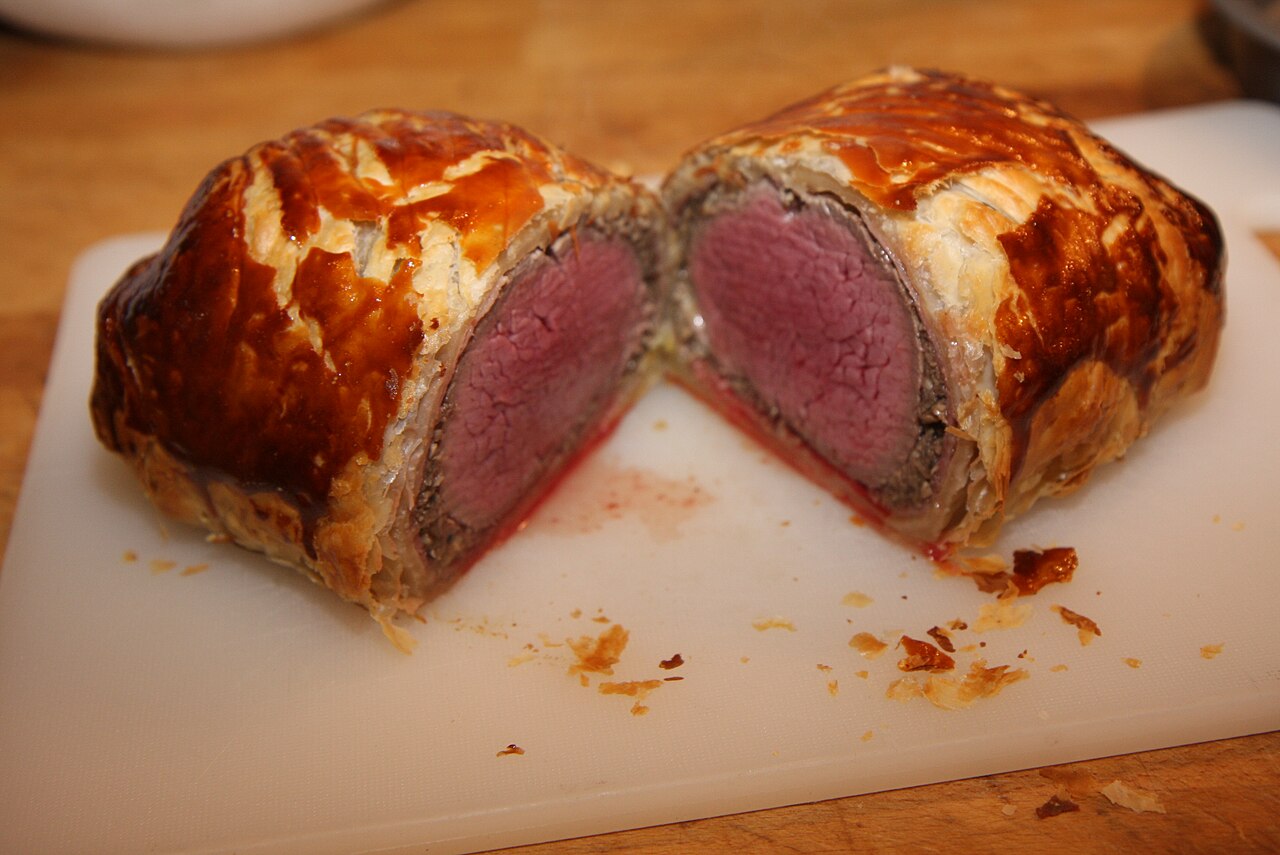
The cover image makes the stakes visible before the clip starts. A good Wellington should show a browned crust, a defined mushroom band, and beef still pink enough that the pastry could not simply have been baked until safe from failure.[5] The slice is the reveal. If the duxelles leaks, the pastry sags. If the beef overcooks, the luxury center disappears. If the wrap is loose, the dish looks expensive but eats confused.
The Sear Is A Boundary, Not The Cooking
Early in the video, the beef gets the kind of attention that can be misread as the main event.[1] It is the expensive part, the object diners name, and the piece that has to land at the right doneness. Yet the official Gordon Ramsay recipe is clear that the sear is fast: the fillets are shaped and chilled first, then browned quickly for about 30 to 60 seconds while remaining rare in the middle.[2] That tells you how to watch the pan work. The goal is not to cook the meat through. The goal is to create a surface boundary.
That boundary matters because Beef Wellington has to survive a second and more dangerous cooking environment. A steak can be pulled from a pan when it reaches the target. A Wellington goes into pastry, where the cook cannot easily see the beef. The sear therefore has to add flavor and exterior firmness without stealing too much temperature headroom from the bake. It is a confidence move with a restraint clause.
This is the first fine-dining lesson in the clip: the most visible luxury object is not allowed to dominate the system. The beef has to be excellent, but it also has to cooperate. If the fillet is too hot before wrapping, it softens everything around it. If the sear is too timid, the final slice lacks savory depth. Ramsay's pace makes the dish look direct, but the logic is careful: prepare the center so the later layers have a chance to do their jobs.[1][2]
The Duxelles Has To Stop Being A Sauce
The middle of the video is where the dish becomes more interesting than a wrapped steak.[1] Mushrooms enter as duxelles, and duxelles is the place where many weak Wellingtons fail quietly. Mushrooms carry water. Puff pastry hates water. Beef releases juice. The dish is therefore full of ingredients that want to make the crust worse unless the kitchen disciplines them first.
Ramsay's written recipe makes that discipline explicit: the chopped wild mushrooms are cooked over high heat until their excess moisture has evaporated and the pan is left with a mushroom paste.[2] The Gordon Ramsay Restaurants version pushes the same idea through a more elaborate professional grammar: mushrooms are caramelized in batches, then combined with shallot, garlic, thyme, madeira, chicken stock, chicken breast, cream, and parsley to make a duxelles-and-filling layer controlled enough to wrap inside crepes and pastry.[3]
That distinction is useful. At home, Parma ham can act as a salty, flexible barrier around the mushroom layer.[2] In the restaurant-style recipe, crepes join the architecture.[3] The two versions are not contradictions. They are two answers to the same problem: how do you put a moist, savory layer next to pastry without letting steam wreck the bite?
When watching the video, then, pay attention to reduction rather than abundance. A lesser luxury dish would pile on more mushroom because more filling looks generous. Beef Wellington requires the opposite instinct. The mushrooms have to concentrate until they become structure. Their job is flavor, but also insulation, adhesion, and moisture management. The duxelles is successful only when it stops behaving like a sauce and starts behaving like a wall.
The Wrap Is Geometry
The most satisfying part of the video is the wrapping sequence, because it turns cookery into engineering without draining away appetite.[1] The official recipe has the beef set in cling film, then wrapped with duxelles and Parma ham, then enclosed in rolled puff pastry and chilled again before baking.[2] That repeated chilling and tightening is not fussy presentation. It is how the cylinder becomes stable enough to cook evenly and slice cleanly.
Fine dining often uses geometry as a visual signature: circles, quenelles, towers, dots, strips. In Beef Wellington, geometry is more than appearance. A loose wrap creates air pockets. Air pockets create uneven cooking and weak slices. A thick pastry patch bakes differently from a thin one. A poorly sealed seam leaks juice into the tray. The dish's old-school grandeur hides a very modern lesson: beautiful form has to earn its keep operationally.
The restaurant-style recipe reinforces the point by adding crepes as a deliberate layer before pastry.[3] Crepes are humble compared with beef fillet, madeira, or puff pastry, but they solve a serious dining-room problem. They help create a buffer so the crust can bake as crust instead of becoming a damp wrapper. That is the kind of detail that separates restaurant craft from showpiece nostalgia. The pastry is not only there to look golden. It is there to prove that the whole package was designed.
The Oven Has Two Masters
Once the Wellington is wrapped, the dish becomes a clock with two endpoints. The pastry needs enough heat and time to puff, brown, and shed its raw dough character. The beef needs enough restraint to remain tender and pink. These goals are not naturally aligned. The pastry wants completion. The beef wants protection. The cook has to choose a size, temperature, chilling strategy, and resting period that let both finish at the same table moment.[2][3]
This is why Beef Wellington remains a restaurant test even though the idea is familiar. It cannot be rescued easily at the end. A sauce can be adjusted. A steak can be basted. A garnish can be replaced. A Wellington is more final. When the knife enters, the kitchen's earlier decisions become public: how dry the duxelles was, how tight the wrap was, how evenly the pastry was rolled, whether the beef had room to finish without turning grey.
The Gordon Ramsay Restaurants Beef Wellington Experience page shows why the dish still has commercial power.[4] It sells the Wellington as the main event, surrounded by a cocktail, starter, mash, red wine jus, and dessert platter. That framing is not accidental. Wellington is built for ceremony because it contains its own reveal. It can be presented whole, sliced with tension, and served as a shared proof of timing. It is theatrical, but the theater depends on execution rather than speech.
Why The Clip Still Works
The best way to watch Ramsay's video is to resist treating it as a shortcut to a famous recipe.[1] The clip is more valuable as a map of dependencies. The beef depends on a restrained sear. The pastry depends on dry duxelles and controlled wrapping. The final slice depends on chilling and geometry. The sense of luxury depends on making those dependencies disappear at the table.
That is the dish's lasting fine-dining force. Beef Wellington is not subtle in reputation, but it is subtle in mechanism. It turns obvious luxury into a hidden timing problem. It asks the guest to see only the golden crust and pink center, while the kitchen has spent the whole process managing the things that would make that picture collapse.
In that sense, the pastry really does keep time. It records whether the cook rushed the mushrooms, overheated the beef, ignored the seal, or trusted decoration over structure. When Beef Wellington works, it feels generous and classical. When it fails, it reveals exactly which part of the clock was ignored.
Sources
- Gordon Ramsay, "Fillet of Beef Wellington | Gordon Ramsay" - official YouTube video source for the embedded Beef Wellington demonstration.
- Gordon Ramsay, "Beef Wellington Recipe" - official recipe covering shaping, quick searing, mushroom duxelles, Parma ham wrapping, puff pastry, and red wine sauce.
- Gordon Ramsay Restaurants, "Traditional Beef Wellington" - restaurant recipe covering mushroom duxelles, madeira, chicken stock, crepes, pastry, and finishing logic.
- Gordon Ramsay Restaurants, "Beef Wellington Experience" - current restaurant experience page framing Beef Wellington as a Ramsay signature with duxelles, pastry, mash, and red wine jus.
- Wikimedia Commons, "File:Beef Wellington - rare, sliced.jpg" - photographic source for the article image.