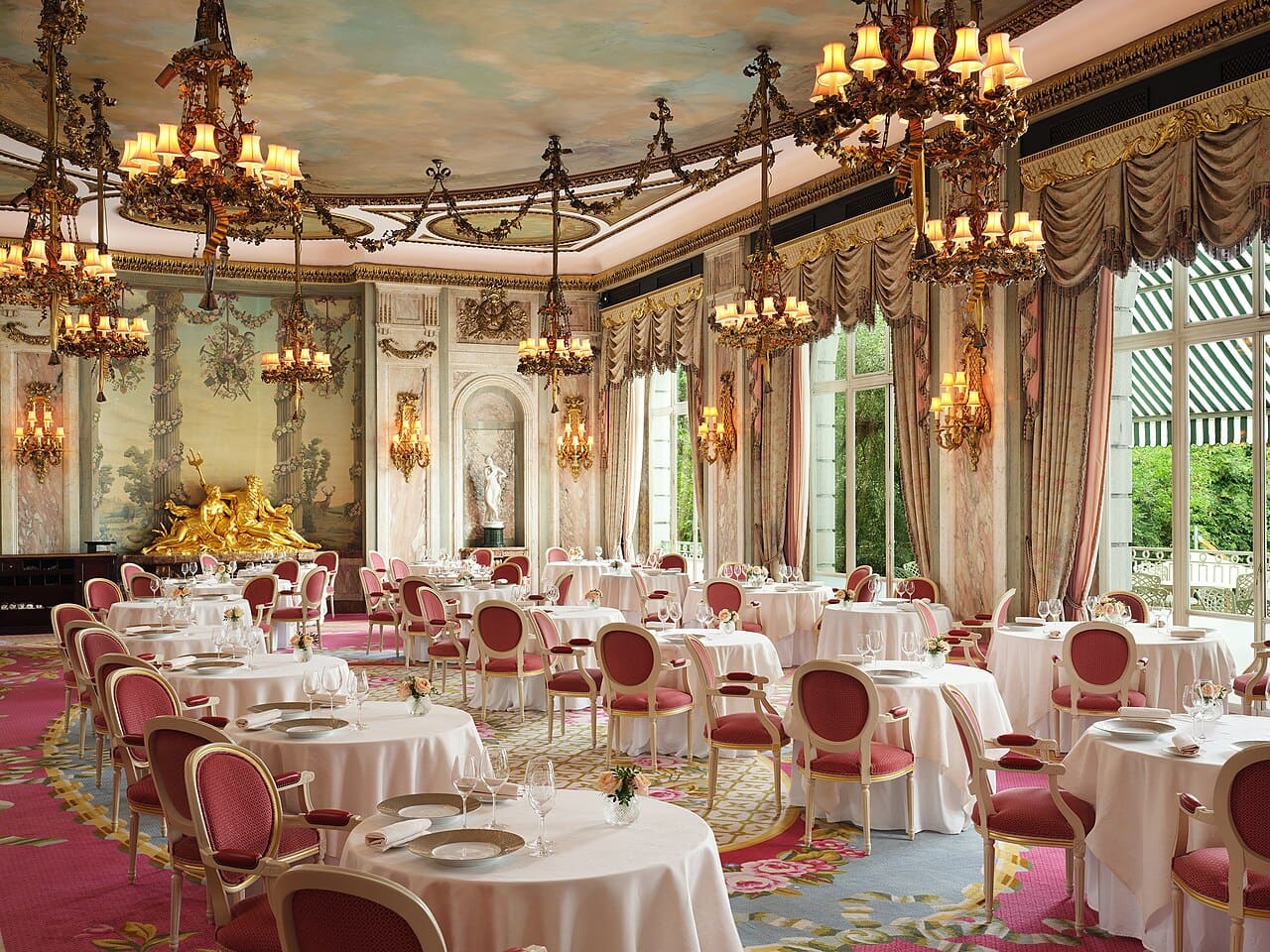
The Ritz Restaurant is easy to misread because the room speaks before the food does. Pink chairs, gilded edges, tall windows, chandeliers, mirrored light, a painted ceiling, and heavy curtains can make the place look like a preserved theatre of London luxury. The better reading is stricter. The room is not merely atmosphere. It is the operating surface.
That is why The Ritz is more interesting as a service feature than as another grand-hotel nostalgia story. The official restaurant page now presents it as a two Michelin-starred dining room under Executive Chef John Williams MBE, with lunch every day from 12:30 p.m. to 2:00 p.m. and dinner from 6:30 p.m. to 9:00 p.m.[1] Those time windows are not background details. In a room this ceremonial, the clock has to be part of the cuisine. Guests do not simply arrive for plates. They enter a system of dress, pacing, table assignments, music, menu lanes, and tableside work.
The magic, when it works, is that the system does not look like management. It looks like ease.
Ceremony begins before the first glass
The Ritz's dress code is often treated as the headline quirk: gentlemen must wear a jacket and tie for lunch and dinner in The Ritz Restaurant, while jeans and sportswear are not permitted for either ladies or gentlemen.[1] The lazy critique is that this is old-fashioned theatre. It is theatre, but theatre is not the opposite of operations. The rule narrows the room before the host says a word.
A dress code changes guest behavior. It slows the threshold. It tells a table that the evening is not meant to collapse into casual luxury, business informality, or tourist spontaneity. It also protects the staff from one of high-end hospitality's hardest problems: guests arriving with radically different assumptions about what kind of night they have bought. The jacket-and-tie rule does not guarantee good service, but it gives service a clearer frame.
The same is true of the Friday and Saturday entertainment model. The restaurant page says live entertainment is offered on those evenings, and that guests choosing the a la carte or Epicurean menus pay an additional GBP 58 per person entertainment charge.[1] That is not just a surcharge. It is a declaration that the room can become a dinner-and-dance space without pretending the extra labor is invisible. Music changes conversation volume, table timing, guest dwell time, and staff movement. Pricing it explicitly makes the old glamour legible as work.
Menus as capacity control
The menu page is where the operating logic becomes clearest. It says the restaurant's seasonal menus are designed for intimate service at tables of up to six guests, while parties of seven to eight are steered to the five-course or seven-course Epicurean tasting menus.[2] That is a small rule with large consequences.
Many fine-dining rooms want large-party revenue but hate large-party chaos. The Ritz's answer is to reduce choice as the party size grows. A six-top can live inside a more flexible rhythm. A seven- or eight-top needs a tighter sequence if the room is going to keep its temperature: guests seated together, courses landing together, drinks pacing together, allergies tracked without turning the meal into a negotiation at every step.
The same page notes a minimum spend of two courses per guest, daily-changing seasonal availability, advance notice for dietary requirements, and the impossibility of guaranteeing absolute freedom from allergens.[2] None of that sounds romantic. That is the point. Serious service has to admit constraints before the table is in motion. If a restaurant this formal pretended that every request could be made frictionless, it would be selling fantasy instead of hospitality.
The tasting-menu anchor is also revealing. The restaurant's public pages describe five- and seven-course tasting options, starting from GBP 215 per person, and frame them around seasonal British produce selected by John Williams and his team.[1][2] The useful detail is not the price by itself. It is the way the price buys a controlled evening: fewer decision points, a known production arc, and a clearer relation between kitchen and dining room.
Tableside work keeps luxury accountable
The strongest Ritz move is not that it preserves tableside service. It is that tableside service makes the old room answerable in real time.
The official restaurant page describes an Arts de la Table four-course menu with traditional gueridon service, available for reservations of two or four guests.[1] National Restaurant Awards goes further in its profile, pointing to tableside dishes such as beef Wellington, hay-aged Bresse duck, and crepes suzette as the way to experience what the restaurant does best.[4] 50 Best Discovery makes a compatible point from another angle: the room is spectacular, but John Williams' Escoffier-inspired cooking keeps the food from being upstaged by the setting.[5]
That is why tableside work belongs here. A trolley does not let a restaurant hide behind plating design. If a sauce is finished, carved, flamed, or portioned in front of the guest, the service team has to own temperature, gesture, explanation, and pace at the same time. The dish is no longer only a kitchen object. It becomes a handoff between cookery and room craft.
This can easily become museum service. The bad version is a performance that asks diners to admire the antique routine. The good version uses ritual as pressure. A crepe cooked or sauced at the table has to smell right, move cleanly, and arrive before the theatre goes slack. Beef Wellington has to carry timing discipline from the kitchen into the room. Duck served with ceremony has to justify the ceremony through carving, sauce, and heat. The old gestures only survive if they still solve present-tense hospitality problems.
The room is not neutral
Photographs of The Ritz Restaurant can make it look almost overdetermined: too much gold, too much pink, too much chandelier. But the visual density is exactly why the operations have to be calm. A minimalist room can make restraint look effortless because there is little visual competition. The Ritz has the opposite challenge. Every table sits inside a bright historical field, so service has to keep the room from becoming noise.
This is where the National Restaurant Awards profile is useful. Its current page ranks The Ritz at No. 2 and lists National Restaurant of the Year 2025 and The Service Award 2022 among its accolades.[4] Awards are not proof by themselves, but those two signals together explain the restaurant's current relevance. The market is not only rewarding the room for being famous. It is rewarding a room that still performs.
The official awards page tells a similar story from the house side, gathering recent recognition around luxury, service, and the restaurant's Michelin standing.[3] Read with the menu pages, the pattern is not simply "old hotel wins prizes." The pattern is that formal systems still matter when they are run with precision: the timetable, the menu lanes, the dress code, the entertainment format, the tableside work, and the allergen boundary all make the room safer for pleasure.
Why it still feels current
The Ritz belongs to a category that many contemporary restaurants try to avoid: explicit ceremony. Much current fine dining sells informality, counter intimacy, product purity, or regional research. Those modes can be wonderful. They can also become their own conventions. The Ritz is useful because it proves that ceremony itself can still be modern if it behaves like a disciplined service tool rather than inherited decoration.
That does not mean the model is broadly portable. A jacket-and-tie dining room with chandeliers, music, gueridon service, and a two Michelin-starred kitchen only works if the whole machine is honest about its obligations. Copy the visual signs without the operating discipline and the result is costume. Strip away the visual signs and some of the tension disappears.
The point of The Ritz Restaurant in 2026 is not that every serious dinner should become grand again. The point is narrower and more interesting: old luxury can remain alive when every ceremonial rule earns its keep. The dress code reduces ambiguity. The service windows protect rhythm. The menu restrictions control table size and production risk. The music surcharge admits the cost of atmosphere. The trolley turns hospitality into visible craft.
That is the house's best argument. It does not ask diners to believe in tradition because tradition is old. It asks them to notice when tradition still works.
Sources
- The Ritz London, "The Ritz Restaurant" - official page covering the two Michelin-starred restaurant, John Williams MBE, lunch and dinner hours, dress code, Arts de la Table, tasting-menu timing, and live-entertainment charge.
- The Ritz London, "Ritz Restaurant Menus" - official menu page covering seasonal menus, table-size limits, Epicurean tasting menus for larger groups, minimum spend, dietary notes, and sample-menu links.
- The Ritz London, "Recent Awards" - official awards page for recent hotel and restaurant accolades, including Michelin and service recognition context.
- National Restaurant Awards, "The Ritz" - current profile with No. 2 ranking, National Restaurant of the Year 2025, The Service Award 2022, John Williams context, and tableside dish notes.
- 50 Best Discovery, "The Ritz Restaurant - London" - profile covering John Williams MBE, the room's Louis XVI grandeur, Escoffier-inspired British-ingredient cooking, tableside crepes suzette, wine-list emphasis, and service hours.
- RT6HPU, "The Ritz Restaurant - medium res.jpg," Wikimedia Commons - real 2022 photograph of The Ritz Restaurant dining room used as the article image.