Tbilisi does not need another restaurant list that mistakes polish for sameness. Its ambitious rooms disagree too vividly for that.
At Barbarestan, dinner begins with a cookbook published in 1874. At Café Littera, it begins in the garden of a house built for a brandy maker and philanthropist. Keto & Kote lowers the temperature from historical project to hillside bistro. Grand Café, the newest of the four, puts white linen and tableside flame inside a former Soviet-era telegraph building.[1][2][3][4][5][6][7]
The useful choice is therefore not “Which one is best?” It is which version of refinement will improve your night. Do you want the meal to recover a text, argue with tradition, relax into wine, or turn dinner back into an occasion?
This is a reported guide based on current restaurant pages, guide entries, and published coverage—not a claim to have eaten four dinners side by side. Practical details were checked on August 3, 2026 and should be confirmed when booking. Menus move faster than architecture.
The four-room answer
- Book Barbarestan for the most focused encounter with Georgian culinary history.
- Book Café Littera for a warm-weather dinner in which a chef’s contemporary voice matters as much as the old house.
- Book Keto & Kote when the table wants bottles, sharing, and a looser form of polish.
- Book Grand Café when the occasion calls for white linen, a central address, and visible service theater.
1) Barbarestan: when the archive becomes the menu
Barbarestan has the clearest thesis of the four. The family-run restaurant cooks from the work of Barbare Jorjadze, the writer and women’s-rights advocate whose Georgian Cuisine and Tried Housekeeping Notes appeared in 1874. The book did not seal “authentic Georgian food” inside a national display case: its range included Georgian, European, Middle Eastern, and Russian preparations. That makes the restaurant’s project more interesting than simple revival. It is recovering a Georgian author who was already recording a kitchen shaped by exchange.[1][2]
The dining room commits to the idea. Fifty Best Discovery describes lace cloth, vintage crockery, soft lamps, patterned fabric, and exposed brick, then points to rabbit wrapped in ham, pumpkin patties, and cherry soup with mint among the signatures. Qvevri wines are aged on site.[1] The room is not neutral packaging around the research; it makes the act of looking backward tactile.
This is the reservation for a diner who wants specificity with ceremony. Ask what comes most directly from Jorjadze’s text and what the present kitchen has changed. That question is more rewarding than demanding a purity performance from every plate. A recovered recipe still passes through contemporary produce, equipment, palate, and service.
Fifty Best Discovery currently lists Barbarestan for lunch and dinner daily and estimates an average spend of US$45 per person.[1] Treat that figure as orientation, not a quote: wine and the shape of the order can redraw it quickly.
Choose Barbarestan if: the historical source is part of your appetite, and you want the most composed full-evening meal on this list.
Choose another room if: your priority is an outdoor table, spontaneous grazing, or the newest expression of the city.
2) Café Littera: when modern Georgian cooking gets the garden
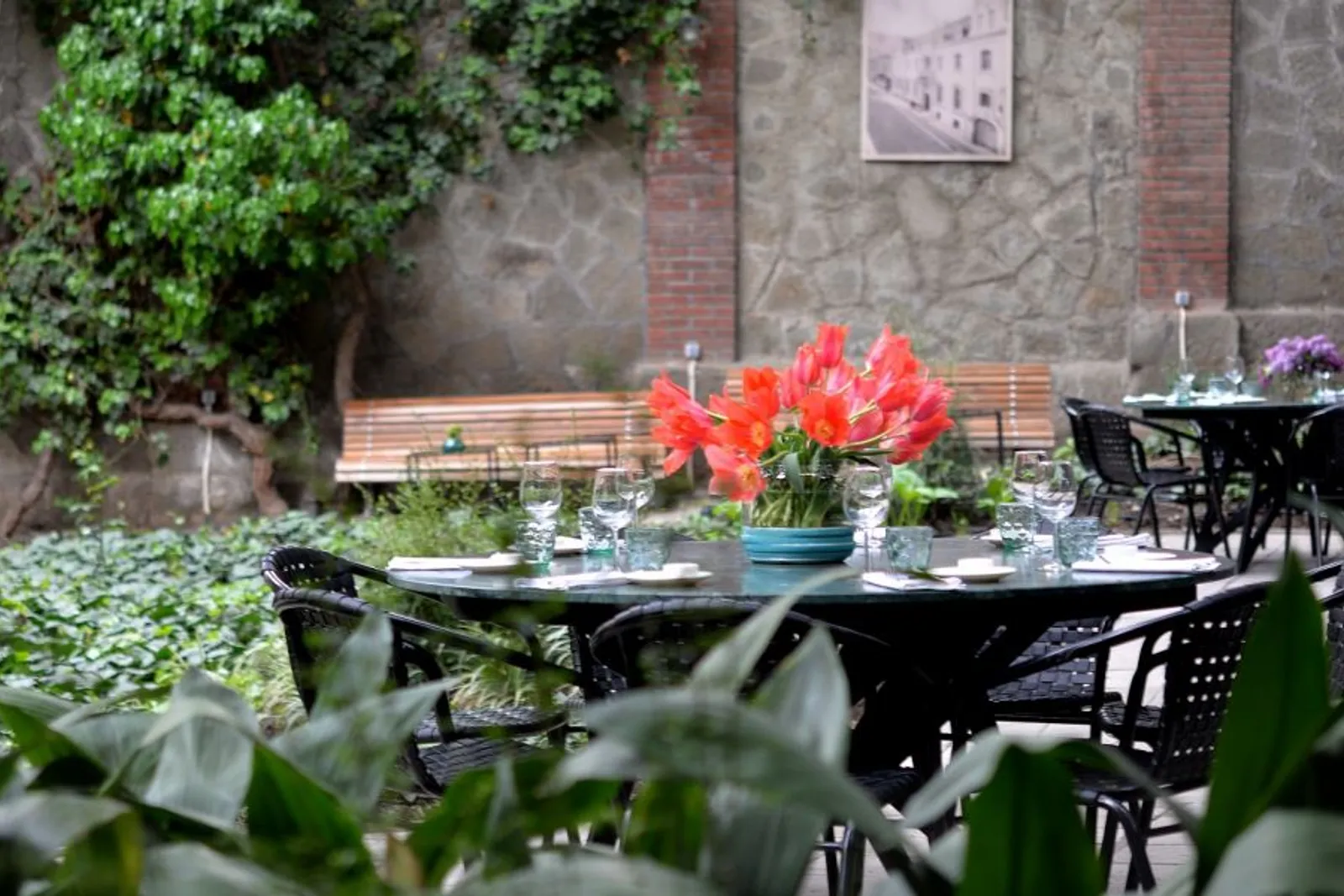
Café Littera’s cover photograph supplies an immediate seduction: set tables disappear beneath leaves and suspended lights. Yet the garden is not generic romance. It sits behind the Writers’ House at 13 Ivane Machabeli Street, in the Art Nouveau mansion David Sarajishvili built between 1903 and 1905. The house became a center of cultural life, then passed to writers and artists after Georgia’s Sovietization. Its beauty and its history are inseparable.[3][4]
Chef Tekuna Gachechiladze does not answer that inheritance by reconstructing an old menu. Gault&Millau calls her cooking “Nouveau Georgian” and describes a frequently changing selection that can move from filet mignon with wild mushrooms to sea bass with spinach and soy-ginger reduction.[3] The important word is changing. Littera is the counterpoint to Barbarestan: one begins with a recovered book; the other gives a living chef room to revise.
That distinction rescues both restaurants from the tired opposition between “authentic” and “modern.” Barbarestan shows that the archive itself was cosmopolitan. Littera shows that a contemporary Georgian kitchen can use an imported ingredient or technique without surrendering its address. The garden helps because it softens the posture of innovation. Dinner feels placed in a house, not staged in a laboratory.
Gault&Millau currently lists service every day from 1 p.m. to 11:45 p.m.[3] In warm weather, request the garden rather than assuming any reservation guarantees it; rain can turn the restaurant’s strongest atmospheric asset into a seating constraint.
Choose Café Littera if: you want the most romantic room, an authorial kitchen, and a meal that treats Georgian flavor as a vocabulary rather than a fixed repertoire.
Choose another room if: historical reconstruction matters more to you than reinterpretation, or your evening should not depend on the weather.
3) Keto & Kote: when refinement loosens its collar
Keto & Kote is the useful middle register. Gault&Millau classifies it as a chef’s restaurant with traditional cooking, but also as a bistro/brasserie. That apparent contradiction is the point. A terrace, a serious wine selection, and a view over modern Tbilisi give the meal shape without forcing every table into a tasting-menu script.[5]
Chef Ramaz Gemiashvili’s combinations, as recorded by the guide, are playful enough to keep “traditional” from becoming a brake: meat with Roquefort and hot-pepper sauce; khinkali sharpened with bright pesto.[5] Those examples are not a promise that both dishes will be available on a particular night. They are evidence of the kitchen’s operating mood—recognizable forms, widened at the edges.
This is where to take a group whose appetites do not move in formation. Order for the table, let the wine lead one or two decisions, and allow dinner to expand rather than arrive as a predetermined procession. The refinement lives in editing and hospitality, not in course count.
The guide currently lists Keto & Kote as open daily from 11 a.m. to 1 a.m.[5] That long window makes it the most flexible choice here, but flexibility should not be confused with invisibility: the terrace and view are part of the value, so reserve rather than treating the restaurant as a late backup.
Choose Keto & Kote if: your ideal serious dinner still permits passing plates, changing the order, and opening another bottle.
Choose another room if: you want one tightly authored sequence or a dining room built around formal service.
4) Grand Café: when the hotel dining room wants its ceremony back
Grand Café is the new proposition. It sits inside the Telegraph Hotel, a 1970s central telegraph building remade by Neri&Hu as a contemporary hotel. Wallpaper describes deep coffered ceilings, antique mirrors, white cloth, walnut banquettes, and chairs arranged with almost Parisian confidence. The building’s preserved concrete and telegraphic references keep that polish from floating free of place.[7]
The food has to perform the same balancing act. The hotel promises European elegance and Georgian tradition, with tableside flambé and composed desserts. Wallpaper’s early account is more concrete: breaded aubergine and walnut on cornbread waffles, tomato with sulguni, miniature khachapuri, and dishes cooked in a traditional Georgian tone oven.[6][7]
That menu makes Grand Café the least archival and most openly theatrical choice here. It is not trying to out-research Barbarestan or out-garden Littera. It is testing whether Tbilisi can sustain the old pleasure of the grand hotel restaurant—mirrors, flame, dessert, a room that expects an occasion—without merely importing a European shell.
The official page lists dinner daily from 5 p.m. to midnight, with breakfast as a separate service.[6] Go at dinner, when the scale of the room and tableside gestures have a reason to gather. If you simply need food near Rustaveli Avenue, the hotel’s many other outlets are likely a better use of the building.
Choose Grand Café if: you want the newest room, the most conventional sense of occasion, and service you can see happening.
Choose another room if: your first priority is a deep Georgian culinary thesis rather than the revival of hotel glamour.
Do not book all four for the same reason
The cleanest Tbilisi plan is not a prestige crawl. It is one deliberate contrast.
Pair Barbarestan with Grand Café if you want to see two kinds of reconstruction: a nineteenth-century cookbook returned to the table, then a twentieth-century communications building returned to social life. Pair Café Littera with Keto & Kote if you care more about how contemporary Georgian cooking can change register—from an authorial garden dinner to a freer, wine-led table.
If there is room for only one, choose by the noun you want to remember the next morning: book, garden, bottle, or room. Barbarestan gives the meal a text. Littera gives it a living canopy and a chef’s argument. Keto & Kote gives it convivial looseness. Grand Café gives it ceremony.
That is the pleasure of this list. Tbilisi’s polished tables do not form a ladder with one obvious top. They are four answers to a more interesting question: how can a restaurant make history present without letting history dictate the whole evening?
Sources
- 50 Best Discovery, “Barbarestan” — family ownership, cookbook concept, room details, signature dishes, qvevri wine, current service pattern, price estimate, and photographic source context.
- Georgian Journal, “Prominent Georgian Female Chef Barbare Jorjadze” (2018) — Jorjadze’s biography, the 1874 cookbook, its cross-cultural scope, surviving copies, and Barbarestan’s use of the recipes.
- Gault&Millau Georgia, “Café Littera” (2025 review) — chef, Nouveau Georgian framing, Writers’ House garden, menu examples, current hours, and cover-photograph source.
- Writers’ House of Georgia, “History of the House” — the 1903–1905 Sarajishvili mansion, its architecture, cultural role, and transfer to writers and artists after Sovietization.
- Gault&Millau Georgia, “Keto & Kote” (2025 review) — chef, bistro classification, terrace, wine, dish examples, and current listed hours.
- The Telegraph Hotel, “Grand Café” — official concept, tableside service, dinner and breakfast hours, address, and live menu links.
- Ianthe Butt, “A 1970s brutalist icon becomes Tbilisi’s most striking new hotel,” Wallpaper (December 5, 2025) — Telegraph Hotel architecture, Neri&Hu redesign, Grand Café interior, oven, and reported menu examples.