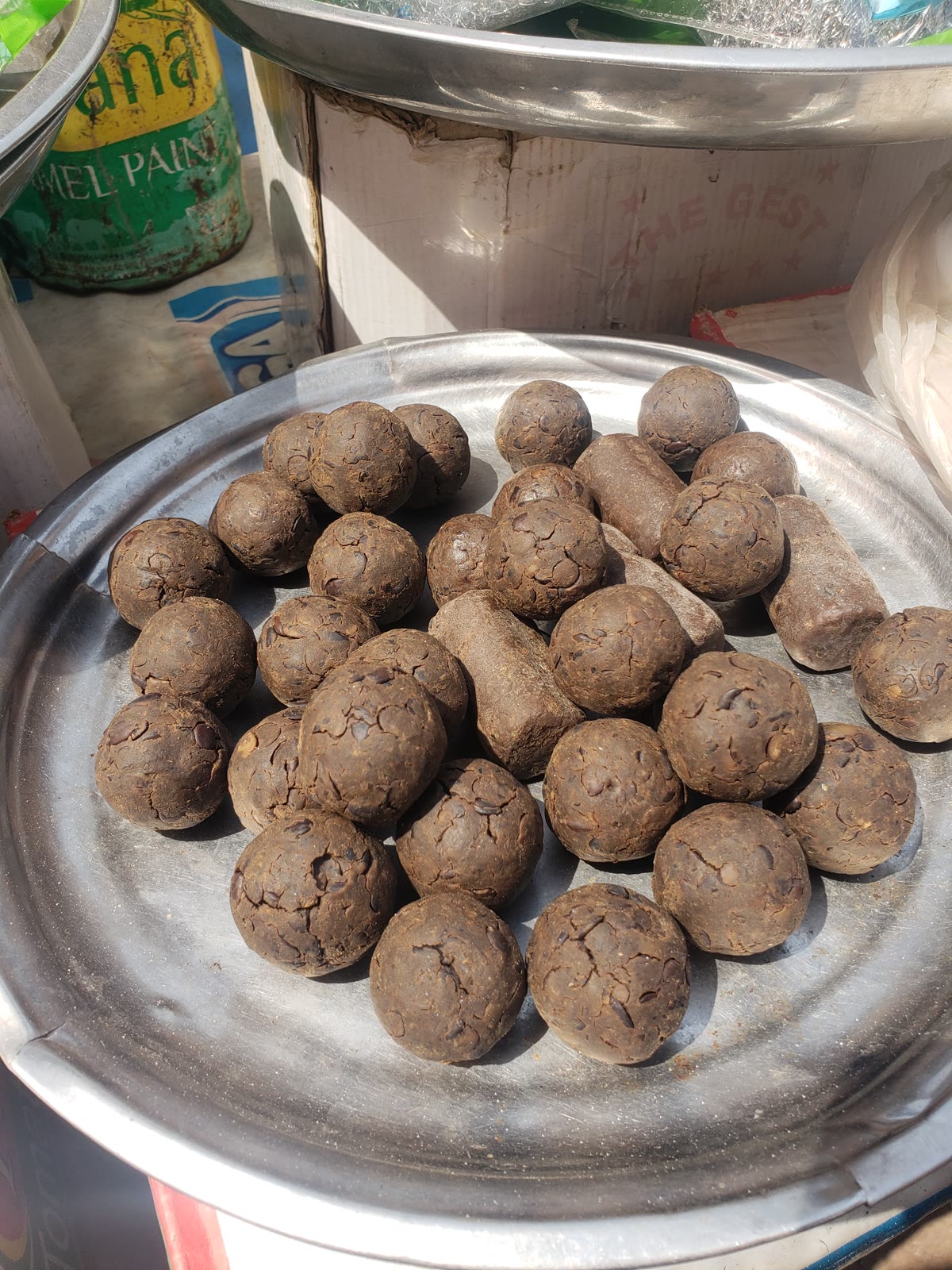
In Achiri Bitamsimli’s photograph from Ghana, dawadawa does not pose as a luxury ingredient. Dark brown balls sit in hard sunlight on a round metal tray. Their surfaces are cracked, knobbled and visibly made from beans; a few have been pressed into short cylinders. There is no garnish to suggest how they should be admired. There is only concentrated seasoning, dried into a form that can travel.[6]
Bring one into a warm kitchen and its first announcement is aroma: roasted seed, aged cheese, something earthy and insistently ammoniac. That opening can make an unfamiliar cook wonder whether the ingredient needs taming. Then it enters soup, stew or sauce, and the loud edge settles into a long savory bass line.
That transformation is why dawadawa belongs in a serious dining conversation. It is often introduced in international food writing as an “umami bomb,” a phrase Ghanaian chef Selassie Atadika herself uses for it.[4] The phrase is vivid, but it can make the ingredient sound like a clever flavor shortcut. Dawadawa is closer to a supply chain made edible: a mature savanna tree, a difficult seed, repeated boiling, dehulling, spontaneous alkaline fermentation, drying, market access and the judgment to know how much a pot needs.[1][2][3]
Fine dining can give that work a clear landing. First it has to resist cleaning up the very character that the process was built to create.
A sweet pod hides a difficult seed
The African locust bean tree, Parkia biglobosa, grows across a broad belt of Africa, especially in the West African savanna. It is a generous-looking tree, with a wide crown and long brown pods. Inside each pod, glossy seeds sit in yellow, sweet pulp. The pulp can be eaten or mixed with water; the fermented seed becomes the condiment known in different places as dawadawa, soumbala or netetu, among other names.[1]
The sweetness is easy to reach. The seed’s savor is not.
The seed coat is hard enough to make processing the central fact of the ingredient. Plant Resources of Tropical Africa describes methods that boil cleaned seeds for many hours, clean and dehull them, boil them again, then ferment them for roughly two to four days before a final sun-drying stage.[1] A Ghanaian processing study lays out the same demanding grammar—cleaning, boiling, dehulling, washing, recooking and spontaneous fermentation—and notes that traditional dehulling can require an initial eight to twelve hours of boiling.[2]
This is the first correction to the word “rustic.” A ball of dawadawa may look rough, but roughness is not the absence of technique. Somebody has spent fuel and time softening a seed that resists both. Somebody has separated hull from cotyledon without throwing away the part that matters. Somebody has managed moisture through a warm fermentation and dried the result so that its flavor can be stored and carried.
Slow Food’s record for the Kandig community in northern Ghana makes the sequence tactile. It describes sorting the dried seeds, boiling, using wood ash as an abrasive during pounding, winnowing away loosened coats, washing, boiling again, pressing off excess water, fermenting for about 72 hours, and shaping the finished condiment into balls.[5] That is one documented local method, not a universal recipe for every product sold under a related name. Its value is specificity: dawadawa begins with a series of physical problems, each solved by practiced labor.
This ferment climbs instead of souring
Wine, yogurt and pickles train many diners to associate fermentation with acid. Dawadawa moves in another direction. It is an alkaline fermentation, driven mainly by protein-degrading bacteria rather than by the lactic-acid logic of sauerkraut or cultured cream.[1][2]
In the Ghanaian study, Bacillus species dominated a mechanically dehulled batch while its pH rose from 5.2 to 8.8 over 48 hours. Free amino acids increased sharply during the middle of fermentation, then changed again as the process continued.[2] The experiment was conducted under defined processing conditions, so its numbers should not be pasted onto every market ball. The mechanism is the useful part: microbial enzymes break seed proteins into peptides and amino acids; further metabolism releases ammonia, helping raise the pH and build the aroma that announces the finished condiment.[2]
In other words, the smell is not an unfortunate wrapper around the flavor. It is evidence of the route taken to reach it.
That does not mean every odor is desirable or every batch is sound. A cook still has to distinguish a clean, characteristic pungency from rancidity, contamination or poor storage. But a kitchen that treats all forceful aroma as a defect may erase the signal before it learns to read it. Fine dining is comfortable celebrating blue-cheese veins, washed rinds, fish sauce and long-aged soy. Dawadawa deserves the same sensory patience without needing to be translated into any of them.
The name is a category, not a complete specification
The vocabulary around fermented African seed condiments is broad. The Ghanaian research paper notes dawadawa in Ghana and Nigeria alongside names including iru, soumbala, netetu, afitin and sonru in other West African settings.[2] PROTA likewise groups several names while recording substitutions made from pigeon pea, baobab, roselle and other seeds in different places.[1]
That is useful orientation and a warning against false equivalence. A name can indicate a family of techniques without guaranteeing the same species, fermentation length, drying method, texture or strength. Even two products made from Parkia biglobosa can differ because the seed, processor, weather and endpoint differ.
For a restaurant buyer, “dawadawa” should therefore begin the conversation rather than finish it. Is this fermented African locust bean or a soy-based substitute? Where was it processed? Is it sold moist, dried, powdered or formed into balls? Was salt or ash added? How assertive is this batch after cooking, not only when unwrapped?
Slow Food notes that soy versions are easier and less labor-intensive to produce than the Parkia product in its northern Ghana case study.[5] Substitution is not automatically fraud; cooks adapt to price, availability and desired results. The problem comes when a menu tells a precise heritage story about an ingredient the kitchen has not precisely identified.
Sourcing reaches past the bag to the tree
The most consequential purchasing question may be the one the dining room cannot smell: who can reach the tree?
A 2022 study near Tamale worked with women’s groups and interviewed women farmers, men farmers and chiefs about a declining Parkia biglobosa population. Most interviewed farmers reported fewer trees in their fields. The causes they identified were not one simple story of climate or demand: aging trees, difficulty protecting saplings until maturity, mechanized farming and pesticide use, cutting for firewood, reduced water availability, and local rules governing who controls land and who may harvest the pods all mattered.[3]
The study describes the seed as a women’s crop in Dagomba culture while access to trees is often mediated by chiefs and male land users. It also records processing as labor-intensive women’s work: soaking, boiling, pounding, boiling again, fermenting, drying and grinding.[3] That evidence is local to the communities studied; it should not be inflated into a claim that every dawadawa processor across West Africa has the same gender, tenure or market conditions. It is still enough to break the fantasy of a frictionless “wild ingredient.” A tree can grow without plantation rows and remain governed by rights, labor and scarcity.
This changes what good provenance sounds like. Naming northern Ghana on a menu is not yet a sourcing achievement. A serious buyer should be able to ask whether the product is truly Parkia, whether processors were paid for the work embedded in dehulling and fermentation, whether the supply rewards keeping mature trees standing, and whether rising restaurant interest improves or strains local access.
Atadika, founder of Accra’s experiential dining company Midunu, gives that argument an edible form. In an interview with Cuisine Noir, she describes using dawadawa in chocolate both for flavor and to start a conversation about a traditional product and the women whose processing businesses are under pressure.[4] That is the better fine-dining frame. The restaurant does not confer importance on dawadawa. It decides whether to reveal or obscure importance that is already there.
Give the flavor a clean landing, not a disguise
Dawadawa’s most persuasive place in a tasting menu is not necessarily a visible crumble or a server’s longest speech. It is wherever the condiment can do its traditional structural work: deepen a broth, lengthen a vegetable sauce, join roasted meat to its cooking liquid, or make grain and greens feel complete.[1][5]
The first kitchen test should be humble. Taste the batch uncooked, then dissolve a measured amount into hot water and taste it again after simmering. The raw aroma reveals condition and intensity; the cooked liquid reveals where the ingredient is going. Repeat at a second concentration before adding smoke, chile, butter or sweetness. Dawadawa already contains a complicated fermentation. It does not need every other signifier of depth piled on top.
Fat can round its harsher volatiles. Tomato, onion and chile can give the savor a familiar body. A clear broth can make its length surprisingly exposed. None of those possibilities is a universal pairing rule, and the evidence above does not prescribe a tasting-menu dish. They are reasons to develop from the actual batch instead of writing “dawadawa course” on paper and forcing the ingredient to perform novelty.
The tableside language can be equally restrained. Say what it is: fermented African locust bean, processed into a seasoning used across West African cooking. Name the processor and place when known. If the product is soy-based, say so. Explain that alkaline fermentation builds both pungency and savor. Then let the guest taste the work in the sauce rather than asking the story to compensate for a timid dose.
Look again at the tray in Bitamsimli’s photograph. The balls are practical, portable and irregular. Their beauty is not the polished beauty of a final plate. It is the beauty of a process left legible: beans still visible, hand pressure still visible, sun and drying written across the surface.[6]
Fine dining does not need to make dawadawa quieter. It needs to become precise enough to hear everything inside the loud note—the resistant seed, the rising pH, the processor’s judgment and the living tree that makes the next batch possible.
Sources
- S. Sina and S. A. Traoré, “Parkia biglobosa,” Plant Resources of Tropical Africa — species distribution, uses, regional condiment names, processing ranges, fermentation microbiology and tree ecology.
- Fortune Akabanda et al., “Effects of Mechanical Dehulling on Microbiological Characteristics and Chemical Changes During Processing of Parkia biglobosa Seeds into Dawadawa,” Journal of Ghana Science Association 17, no. 2 (2017) — process sequence, dehulling burden, pH, microbes and amino-acid changes.
- Margareta Amy Lelea et al., “Strategies to Promote Sustainable Development: The Gendered Importance of Addressing Diminishing African Locust Bean Resources in Northern Ghana’s Agro-Ecological Landscape,” Sustainability 14 (2022), doi:10.3390/su141811302 — open paper on processing labor, tree access, scarcity and regeneration near Tamale.
- Phyllis Armstrong, “Selassie Atadika’s Midunu Shifts the Story of Chocolate from Ghana,” Cuisine Noir, December 9, 2025 — interview on using dawadawa in Midunu chocolate and supporting awareness of traditional processing.
- Slow Food Foundation for Biodiversity, “Dawadawa” — a Kandig, northern Ghana account of harvest, boiling, ash-assisted dehulling, fermentation, shaping, trade and substitution pressure.
- Achiri Bitamsimli, “Dawadawa.jpg,” Wikimedia Commons — source page, CC BY-SA 4.0 license and metadata for the 2021 documentary photograph made in Ghana.