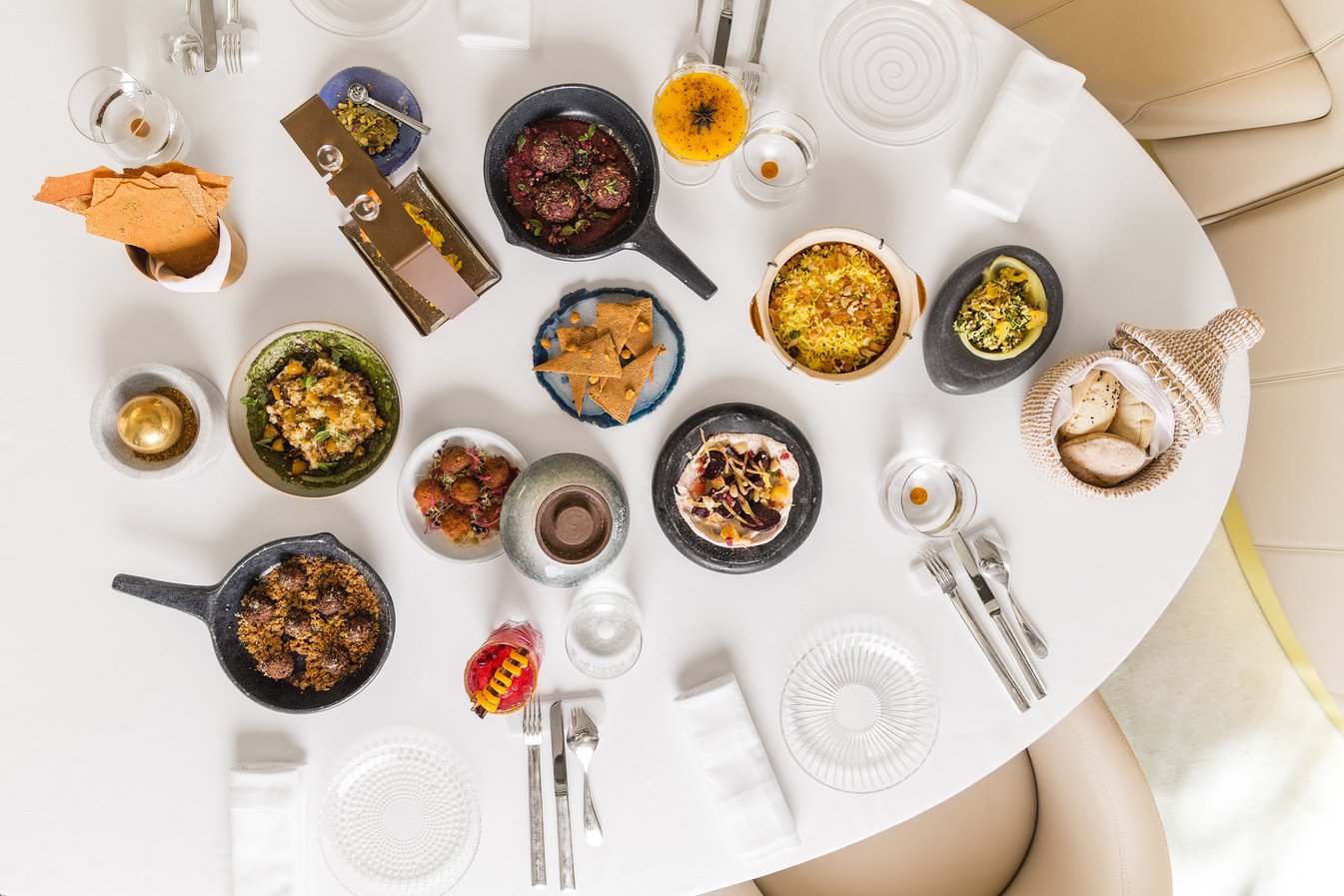
Jiwan looks expensive before anyone brings the menu. On the fourth floor of the National Museum of Qatar, the terrace faces Doha’s waterfront while Jean Nouvel’s pale museum discs fold below it. Inside, more than four million pearl-like crystal beads tremble over a carpet that shades from sand to aquamarine.[6][7] The room has been designed to make desert, sea and pearl feel like parts of the same evening.
Then the current lunch menu lands at QAR 150. It is not cheap in the ordinary sense, but it is startlingly restrained for a dining room that has done so much visual work to announce occasion. More importantly, the lunch does not save money by deleting the meal’s center. It keeps the slow-cooked lamb shoulder, saffron rice and coffee-caramel baklava. What it gives up is the experience menu’s sea bream and much of the story told on the way there.[2][3]
That makes Jiwan’s two set menus a useful value test. The extra QAR 100 for the full experience does not buy a more prestigious version of the same plate. It buys range: harees, harira, fish and a second dessert. Lunch is the tighter meal. The experience menu is the fuller argument.
There is a calendar asterisk before the arithmetic. As of August 3, 2026, Jiwan’s official contact page marks the restaurant temporarily closed and says it reopens on August 30.[8] The menus analyzed below are the latest ones linked as the “current offering” on Jiwan’s cuisine page, but they are a plan for after reopening, not an invitation to turn up this week.[1]
The QAR 150 menu has a real middle
The weekday lunch begins with three dishes that already cross several registers: a crisp herb samboussek with confit lemon; fried Brussels sprouts with sumac; and a warm chickpea-and-lentil composition sharpened by dried camel. Lamb shoulder follows with coco beans and smoked paprika, accompanied by saffron rice. Baklava with kahwa caramel closes the sequence.[2]
Nothing there reads like the usual economy edit—a token starter, a downgraded main and the dessert a kitchen most needs to move. The lamb is also the most expensive main on Jiwan’s current à-la-carte menu, listed at QAR 150 before rice, mezze or dessert enter the order.[4] Lunch therefore protects the dish that gives the meal weight: mint-and-molasses-marinated shoulder, slow-cooked and set against beans and smoke.[4]
The three opening plates keep the lamb from becoming a blunt hotel main course. Bitter herbs and lemon make the first cut; sumac and pomegranate pull the sprouts toward acid and sweetness; camel crisp gives the legumes a specifically regional accent without turning the plate into a meat course.[2][4] By the time the lamb arrives, the meal has already moved through pastry, brassica, pulses, cultured dairy, citrus and dried meat. The menu may be short, but it is not monochrome.
There is another practical catch: when service resumes, the published lunch runs Sunday through Thursday, 12:30 to 3 p.m.[2] This is the value window, not a standing discount available at sunset or on the weekend. The museum’s normal listing gives Jiwan later hours on most days and Tuesday as its weekly closure, but the restaurant’s temporary-closure notice takes precedence until August 30.[6][8] The QAR 150 route rewards the diner who can move the occasion into the working week—and who confirms the schedule before leaving for the museum.
À la carte reveals the force of the bundle
Order the lunch’s named components individually at the prices on Jiwan’s May 2026 menu and the labels add up quickly: QAR 55 for herb samboussek, 65 for Brussels sprouts, 50 for chickpea and lentils, 150 for lamb shoulder, 30 for saffron rice and 50 for the baklava dessert. The paper total is QAR 400.[4]
That is not proof that lunch delivers QAR 250 in savings. The à-la-carte dishes may be larger, and the set menu may resize or compose them for a shared progression. Jiwan does not publish comparable portion weights. Treating unlike portions as identical would turn neat arithmetic into false precision.
The comparison still reveals the mechanism. Jiwan is not discounting one isolated plate. It is bundling a complete arc at a price equal to the listed lamb alone. The restaurant can control pacing, preparation and the number of choices; the diner receives breadth without paying the à-la-carte premium for flexibility. Value here comes from surrendering optionality.
That trade is especially coherent because Jiwan describes its food as family-style and designed for the whole table.[1][6] The set menu lets the kitchen decide how the plates speak to one another. À la carte remains the better instrument for a table with sharply different appetites, dietary constraints or a desire to linger over mezze. It is the expensive way to remain in charge.
The extra hundred buys the missing grammar
The QAR 250 Jiwan experience retains every major element of lunch, then restores four things: Jiwan harees among the opening dishes, a separate harira course, sea bream with pumpkin, curry and kumquat, and a mango dessert before the baklava.[3]
The fish is the obvious luxury increment, but the harees is the more consequential addition. Jiwan’s à-la-carte menu identifies its version as whole wheat stewed with chicken, spices and ghee.[4] Without it, lunch still tastes broadly Middle Eastern and contemporary. With it, the experience menu makes room for a preparation tied more directly to the Gulf and Qatar. Harira then pulls toward North Africa; curry and kumquat bend the sea bream toward the Indian Ocean routes that also shape Doha’s table.[1][3][4]
This is why the experience menu is better understood as an editorial expansion than an upgrade. The lunch does not serve inferior lamb or hide the desirable dessert behind a higher tier. The extra hundred finances more sentences: a grain-and-chicken staple, a soup, a seafood main and a brighter fruit ending. It lets the restaurant’s stated geography—Qatar in conversation with North Africa, the Levant and South Asia—become legible over more courses.[1]
MICHELIN’s current Jiwan listing makes almost the same distinction from the inspector’s side. It awards the restaurant a Bib Gourmand, calls the set menu very good value, and recommends the tasting menu for the complete experience.[5] Those judgments need not be accepted as law. They are useful here because the menu arithmetic independently points to the same fork: the shorter route wins on compression; the longer one wins on context.
The room is not a free extra
Price analysis in fine dining often pretends the food arrives in a vacuum. At Jiwan, that would miss one of the things the check is buying. Koichi Takada Architects lists the restaurant at 260 seats, completed in 2019, with a terrace over Doha Bay and a ceiling built from those millions of suspended crystal beads.[7] The National Museum describes dining pods shaped after the dunes of Khor Al Adaid and positioned for the fading light over the sea.[6]
That scale matters. Jiwan is not a tiny counter whose cost is explained by one chef cooking for twelve guests. It is a large, highly designed museum restaurant. The visible spend sits in architecture, terrace, view, maintenance and a room capable of hosting many different kinds of table. A QAR 150 lunch inside it feels generous partly because the setting is not reduced with the menu.
It would be irresponsible, however, to claim where Jiwan’s actual profit margin sits. Public menus show prices, not rent arrangements, payroll, food cost, museum support or covers served. The honest conclusion is narrower: the lunch price gives access to the same high-investment room and preserves the menu’s costliest listed main. It does not tell us whether the restaurant makes more money from lunch, dinner, private events or anything else.
The drinks do not ambush the bargain
Jiwan’s current beverage list keeps the value structure unusually readable. Three paired mocktails cost QAR 70. Individual signatures—green apple with lemongrass and dill, loomi with saffron, or raspberry with mint and ginger ale—run from QAR 30 to 40.[4] Buying three separately would therefore list at QAR 90 to 120, depending on the choices. Here the pairing behaves like a bundle too.
Lunch plus the three-drink pairing totals QAR 220, still QAR 30 below the food-only experience menu. That is the cleanest choice for a diner who values the room, the lamb-centered sequence and beverage pacing more than the missing fish course. It also avoids the familiar fine-dining reversal in which an accessible set menu becomes expensive only after drinks and water are counted.
Again, this is menu analysis rather than a report from the table. A PDF cannot tell us whether three mocktails feel repetitive, whether a portion satisfies a particular appetite, how the lamb arrives on a humid August afternoon, or whether service sustains the room’s promise. Seasonal menus can also change; Jiwan’s own cuisine page says they do.[1] The prices and dishes here are a dated snapshot of the restaurant’s current published offering, not a permanent tariff.
Choose how much of Doha you want the menu to explain
The lunch is the sharper value if the purpose is pleasure with a boundary: three lively openings, serious lamb, fragrant rice, one polished dessert and the full museum room for QAR 150. It is not a consolation menu. Its omissions are deliberate and easy to name.
Choose the QAR 250 experience when those omissions are exactly what you came to understand. Harees locates the meal more firmly in the Gulf. Harira widens the regional lens. Sea bream gives the menu a second center of gravity, and mango prevents baklava from carrying the whole transition into sweetness.[3][4] The extra hundred buys not simply more food, but a more articulate map.
The best value at Jiwan therefore depends on what the diner wants the restaurant to do. Lunch lets the room feel lavish while the menu stays edited. The experience menu asks the kitchen to explain why this lavish room belongs in Doha. One keeps the lamb and the view. The other adds the missing coastline.
Sources
- Jiwan, “The Cuisine” — official overview of the restaurant’s seasonal à-la-carte, tasting and sharing formats, regional produce and Middle Eastern scope.
- Jiwan, “Lunch Menu — English,” March 2026 — official QAR 150 menu, dishes and Sunday–Thursday service window.
- Jiwan, “Experience Menu — English,” March 2026 — official QAR 250 sequence from samboussek and harees through sea bream, lamb and two desserts.
- Jiwan, “À La Carte Menu — English,” May 2026 — official dish descriptions and current food, mocktail and soft-drink prices.
- The MICHELIN Guide, “Jiwan — Doha” — current Bib Gourmand listing, inspector’s value assessment, cuisine description and view notes.
- National Museum of Qatar, “Jiwan” — official location, hours, terrace and dining-room description, plus the source photograph used for this article.
- Koichi Takada Architects, “Jiwan Restaurant” — architect’s project record for the 2019 interior, 260-seat capacity, Doha Bay setting and suspended-bead ceiling.
- Jiwan, “Contact” — official temporary-closure notice and August 30 reopening date, checked August 3, 2026.