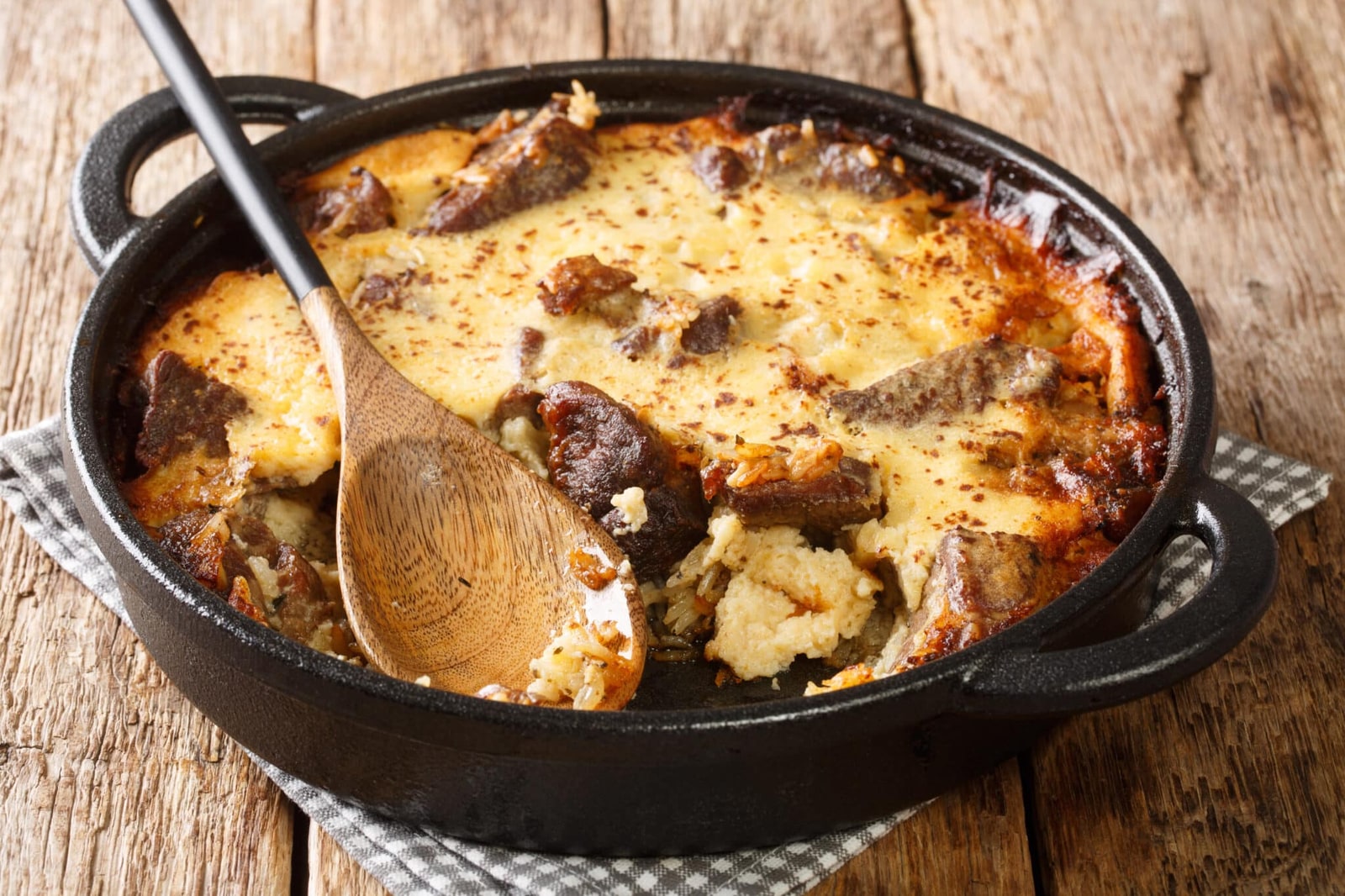
The pleasure of tavë kosi begins at the surface: a browned covering that gives way to something softer underneath. There is no pastry to peel back. Yogurt, eggs and flour make the topping, with lamb below and, in many versions, a little rice. The dairy has gone into the oven with dinner. It emerges as a savory custard whose tartness stays in the same mouthful as the meat.[3][4][5]
This Albanian casserole belongs especially to Elbasan. The National Tourism Agency places it within the hospitality of central Albania, at gatherings of family and friends; a municipality-hosted tourism report describes it among Elbasan's distinctive foods.[1][2] Those are useful bearings for a dish whose quiet appearance can undersell its ambition. Here, refinement lives in the meeting of browned surface, soft filling and sour dairy. A garnish has little work left to do.
The yogurt gets a second texture
Think of the topping as two experiences in one spoonful. Above, the oven gives it color. Beneath that surface, the mixture remains soft enough to yield with the lamb. Calling it a crust describes its position and appearance, but can suggest the wrong bite: the aim is a set yogurt covering, not the brittle shell of a pie.[3][5]
Ayla Clulee's published Elbasan tava recipe makes the division of labor explicit. Eggs set the topping; flour thickens it. She mixes in cooking liquid from the lamb after allowing it to cool, carrying the meat's flavor into the dairy layer. Her warning about adding that liquid too hot is practical: the eggs can scramble before the mixture reaches the oven.[5]
Other cooks arrive by a different route. My Albanian Food prepares a butter-and-flour roux separately before combining it with yogurt and eggs. Saveur also uses a roux, adding its dairy and eggs off the heat.[3][4] The recipes share an end point without sharing every maneuver. What matters to the diner is the continuity: a topping that holds together while staying tender, with enough yogurt character to keep the lamb's richness interesting.
Rice should leave room for the rest
The rice can be surprisingly easy to miss on an ingredient list. Saveur's version pairs three tablespoons of rice with two pounds of lamb, alongside four cups of yogurt. Those proportions describe a casserole whose identity rests heavily on dairy and meat. A broad bed of pilaf would give it a different center of gravity.[4]
My Albanian Food uses a more generous 70 grams of rice for 600 grams of diced lamb, cooking the grain briefly with the meat and additional water before assembling the bake.[3] Clulee leaves rice out of her main recipe and offers it as an addition.[5] Taken together, these versions make a rigid rice quota difficult to defend.
They also suggest a useful way to judge a serving. Grain should belong to the lamb and its juices rather than feel like a separate course hidden underneath. The spoonful still needs room for the yogurt. For this dish, a satisfying balance is more revealing than a claim that one set of quantities settles authenticity.
The lamb needs a head start
The report hosted by Elbasan municipality describes meat baked first, then covered with an egg, flour and yogurt mixture and baked again.[2] The two stages explain something fundamental about the plate: the lamb begins cooking before its delicate covering joins it.
That sequence survives in recipes that move the first stage to the stove. My Albanian Food browns and simmers the lamb before adding rice and, later, the topping. Clulee simmers hers until fork-tender, then transfers it to the baking dish.[3][5] These are different preparations with a shared priority: give the meat time before asking the yogurt layer to finish.
For a restaurant kitchen, the implication is straightforward. The surface is only one measure of success. A beautiful brown top cannot compensate for meat that still resists the spoon. The casserole has to be judged vertically, through the whole serving, rather than by its most photogenic layer.
Keep the spoonful intact
A formal dining room could serve tavë kosi in a small ceramic dish or lift a portion from a larger bake. My Albanian Food explicitly allows either a casserole or individual bowls and recommends a short rest after baking.[3] The choice changes the presentation; it need not change the pleasure of finding the layers together.
My preference would be for a portion generous enough to include the browned top, its pale underside and lamb in one pass of the spoon. Pulling those elements apart for a more elaborate presentation would lose the contact that makes the dish compelling. Its interest lies in how the yogurt surrounds the meat, rather than in a succession of isolated tastes.
The final accompaniment can be modest. My Albanian Food suggests salad and bread; Clulee likewise favors something fresh beside the substantial casserole.[3][5] That leaves the bake at the center of the table. The yogurt has already supplied the bright counterpoint, the soft middle and the golden surface. Let the first spoonful show all three.
Sources
- Albania National Tourism Agency, “Baked lamb yogurt casserole” — Elbasan, family hospitality and source of the accompanying photograph.
- Elbasan municipality, tourism analysis, “Unique cooking of Elbasan,” printed page 25 — local context and the two-stage preparation of tavë kosi.
- My Albanian Food, “Tavë Kosi: Baked Lamb and Yogurt,” February 12, 2017 — rice proportions, roux, individual-bowl option, resting and serving suggestions.
- Saveur, “Albanian Baked Lamb and Rice with Yogurt (Tavë Kosi),” first published in the November 2013 issue — a contrasting recipe with a small quantity of rice and a yogurt-and-egg covering.
- Ayla Clulee, “Tave Kosi – Elbasan Tava,” Cooking Gorgeous — egg-and-flour topping, cooled cooking liquid, optional rice and serving texture.