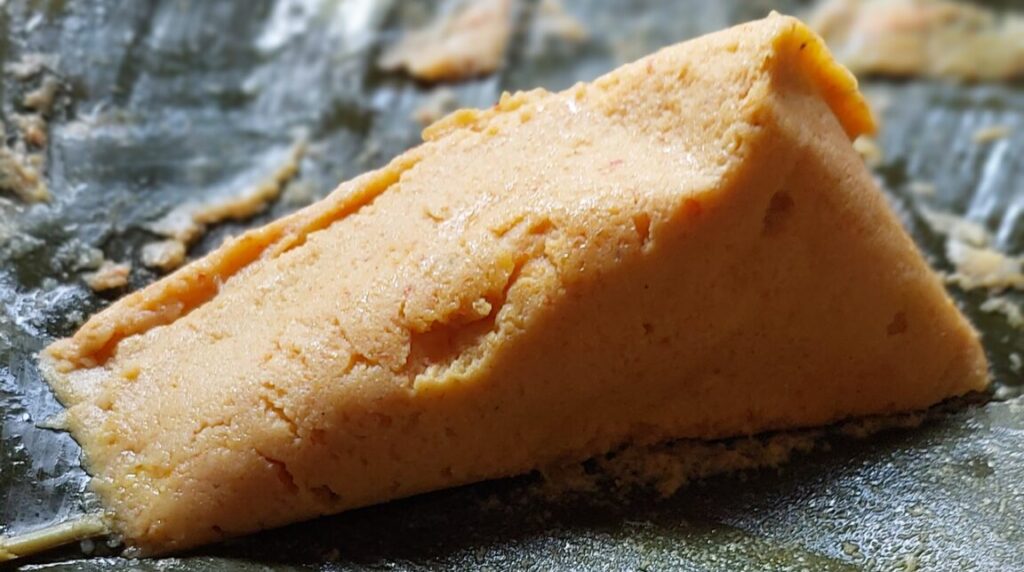
A spoon should meet a little resistance, then pass through. Moin moin's pleasure lives in that narrow interval: a savory bean pudding with enough structure to keep its shape and enough tenderness to make the next mouthful easy. Nigerian cook Lola Osinkolu describes the target as moist and firm, without crumbling or collapsing.[2]
That is an exacting brief for something that begins as beans, onion and pepper. Moin moin, also written moi moi, can accompany a celebratory plate of jollof rice or a breakfast of pap. Its technical ambition belongs to those everyday tables already.[3] For a restaurant serving it as a small course, the interesting challenge is preserving that texture as the portion and presentation change.
The decisive work happens before the lid goes on. Once the batter is enclosed, the cook has surrendered the chance to stir in a correction.
First, take the bean apart
Peeling is the opening texture decision. Osinkolu allows that unpeeled beans can be used, but explains that the skins give a rougher result. Her method briefly soaks the beans, pulses them in a food processor, then uses water to separate the loosened skins.[2]
This is preparation with a specific sensory purpose. A diner does not need to identify a fragment of skin to notice that the pudding feels coarse. Nor will an elegant mold make that coarseness disappear.
There are two different machine jobs here: loosening skins and making the final batter. The first is deliberately brief. The second must be thorough. Osinkolu identifies insufficient blending and excess water as recurring failures; adding water may help the blades turn, but it can leave a pudding unable to hold its shape.[2]
My reading of that advice is that the blender's convenience must not dictate the recipe. A batter that circulates beautifully in the jug can still be wrong for the plate. Smoothness and dilution need separate attention.
The liquid includes what the blender already drank
All Nigerian Recipes makes a particularly useful distinction: its stated liquid allowance includes the water used for grinding and any stock added afterward. It is a total, not an invitation to pour the listed amount into an already wet purée. The author also treats the final texture as a household preference rather than a universal formula.[3]
That is a small bookkeeping point with a large consequence. When a kitchen scales a recipe, liquid can enter at several moments. The person blending and the person finishing the bowl need to be following the same account.
Oil deserves equal attention. Ozoz Sokoh's Serious Eats method whisks it into the purée for a silkier result.[1] Adunni Ogunlanoh's Taste Tutor version takes another route: oils, peppers, aromatics and broth are blended first, then the peeled beans are added and the mixture is strained.[4]
These are complete methods to follow, not loose instructions to splice together. Their sequences differ, but both make the batter an object of care before cooking. For restaurant development, I would judge a trial batch without its garnish first. If the pudding itself feels gritty or heavy, the finishing sauce is answering the wrong question.
A leaf does more than hold a shape
Sokoh identifies moin moin leaves as Thaumatococcus daniellii, called ewe eran in Yoruba and uma in Igbo, and describes their light vegetal aroma. Banana and plantain leaves are alternatives, not the same botanical material.[1]
A ramekin offers another kind of precision. It fixes the portion and removes the need to fold a watertight parcel. Osinkolu uses greased ramekins in her recipe; Ogunlanoh offers both vessels and wrapped versions.[2][4] Neither choice is merely a styling decision.
Consider what the guest receives. A pudding presented in its leaf invites an unfolding before the spoon arrives. A neatly unmolded one exposes its surface immediately. The former makes the cooking wrapper part of the encounter; the latter puts the texture under brighter scrutiny. Those are different dining-room pleasures, and either can be handled thoughtfully.
The distinction also matters when describing the dish. A fresh leaf slipped beneath a pudding after cooking does not document leaf-steaming. If the kitchen wants the wrapper to carry part of the story, its role should be real.
The timer belongs to the vessel
Published cooking times vary substantially. Osinkolu's method suggests about 45 minutes. Ogunlanoh gives a range of 45 minutes to 90 minutes for ramekins in a water bath, explicitly depending on size.[2][4] All Nigerian Recipes likewise connects cooking time with quantity and container, and describes checking that the interior has set rather than remaining watery.[3]
These are not competing answers to one identical experiment. Portions, mixtures and pot arrangements differ. A cook cannot shrink a large parcel into a tasting-menu cup, retain the old timetable unquestioningly, and call that precision.
The useful service lesson is to test the vessel that will actually go to the table. Keep that portion consistent. Follow the chosen recipe's water-level checks. Assess the center, not just the surface. This is a practical inference from the recipes' differing methods, rather than a new universal cooking time.[2][3][4]
Fillings add another decision. All Nigerian Recipes offers alternatives such as egg, corned beef or cooked marrow, while Ogunlanoh includes optional egg and sardines.[3][4] Each gives the spoon something distinct to encounter. On a small plate, I would leave enough uninterrupted pudding for its own texture to register.
A lavish center can make a memorable bite. The surrounding beans still have to earn the second one.
Sources
- Ozoz Sokoh, “Moin Moin (Nigerian Steamed Bean Cake),” Serious Eats, updated February 14, 2025 — oil incorporation and cooking-leaf identity.
- Lola Osinkolu, “How to make Moin Moin/Moi Moi,” Chef Lola's Kitchen, updated October 9, 2024 — peeling, blending, texture, ramekins and steaming.
- All Nigerian Recipes, “Nigerian Moi Moi” — liquid accounting, accompaniments, fillings, container differences and checking the set.
- Adunni Ogunlanoh, “MOIN MOIN (Steamed Bean Pudding),” Taste Tutor, July 9, 2019 — an alternative blending sequence, straining, fillings and vessel-specific cooking ranges.
- ProVeg International, “Moin-Moin-good.jpg,” photograph dated February 8, 2017, Wikimedia Commons — photographic source, CC0.