A bowl of curd, a layer of palm syrup, a spoon: Sri Lanka's curd and treacle makes an unusually direct argument for paying attention to a sweetener. The syrup stays visible. It is something to draw through the curd, leaving a dark trail across the pale surface. FAO's account of Sri Lankan food and forest livelihoods describes this simple pairing as a particular pleasure.[1]
In a restaurant, that simplicity gives the ingredient nowhere to hide. A pastry kitchen can build elaborate textures around sweetness; here, the sweetener has to contribute interest of its own. The useful place to begin understanding kithul is several steps before the bottle, with a flower high above the ground.
Kithul syrup comes from Caryota urens, the fishtail palm. Producers collect sap from its young flower cluster, or inflorescence, and boil away water. Sri Lanka's Export Development Board gives a typical sap-to-treacle conversion of approximately eight to one, with variation according to environmental conditions. Further boiling and stirring produces the solid sweetener called jaggery.[2]
The harvest is above your head
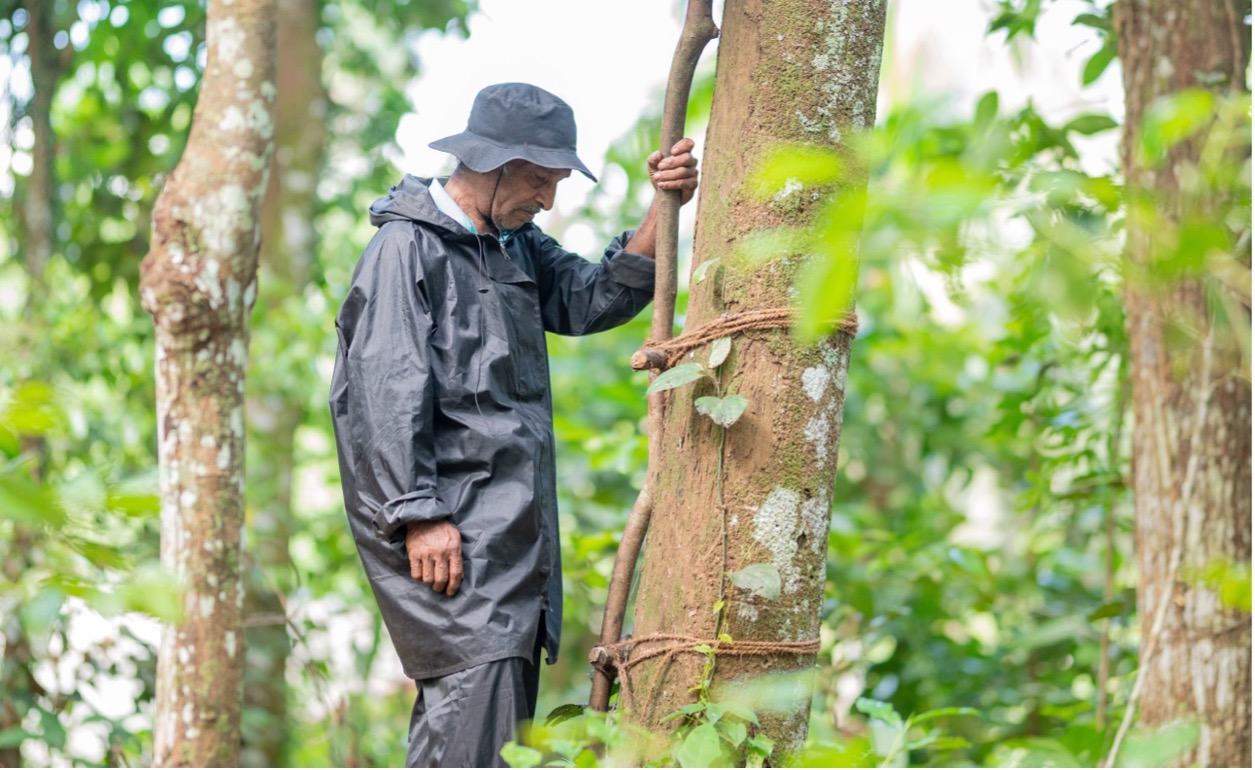
The producer Ceylon Saplings describes repeated daily climbs on a makeshift ladder and precise cuts to a kithul flower. This is its account of the work behind its Raga products, rather than an independent survey of every producer. It nevertheless makes the practical difficulty wonderfully clear: owning a palm does not automatically give you the skill to harvest it.[4]
In December 2025, UNESCO inscribed Sri Lanka's kithul tapping tradition on its Representative List of the Intangible Cultural Heritage of Humanity. Its announcement describes a practice extending across 13 districts, sustained through family teaching and village cooperatives. Sap feeds several culinary lives: fresh drinks, treacle, jaggery, toddy, vinegar and sweets.[3]
The recognition gives a dining room a richer story to tell. It also identifies what the story concerns: people carrying knowledge between generations. A server who mentions the palm's name has introduced the ingredient. Explaining the work of the tapper begins to explain its value.
A sweet liquid with another possible future
Once collected, sap can become something other than syrup. A 2013 University of Colombo thesis isolated wild yeasts from fermenting kithul sap and identified fermenting strains as Saccharomyces cerevisiae. Fermentation is part of this ingredient's biology, with a legitimate culinary destination in fermented drinks.[5]
For a producer making treacle, however, that possibility creates a handling problem. The export board's June 2020 guidance notes that yeasts multiply between collection and processing and recommends shortening the interval. It offers no universal countdown that would let a buyer declare every batch acceptable after a fixed number of hours.[2]
For a restaurant, that makes the collection routine worth discussing alongside the place of origin. Both help explain the ingredient.
A standing tree can still supply nothing
An older FAO field account records a striking example from a Colombo home garden. A woman named Nilmini had kithul palms that went untapped for years because the family could not find a professional tapper. Eventually, the household replaced them with other fruit trees. The same account describes younger workers seeking more dependable employment.[1]
This historical example shows how losing a skill can make an available tree unproductive. It cannot measure today's workforce.
The FAO account also makes another contributor visible: women boiling the collected sap and making jaggery while men tap and gather it. A sourcing story that ends with the climb leaves the processing work outside the frame.[1]
For a kitchen buying a small, carefully chosen ingredient, the interesting question becomes how an order supports the people doing both jobs. Repeat orders and realistic delivery expectations are worth discussing with suppliers. The evidence here cannot establish what any particular bottle pays a household, so the human story deserves the same specificity as the botanical one.
The bottle needs a memory
Ceylon Saplings offers one concrete example of how a producer says it keeps that specificity. Through sister company Agri Ceylon, it describes training harvesters, sealing sap containers and attaching barcodes with harvest information. Containers can then be tracked through processing. These are the company's own operating claims; its website is not an independent audit.[4]
The useful idea is modest: a bottle should remain connected to a harvest. A restaurant can ask a supplier to explain that connection in ordinary language, from the people collecting sap to the batch being delivered.
The export board's report describes added sugar as an authenticity problem when harvest volumes are low or sap is dilute. It recommends batch identification and origin records.[2] That gives a buyer better questions than whether a syrup looks sufficiently dark or comes in sufficiently rustic packaging.
At the table, the explanation can stay brief. Name kithul, describe its origin, and let the guest taste it alongside the curd before mixing everything together. In the kitchen, keep the fuller conversation: who harvested it, how it was handled and what the supplier can document.
The pleasure of the dessert is its apparent ease. Following the syrup back to the flower reveals how much work makes that ease possible.
Sources
- FAO, Sri Lankan Women and Men as Bioresource Managers, chapter VIII, section 8.2 — historical field accounts of kithul livelihoods, household palms, processing work and curd with treacle.
- Sri Lanka Export Development Board, Exporting Kithul from Sri Lanka to Europe, June 2020, pp. 2, 8–9 and 11–12 — production, approximate conversion ratio, collection-to-processing interval, authenticity and batch records; used as dated trade guidance.
- UNESCO, “Kithul Tapping inscribed on UNESCO's Representative List of the Intangible Cultural Heritage of Humanity,” 11 December 2025, updated 14 December — recognition, communities, products and photographs credited to Dr Raveendra Withanachchi.
- Ceylon Saplings, “The Story of Kithul” — the producer's account of Raga harvesting, training, sealed collection containers and barcode traceability.
- P. Ranasinghe, Bioactive Properties of Caryota urens L. (Kithul) Sap and Treacle and Isolation and Molecular Characterization of Economically Useful Yeasts from Fermenting Sap, University of Colombo, 2013 — thesis abstract; cited only for yeast isolation and identification.