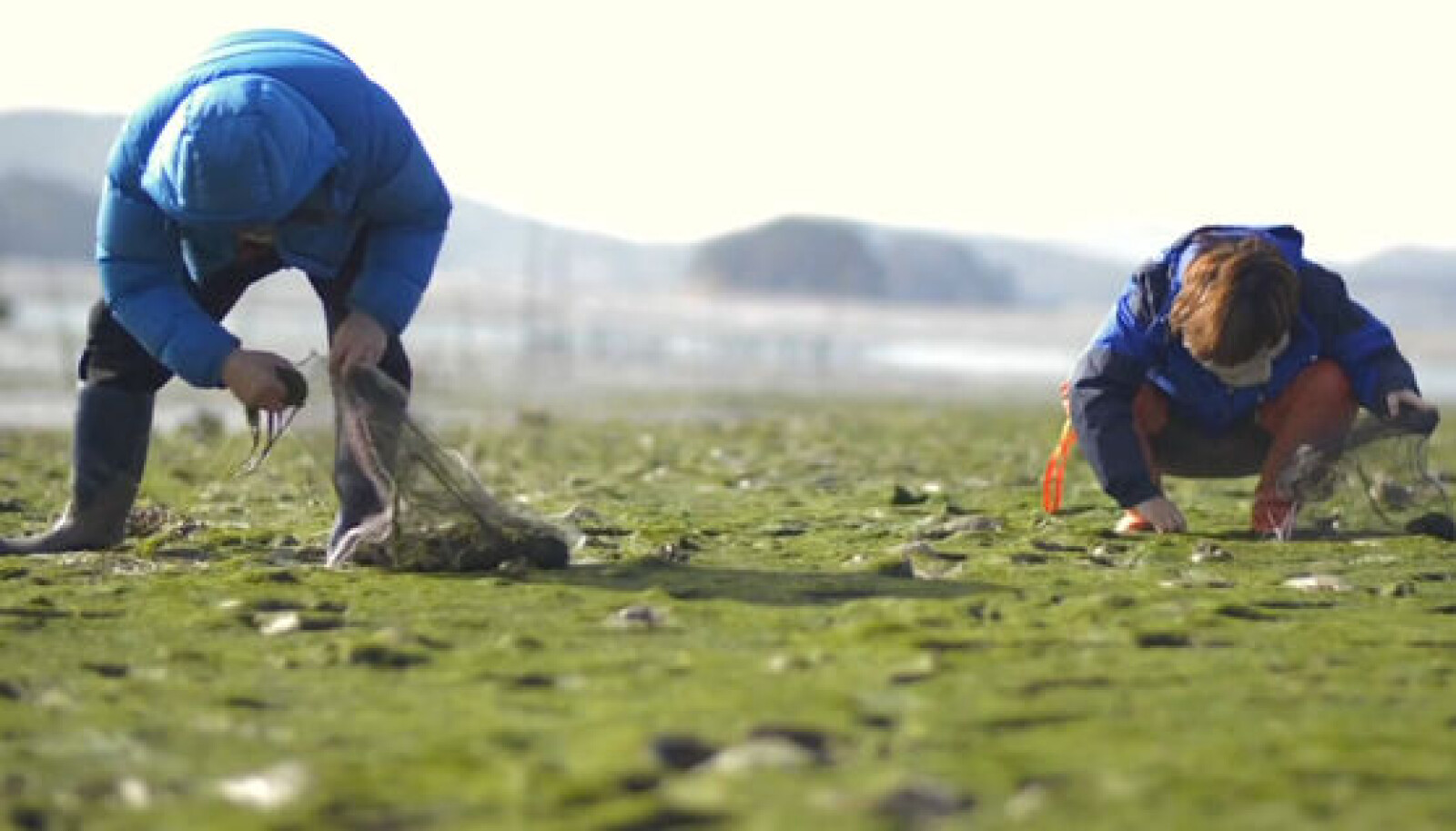
In Badasoop's photograph, the harvest has none of the crisp geometry of the finished product. Two people in blue winter layers crouch close to an exposed mudflat. One lifts a dripping green fringe toward a clear bag; the other searches the slick surface with a red-gloved hand. Pale hills and tidal stakes blur behind them. Nothing resembles a sheet yet.[3]
That is the right place to begin with gamtae. On a tasting-menu plate, it may arrive as an emerald veil around raw fish, a powder over a tart, or a ragged square whose marine perfume is compared to truffle. Before that polish, it is a winter organism attached to mud, shell or gravel; a tide-timed harvest; careful washing; difficult hand-forming; controlled drying; and a product that can fade if warmth or light are allowed to undo the work.[2][3][4]
Its recent luxury billing is understandable. The flavor can move from briny and grassy to gently bitter and sweet, while the filamentous sheet looks more like pressed moss than familiar, flat-bladed gim. Yet "luxury seaweed" is the least informative thing a kitchen can say about it. A serious account starts with a less glamorous question: which gamtae?
First, get the seaweed's name right
English-language food coverage repeatedly identifies the fine green mudflat gamtae sold by Badasoop as Ecklonia cava.[3][7] Official Korean sources draw a more useful distinction.
The National Culture Portal explains that two entirely different algae are commonly called gamtae in Korea. The west- and south-coast food also known as gasiparae is Ulva prolifera, a green alga with very fine strands. A different gamtae, Ecklonia cava, is a brown alga associated particularly with Jeju and Ulleungdo. The National Marine Biodiversity Institute's species record reinforces the first identification: Ulva prolifera is dark green, cylindrical and threadlike, branches into fine pointed filaments, and attaches to pebbles, shells and mud; the record also notes that it is known as gamtae in southern coastal usage and is eaten.[1][2]
Those details match the ingredient in the photograph and the producers' account far better than a broad brown kelp does. This article therefore uses gamtae for the Garorim Bay food product and *gasiparae, Ulva prolifera when botanical precision matters. It does not silently copy the Ecklonia cava label from international coverage.[1][2][3]
That correction is not pedantry. A scientific name is a compact purchasing specification. If two biologically different seaweeds can travel under one common name, then nutrition claims, harvest descriptions, flavor expectations and even storage advice can become attached to the wrong ingredient. A menu that names the wrong species has not made the product more accessible; it has made an intricate supply chain less legible.
The practical buyer's question is simple: ask the processor which organism is in the pack, where it was gathered, and whether the answer appears on the specification sheet. "Korean gamtae" is cultural orientation. It is not yet full provenance.
The bay sets the clock
Garorim Bay lies between Seosan and Taean on Korea's west coast. Its constricted, shallow water opens into a large intertidal landscape, so low tide does not merely reveal the harvest site; it creates the working shift. Eater's visit with Song Cheol-su and his daughter Song Ju-hyeon records water moving in and out twice a day and Song following the lunar calendar to know when the flat can be worked. His plain conclusion is the whole seasonal constraint: weather decides whether a year is generous or poor.[4]
This is not just picturesque terroir. The Daesan Regional Office of Oceans and Fisheries records 92.04 square kilometres of Garorim Bay as a marine protected area, designated to conserve habitat and breeding grounds for protected marine life, fisheries species and benthic organisms. The page names spotted seals, red-clawed crabs, white-footed fiddler crabs and eelgrass among its significant resources.[5] A gamtae supply from this bay is therefore inseparable from a functioning intertidal system. The protected-area label is not a restaurant sustainability certificate, but it makes the ecological setting impossible to treat as blank scenery.
Badasoop's production calendar, as Song Ju-hyeon described it to the Korea JoongAng Daily, is narrow. Their first early-December growth is paler and directed toward powder; darker green material arrives after mid-December. By March, she says, yellowing and flavor loss bring the useful season to an end. She also describes gamtae as rooted in the mudflat rather than raised on the suspended nets familiar from gim production.[3]
Those statements describe one producer's site and standards, not a universal biological clock for every Ulva prolifera population. That boundary matters because the National Marine Biodiversity Institute records the species around Korea's coasts and notes a broader ecological pattern.[2] A buyer should not turn Badasoop's calendar into mythology for every pack labeled gamtae. The stronger claim is narrower: this ingredient from this bay reaches its best color and flavor through a short winter harvest governed by tide and weather.[3][4]
Something this fine resists becoming a sheet
Gim cooperates with the mental image of paper. Gamtae does not. Its individual branches are thin, tubular and tangled; the National Marine Biodiversity Institute describes filaments only 1 to 3 millimetres across, issuing still finer pointed branches.[2] The finished sheet is therefore a network of threads with open spaces, not a continuous leaf pressed flat.
That difference moves labor into the foreground. Badasoop describes its production as manual from gathering through drying, while the Eater account follows harvesting, washing and cleaning before the seaweed is formed into roughly 400 to 500 sheets a day.[3][4] The number is an observation from that visit, not an industry throughput benchmark. Its value is scale: even several hundred sheets still belong to a daily hand process, not to an invisible roll of green film.
Washing has to remove mud and grit without destroying the fragile strands. Forming has to distribute something that does not naturally knit as readily as gim. Drying has to fix the lacy structure without bleaching away the green or flattening its perfume. The visual irregularity that chefs prize is not a styling effect added at the end. It records the raw material's refusal to become uniform.
This is where the common truffle comparison begins to mislead. The Philadelphia Inquirer documents chefs using gamtae in tomato sandwiches, over grilled octopus, around cured fish, in bouillon, in dough and as a powder.[7] Those applications show range, but truffle language encourages a kitchen to treat gamtae chiefly as an expensive aroma sprinkled over something else. The sheet asks for a different kind of attention: texture, moisture and timing matter as much as perfume.
A whole piece placed too early on a wet surface loses its lift. A dry shard can seem papery if there is nothing juicy or fatty beneath it. Powder travels evenly but erases the product's filamentous structure. None of the forms is automatically superior. The kitchen has to decide whether the course needs a wrapper, a crisp edge, a broth-level seasoning or an aromatic finish—then buy and hold the corresponding form.
The cold chain belongs in the flavor story
Seasonality does not end when the flat floods again. Song Ju-hyeon says the harvested product is kept below -20°C, protected from direct light in aluminium packaging, and sold only through distributors able to preserve those conditions.[3] That is a producer's specification, not a general regulatory threshold, but it explains why a winter ingredient can appear on menus later in the year without becoming timeless.
For a restaurant, "dried seaweed" can sound shelf-stable enough to forget. Gamtae punishes that assumption. Heat and light dull the color and aroma that justified buying the premium product in the first place.[3] A chef may execute the final ten seconds perfectly and still serve a diminished ingredient because receiving, storage or an open packet failed weeks earlier.
Good sourcing therefore includes unromantic questions. Was the product shipped frozen or merely cool? What form arrived? When was it harvested and processed? How long has the current pack been open? Is its vivid green the seaweed's own color, or has seasoning changed the appearance? Can the distributor identify the processor rather than only the importing brand?
The answers are part of taste. A supply chain that preserves volatile marine aroma is doing culinary work before the cook touches the packet.
A wild harvest is still an organized economy
The word wild can make an ingredient sound free of human systems. Gamtae proves the opposite. Song Ju-hyeon told the Korea JoongAng Daily that about 100 households gathered for Badasoop, creating winter work during a season that could otherwise be slow.[3] An academic study of gamtae production and distribution in Muan, farther south on Korea's west coast, describes a longer regional pattern: tidal-flat knowledge accumulated across generations, winter gathering historically carried out by women, and a product that remained secondary to larger seaweed industries even as it circulated locally and abroad.[6]
The Muan study should not be used to invent a single unbroken tradition for Badasoop in Seosan. The places, processors and present-day arrangements differ. Read together, however, the two accounts correct the same fantasy. Gamtae does not move straight from untouched nature to an enlightened chef. Gatherers read the flat; households organize seasonal work; processors clean, form and dry; cold storage extends the season; importers introduce the product; and restaurants decide which parts of that chain guests are allowed to see.[3][4][6]
That last decision matters as demand grows. A menu can call gamtae rare, compare it to white truffle and leave the producer invisible. Or it can name the bay, processor, harvest form and species while using the ingredient with enough restraint that its own flavor survives.
Let the course preserve what sourcing made possible
The most persuasive gamtae dish is not necessarily the one wearing the largest green crown. Start by tasting three states: a small piece straight from the pack, another briefly warmed, and a third softened against plain rice or a neutral broth. That sequence reveals how quickly the aroma lifts, where bitterness sits, and whether the sheet wants to remain crisp or become tender. It also exposes stale stock before caviar and sauce make the diagnosis expensive.
Then choose one job. Use the intact lattice where the diner can feel its fragility. Use threads where they can cling without becoming decorative hair. Use powder where even distribution truly matters, but measure it as a seasoning rather than a prestige dust. The Inquirer's restaurant examples suggest why gamtae travels so easily across cuisines: tomato, octopus, potato, fish, foie gras and dough each offer moisture, fat, starch or savor for the seaweed to sharpen.[7] The lesson is not to copy those plates. It is to give gamtae a clear contrast rather than burying it under a second ocean of luxury signals.
Tableside language can be just as disciplined: winter gamtae from Garorim Bay, gathered on the mudflat and formed by hand. If the supplier verifies the product as gasiparae, add Ulva prolifera. Name Badasoop or another processor when known. Skip the claim that it is "Korea's rarest seaweed" unless the kitchen can define and support rarity.
Back in the photograph, the bay still looks bigger than the harvesters. That scale is the ingredient's useful correction to fine dining. The green sheet may be delicate, expensive and beautifully strange, but none of those qualities begins at the pass. They begin when cold water retreats, the mud holds, a gatherer bends down, and a tangle of threads is lifted before the tide returns.[3][4]
Sources
- National Culture Portal, "A rice thief from the mudflat: seasoned gasiparae (gamtae) and gamtae-gim" — Korean local-food account distinguishing the west- and south-coast green alga Ulva prolifera from the brown alga Ecklonia cava that shares the common name gamtae.
- National Marine Biodiversity Institute of Korea, "Ulva prolifera O.F. Müller, 1778" — official species record covering taxonomy, filament structure, attachment to mud and shell, coastal distribution, the regional name gamtae and food use.
- Yim Seung-hye, "Gourmet algae gamtae is the new seaweed on the block." Korea JoongAng Daily (September 12, 2023) — interview with Badasoop CEO Song Ju-hyeon on the Seosan harvest calendar, manual processing, storage, household network and chef adoption; source of the Badasoop harvest photograph used here. Its Ecklonia cava label is not used for botanical identification.
- Avery Dalal and Eater Video, "The Trick to Harvesting the Most Delicious Seaweed in the Ocean." Eater (June 15, 2022) — field account with Song Cheol-su and Song Ju-hyeon on Garorim Bay tides, weather-dependent supply, washing and daily sheet-forming scale.
- Daesan Regional Office of Oceans and Fisheries, "Garorim" — official protected-area record with designation history, 92.04-square-kilometre boundary, conservation purpose and significant marine species.
- Garam Kim, "A Study on the Tradition of Gamtae Collecting and Changes in Production Method: In the Case of Muan County." Intangible Heritage Studies 9, no. 2 (2024) — KCI record and abstract on traditional tidal-flat gathering, women's seasonal work, factory expansion and distribution change.
- Kiki Aranita, "This luxury seaweed is the new truffle." The Philadelphia Inquirer (November 10, 2024) — reported examples of gamtae in contemporary restaurant cooking and importer, chef and home-cook perspectives on its flavor and forms; used here for culinary applications, not botanical identification.