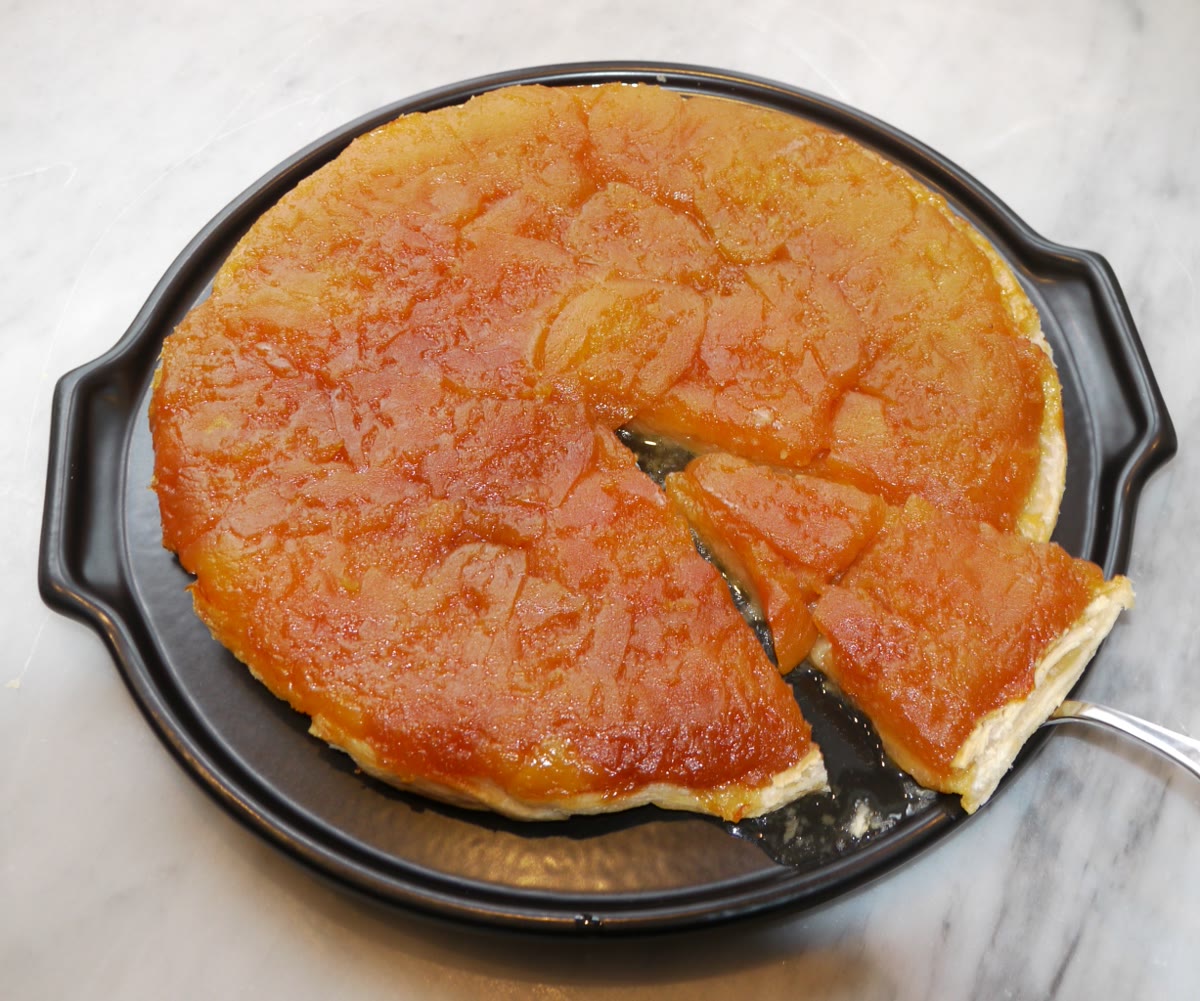
Tarte Tatin is one of French pastry's best jokes because the punch line is structural. The dessert looks as if it has been built upside down, which it has. Apples cook first in butter and sugar; pastry arrives late, as a lid rather than a base; the tart is baked, rested, then inverted so the fruit becomes the glossy surface and the crust becomes the support. Merriam-Webster's plain definition is almost enough to explain the charm: a caramelized apple tart baked with pastry on top and turned over for serving.[3]
That turn is why tarte Tatin belongs in fine dining even when the ingredients remain ordinary. It does not need gold leaf, rare fruit, or elaborate sugar architecture. Its luxury is timing. The kitchen must push apples far enough toward jammy concentration without losing their shape, keep caramel dark but not bitter, protect the pastry from sog, and then perform the most important act after the cooking is over. The dessert becomes serious because one simple movement can ruin or reveal the whole thing.
The official birthplace story still matters. La Maison Tatin in Lamotte-Beuvron, in the Sologne, identifies its nineteenth-century hotel as the birthplace of the dessert and names Caroline and Stéphanie Tatin as the sisters behind the specialty.[1] The same page notes that their restaurant was already reputable enough to be mentioned in the first Michelin Guide and that no visit to the house would be complete without tasting the regional emblem.[1] Those details keep the dish from floating away into generic French-dessert nostalgia. Tarte Tatin is not only a recipe. It is a railway-hotel dessert with a village address, a sister story, and a service trick.
The useful part of the legend
The accident legend is famous: a busy hotel kitchen, shooting-season guests, apples started in the wrong order, a tart rescued by baking pastry on top and flipping the result. It is a delightful story, and probably too neat. Felicity Cloake's National Geographic reconstruction is careful about that boundary. The hotel existed, the sisters' apple tarts were known, and Lamotte-Beuvron was the right setting, but fruit tarts and upside-down cakes long predated the sisters' restaurant.[2]
That does not make the legend useless. It makes it more interesting. The story's power is not that one can prove every beat like a court transcript. Its power is that it describes the dessert's method accurately: mistake becomes design, disorder becomes ceremony, and a rustic apple tart becomes memorable because the service sequence is slightly risky. The myth survives because it fits the physical truth of the dish.
National Geographic supplies the stronger historical hinge: by 1903, the Tatin tart was reportedly known widely enough in Sologne to be described as famous in a local geographical-society account; by the 1920s, Curnonsky was recommending the apple or pear tart from the demoiselles Tatin; by the late 1930s, it had reached Maxim's in Paris.[2] That is the lineage worth tracking. Tarte Tatin did not become a classic simply because it was invented. It became a classic because a regional specialty acquired a story polished enough for Paris.
Why inversion tastes expensive
Many desserts end with a garnish. Tarte Tatin ends with a reveal. Until the flip, the dish is partly concealed: pastry side up, fruit underneath, caramel hidden in the pan. That concealment matters because it gives the dining room a moment of suspense without requiring theatrical equipment. A baba can be poured. Crêpes Suzette can flame. Pressed duck can involve silver machinery. Tarte Tatin needs only the pan, the plate, and the confidence to turn the whole thing over.
The flip also changes the meaning of caramel. In an ordinary apple tart, sugar can sit on top as shine or glaze. In tarte Tatin, caramel is the cooking medium and the surface memory at once. It browns the fruit, concentrates butter and sugar, and then becomes the face of the dessert. The pastry is demoted visually but promoted structurally. It must be crisp enough to carry the apples after it has spent the bake absorbing steam from below.
This is why the dish can feel both homey and precise. A sloppy tarte Tatin is still recognizable, but a great one has almost architectural clarity: apples tightly set, caramel deep amber, pastry firm, juices controlled. The technique rewards patience more than decoration. That is a very modern luxury lesson inside an old dessert. The kitchen proves itself by restraint.
Apples, pastry, and the line between classic and variant
Tarte Tatin's grammar is simple enough to invite variation, which is exactly why the classic version has needed defenders. National Geographic notes that apples remain the easiest and most classic fruit because they are relatively dry and can hold shape under caramel; it also records the broader family of pear, peach, apricot, plum, pineapple, quince, banana, and even savory vegetable versions.[2] Merriam-Webster's current examples show the word still stretching in 2026, including onion and squash versions in restaurant contexts.[3]
That elasticity is useful, but it creates a boundary problem. If every inverted tart becomes a Tatin, the name stops pointing to Lamotte-Beuvron and starts meaning only "flipped." The old Confrérie des Lichonneux de la Tarte Tatin understood that risk. The French association registry records the group as created in 1979 with a mission to promote the hot, inverted tart known as tarte Tatin, protect its culinary value and method, and encourage its consumption; it also records the association's dissolution in December 2024.[4] Even dissolved, the group tells us something about the dish's status. This was not a casual recipe category. It had custodians.
The pastry debate sharpens the same issue. National Geographic notes that puff pastry has become common in restaurant versions, while shortcrust, associated with Stéphanie Tatin, is sturdier if the dessert must wait; Larousse, in that account, accepts either.[2] The choice changes the dining experience. Puff pastry gives dramatic lift and shatter when served quickly. Shortcrust gives a calmer, more durable base. Neither is automatically more authentic at the table. The better question is whether the pastry supports the apples at the moment the guest eats.
From Sologne tart to restaurant language
The reason tarte Tatin keeps working in fine dining is that it carries a complete restaurant sentence in a short form. It has origin, technique, suspense, aroma, and a final act that can be felt by the whole table. It also avoids the common failure of classic desserts: it does not depend on reverence alone. A diner who knows nothing about the sisters, the hotel, Curnonsky, Maxim's, or the brotherhood still understands the pleasure when caramelized apples slide out glossy and intact.
Yet the history improves the taste because it explains the discipline. La Maison Tatin's current framing keeps the dessert tied to Sologne, the railway-facing hotel, and the sisters' reputation.[1] National Geographic's account complicates the accident story while showing the tart's travel into broader French restaurant culture.[2] Merriam-Webster shows how the name has become common culinary language.[3] The association record shows that locals cared enough about the method to formalize guardianship around it.[4] Put together, those sources describe a dessert that became famous by balancing openness and control.
That balance is the dish's real fine-dining value. Tarte Tatin is easy to imitate and hard to make inevitable. Too pale, and it is apple pie with ambition. Too dark, and caramel becomes punishment. Too wet, and the pastry gives up. Too decorated, and the clean inversion loses authority. The best version feels almost obvious after the fact, as if apples, butter, sugar, and pastry were always waiting for someone to reverse the usual order.
The flip made that order visible. It turned a local apple tart into a service event, a regional specialty into a Parisian story, and plain fruit into a dessert with lineage. Tarte Tatin still feels luxurious because it lets the table witness a controlled reversal: what was hidden becomes the face, what looked like the base becomes support, and a practical kitchen maneuver becomes the moment everyone remembers.
Sources
- La Maison Tatin, "History" - official hotel history, Lamotte-Beuvron location, Tatin sisters, Michelin Guide mention, and regional dessert framing.
- Felicity Cloake, "Deconstructing tarte tatin, the classic French dessert," National Geographic Traveller / National Geographic, last updated May 16, 2023 - historical reconstruction, Sologne context, Curnonsky/Maxim's spread, technique notes, and variant boundaries.
- Merriam-Webster, "tarte tatin" - current dictionary definition, etymology, and 2026 usage examples showing the term's broader culinary reach.
- Assoce.fr, "Confrérie des Lichonneux de la Tarte Tatin" - French association registry record covering the group's 1979 creation, mission to protect the hot inverted tart and its method, and 2024 dissolution.
- Wikimedia Commons, "File:Tarte.tatin.wmt.jpg" - real 2010 photograph by Wmeinhart used as the article image.