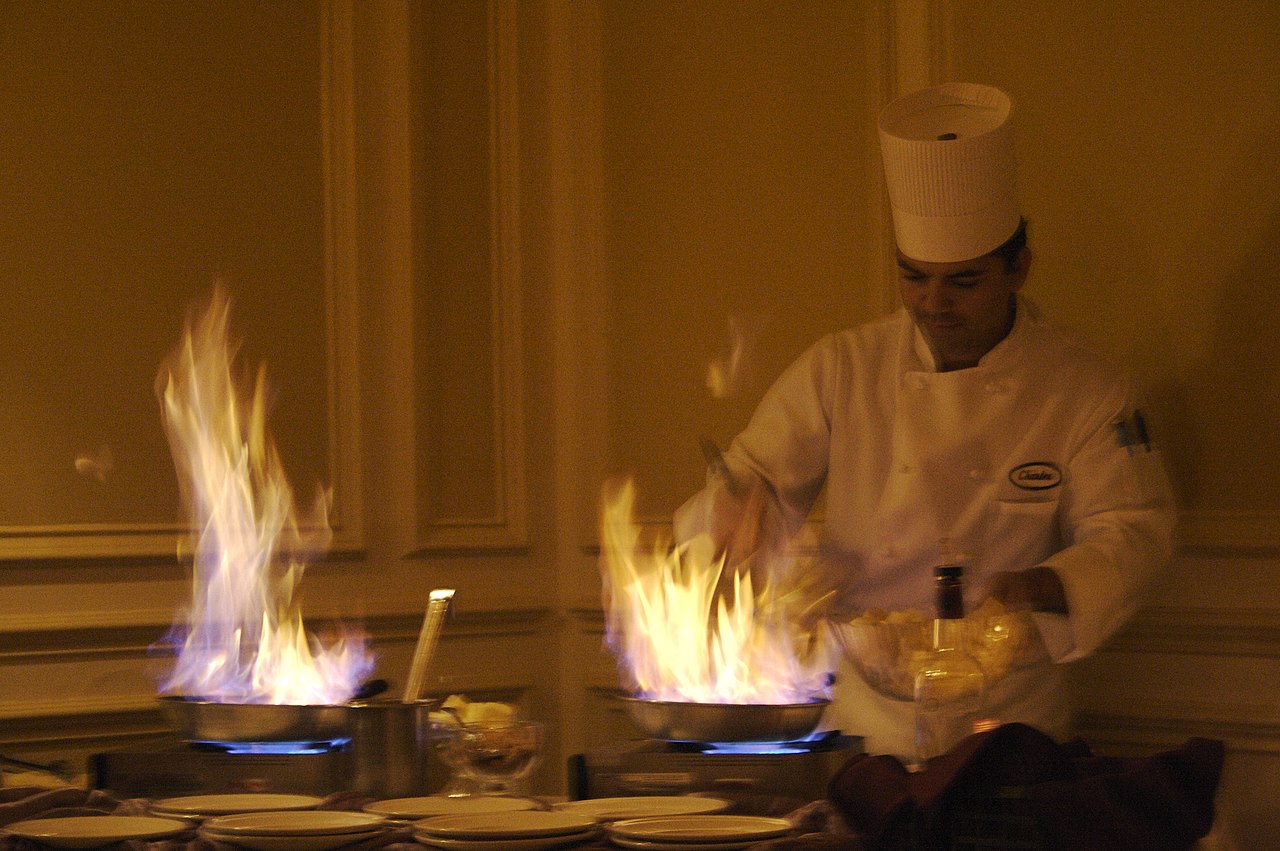
Crepes Suzette is the rare dessert whose most famous gesture is also its biggest risk. The flame can easily become a cheap thrill: a blue flare, a few seconds of dining-room applause, then a plate that tastes mostly of alcohol and sugar. In the right hands, though, the fire is not decoration. It is a service technique. It warms the sauce in public, concentrates attention, and gives the server one small window in which citrus, butter, liqueur, crepe texture, and theater have to align.
That is why the dish belongs in fine dining. It is made from ordinary materials: thin crepes, orange or mandarin, butter, sugar, and a liqueur such as Grand Marnier, curacao, Cointreau, cognac, or brandy.[2][3] Nothing on that list is rare enough to carry luxury by itself. The luxury is in sequencing. The crepes must be ready before the room sees them. The sauce must be hot enough to catch but not so loose that it floods the plate. The server must work close to the diner without making danger the subject. The flame should make the dessert feel inevitable, not improvised.
Monte-Carlo Societe des Bains de Mer's current legend page gives the romantic version: at the end of the nineteenth century, the Prince of Wales, later Edward VII, was dining at Cafe de Paris Monte-Carlo when a chef prepared liqueur crepes before him and the pan caught fire by accident; the prince admired the spectacle, and the dish was named for Suzette, the woman sharing his meal.[1] The story is useful, even if the exact authorship remains contested. It identifies the essential grammar: a grand room, a pan in view, accidental-looking flame, and a dessert whose name came from the social scene around it as much as from the recipe.
The more practical sources complicate the myth in the right way. CooksInfo records several origin claims, including Henri Charpentier's lifelong account, a Marivaux restaurant claim, and versions attached to Escoffier, while also noting that Escoffier's 1903 method was not the now-standard flaming sauce.[2] That matters. Crepes Suzette did not become durable because one legend is perfectly provable. It became durable because the dish sits at the meeting point of two restaurant languages: codified French technique and guest-facing performance.
The sauce is the point
The dish is often remembered as "the flaming crepe," but the sauce is the actual engine. FoodReference's compact description is blunt and helpful: sweet crepes with an orange-flavored butter sauce, flambeed with orange liqueur.[3] The crepe gives tenderness and surface area. The orange gives perfume, acid, and a slightly bitter edge from the zest. Butter gives gloss and body. Sugar gives caramel warmth. The liqueur gives volatility, aroma, and the possibility of fire.[2][3]
That balance is fragile. If the sauce is merely sweet, the dessert collapses into a breakfast pancake with a costume. If the liqueur dominates, the flame becomes a cover for harshness. If the crepe is too thick, it absorbs clumsily and loses the elegance that lets the sauce do its work. A good version should feel soaked but not sodden, theatrical but not noisy, orange-forward but not marmalade-heavy. The diner should notice warmth, citrus oil, butter, and a little bitterness before noticing the alcohol.
This is where the dish's old-fashioned reputation becomes misleading. Tableside service can look nostalgic, but Crepes Suzette is not nostalgic when it is executed well. It is exact. The server is managing heat transfer, aroma release, timing, and audience focus at once. The pan is not a prop. It is the place where the dessert reaches its final state.
Escoffier without the flame
The strongest clue that the flame is not the whole dish is that the Escoffier method described by CooksInfo uses a different construction. In that account, the batter is flavored with curacao and mandarin juice; a beurre Suzette is made from butter, sugar, mandarin juice, mandarin zest, and curacao; the hot crepes are spread with the butter, folded, and served hot, with no separate sauce and no flambe.[2] Larousse Cocina's dictionary entry points in the same direction: traditionally, the filling and sauce were perfumed with mandarin, while today's versions often use orange; in Escoffier's recipe, mandarin and curacao appear in the batter and in the butter-sugar mixture.[4]
Read together, those versions make the dish more interesting. Crepes Suzette is not one fixed special effect. It is a family of solutions to the same problem: how do you make a thin pancake carry luxury without overloading it? Escoffier's route answers with perfumed butter and heat. The modern restaurant route answers with a visible sauce and flame.[2][3][4] Both depend on restraint. Both fail if sweetness, alcohol, or spectacle takes over.
Editions Larousse's contemporary recipe page is also useful because it removes the pyrotechnics and leaves the citrus-butter frame exposed: cooked crepes are folded and served with orange syrup made from sugar, orange juice, orange zest, and butter.[5] That helps explain why the non-flaming version should not be treated as a lesser ancestor. The flame is memorable, but the discipline underneath is older: simplify the plate, clean the sauce, make the gesture legible, and let service finish the experience without drowning the food.
Why the room matters
Crepes Suzette is a dining-room dessert because the room changes its meaning. If the same sauce is poured in a kitchen and the plate arrives finished, the result can still be delicious. But the classic version asks the guest to see transformation happen. The server bends over the pan, alcohol is added, the flame rises, and the table briefly becomes the stage on which the dessert is completed.
That visible completion is not only showmanship. It changes appetite. The guest smells orange and hot butter before eating. The flame marks a pause between main meal and sweet course. The server's control reassures the table that pleasure and risk can coexist without chaos. Fine dining has always used such moments: carving, saucing, pouring, pressing, flambing. Crepes Suzette survives because it compresses that whole service tradition into a small dessert.
The Cafe de Paris setting strengthens the point. Monte-Carlo SBM's history page presents the cafe as an aristocratic 1900s brasserie where visitors came for hot chocolate, Crepes Suzette, Munich beer, and public glamour, and where the room became a social stage in the heart of the principality.[7] In that context, the dish's form makes sense. It is not merely French pastry. It is Riviera hospitality: a little danger, a little citrus brightness, a visible server, and the pleasure of being watched while being served.
The danger of empty fire
The modern risk is that Crepes Suzette gets reduced to the flame. That is understandable. Fire photographs well. It is the part guests remember first. But it is not the part they eat. The edible memory is sauce texture, crepe softness, citrus lift, and the way warmth lingers after the blue light has disappeared.
This is why the dish is a useful test for contemporary fine dining. Many restaurants now want interactive moments: smoke under a cloche, broth poured into a bowl, a sauce finished at the table, a final garnish shaved by hand. Crepes Suzette shows the older, stricter version of that impulse. The interaction must improve the dessert. If the performance does not make the sauce hotter, more aromatic, more integrated, or more emotionally precise, it is only noise.
That standard also explains why the dish remains hard to modernize. Add too many components and the crepe disappears. Make the flame too large and the server becomes the point. Remove the flame entirely and the dish can still work, but then the beurre Suzette must be clean enough to carry the name without help from theater.[2] The best versions understand that the flame is a servant. It is there to complete the sauce and focus the table, then get out of the way.
Crepes Suzette became a classic because it found a rare balance between fragility and confidence. A crepe is delicate. A flame is blunt. Orange butter is generous. Liqueur can be crude. Service has to turn those contradictions into one controlled sentence. When it works, the result is not merely a dessert that catches fire. It is a dessert that makes fire behave like hospitality.
Sources
- Monte-Carlo Societe des Bains de Mer, "La Crepe Suzette" - official resort page covering the Monaco legend, Prince of Wales framing, accidental flame story, and naming story.
- CooksInfo, "Crepes Suzette" - composition notes, restaurant chafing-dish service, alternative Escoffier method, and disputed origin claims.
- FoodReference, "Crepes Suzette: History and Origins" - Charpentier/Prince of Wales version, disputed origin variants, orange-butter sauce description, and flaming service method.
- Larousse Cocina, "Crepes Suzette" - Spanish Larousse gastronomic dictionary entry covering the mandarin-to-orange shift and Escoffier's mandarin-curacao method.
- Editions Larousse, "Crepes Suzette" - current Larousse recipe page showing a non-flaming orange syrup version with sugar, orange juice, zest, butter, and folded crepes.
- Wikimedia Commons, "File:The chef prepares the Crepe Suzette.jpg" - real 2006 photograph by Ewen Roberts used as the article image.
- Monte-Carlo Societe des Bains de Mer, "The history of the Cafe de Paris Monte-Carlo" - official resort history covering the brasserie's 1868 opening, 1900s clientele, and Crepes Suzette as part of its public dining identity.