Le Taillevent is easy to admire for the obvious reason: a grand Paris dining room with a famous cellar. That description is true and still too blunt. The better reason to care is that Taillevent has learned how to make wine behave like structure rather than ornament. The cellar is not a trophy room attached to dinner. It is one of the ways the house organizes time.
The official cellar page gives the first hard anchor: since its 1946 creation, Le Taillevent has housed one of the world's largest restaurant cellars, with more than 30,000 bottles underground.[3] The home page adds the service-facing version of the same fact: the restaurant offers more than 3,800 wines and spirits, and frames food-and-wine pairing as a subtle, modern part of the experience rather than a side sale.[1] Those numbers matter, but only after you understand the house habit behind them. Taillevent's story is not "big list, expensive bottles." It is "old list, edited bottles, served in a room where ceremony is supposed to reveal pleasure rather than smother it."[1][3][5]
That is why this is best read as a beverage-pairing feature, not a restaurant profile. Taillevent's most interesting current luxury signal is liquid sequencing: how the sommelier can move from famous labels to quieter vintages, from Burgundy memory to Bordeaux depth, from current cooking to older bottles that have waited longer than many restaurants survive. In a period when tasting menus often chase novelty through ingredients, Taillevent's sharper move is to make classicism feel alive by pouring time in the right order.
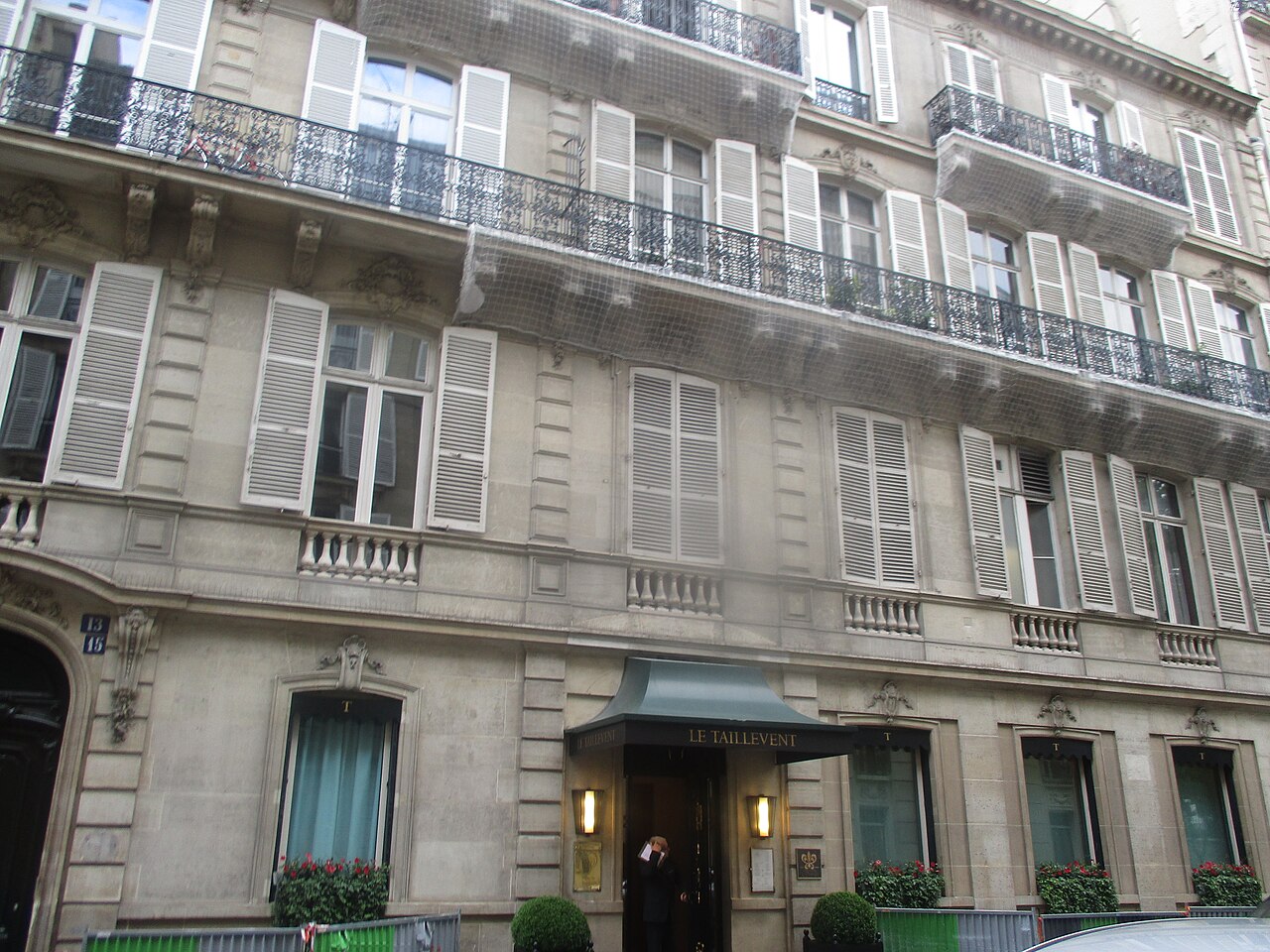
Image context: the cover uses a real street photograph rather than a bottle close-up because Taillevent's wine argument begins with house identity. The facade is restrained, almost private, which suits a restaurant whose drama is less about spectacle than about what the room can release from the cellar at the right moment.[7]
The cellar is historical, but not nostalgic
Taillevent's wine identity begins with a small act of resistance. The official history says founder Andre Vrinat broke from Paris's Bordeaux-heavy dining-room norm by giving other terroirs, especially Burgundy, serious space on the list.[2] The cellar page sharpens the point: from the beginning of the 1950s, Burgundy was pushed forward at a time when the region was still struggling to develop, and wines arrived in 228-liter Burgundy barrels before being bottled in Taillevent's own cellars.[3]
That detail makes the present list feel different. A restaurant can buy prestige after prestige is obvious. Taillevent's claim is that it built relationships and bottle memory before the current fine-wine market made those bottles nearly mythic. The same cellar page points to rare allocations from estates such as Raveneau, Rousseau, and Leflaive, an 1890 Chateau Ducru-Beaucaillou, and a horizontal of the 1918 vintage from the 1855 first growths.[3] These are not just flexes. They tell you what the restaurant is designed to do: hold wines until maturity can become service.
The distinction matters at the table. A great bottle list can intimidate a guest into deference. A great pairing program does the opposite. It translates the cellar's depth into choices the meal can actually use. En Primeur Club's current Taillevent profile reaches the same operational reading from outside the house: it identifies the restaurant as a classical French address where the wine program is a primary event, with 3,800 selections across Burgundy, Bordeaux, Rhone, Champagne, Loire, Alsace, Italian wines, and Port.[5] In other words, the cellar's value is not only what can be sold by the bottle. It is how much range the room can deploy without turning every dinner into a single-label performance.
French service is the delivery mechanism
Taillevent's home page describes French service as a ceremony made more wonderful than intimidating, and that phrasing matters because it identifies service as part of the product, not as decorative manners around the product.[1] Les Grandes Tables du Monde calls the restaurant a temple of "gesture" and says dishes are paired with 3,800 wine references, from famous labels to more confidential ones.[6] The chef page gives the clearest practical sequence: the process begins in the kitchen and continues in the dining room through cutting, flambeing, seasoning, and candlelit wine decanters.[4]
That sentence is the key to Taillevent's beverage logic. Wine is not only selected; it is staged. Decanting by candlelight can look antique if the restaurant has nothing else to say. Here it has a job. It slows the room down enough for older bottles, sauce, roast, shellfish, game, and conversation to meet at the same tempo.[4] The gesture is useful because the wine program depends on timing. A mature Burgundy, an old Bordeaux, a serious Champagne, or a quiet Loire bottle will not show properly if dinner is paced like a product demo.
This is also where Taillevent differs from a modern wine bar with a great list. A wine bar can lead with the glass. Taillevent has to make the glass answer to a fuller grammar: napery, carving, sauce, temperature, table rhythm, and the chef's current idea of French tradition. The danger in that format is stiffness. The opportunity is that the bottle can become part of a composed evening rather than a separate enthusiasm sitting beside dinner.
Sperandio's cooking gives the list a present tense
A cellar this strong can become a trap if the kitchen starts behaving like a museum kitchen. Taillevent's current public language is careful about that problem. The chef page says Giuliano Sperandio has been writing the restaurant's history since 2021, while keeping the house's triptych intact: sensitive and generous cuisine, French-style service, and a unique cellar.[4] The same page describes his cooking as in service of the past but turned toward the future, clear and free, with refined products such as scallops, venison, lobster, and sweetbreads treated through a contemporary expression.[4]
That matters for pairing because old-cellar restaurants need new tension. If the food only reenacts the past, the wine becomes memorabilia. If the food ignores the past, the cellar becomes a disconnected archive. Taillevent's current challenge is to keep the two in conversation. The home page's description of cuisine, service, and cellar as the base of the house is useful precisely because it refuses to separate those departments.[1]
The best Taillevent pairing, then, should not feel like a parade of famous bottles. It should feel like a sequence of calibrations. A white Burgundy might not be there only because Burgundy is central to the house story; it might be there because a sauce needs breadth without sweetness. A mature red might not be there only because age impresses; it might be there because venison or sweetbreads need softened tannin and savory development rather than young force. A Champagne or confidential grower bottle might not be there to reset the guest's palate generically; it might be there to bring lift back into a room where tradition could otherwise get heavy.[1][4][5]
The useful way to book Taillevent
For a diner, the practical lesson is simple: do not treat Taillevent's wine program as an upgrade you decide on after choosing food. Treat it as the main way the restaurant explains itself. The address, 15 rue Lamennais, and the Tuesday-to-Friday lunch rhythm listed on the home page already signal a house with a formal weekday cadence rather than a high-volume destination built around weekend spectacle.[1] The wine program fits that cadence. It rewards attention, conversation, and trust in the dining room.
That does not mean every table needs a grand bottle. The more useful move is to ask the team to build a progression that shows the house's Burgundy center, one older or more mature register if the menu allows, and one less obvious bottle that proves the list is not trapped by famous names alone.[3][5] For many diners, that request will reveal more about Taillevent than simply chasing the most famous vintage available that night.
The wrong approach is to arrive with only trophy anxiety: the need to order the most famous vintage, photograph the label, and let the bottle dominate the meal. Taillevent's strongest promise is quieter. It has enough cellar depth to make restraint interesting. It has enough service culture to make old gestures functional. It has a chef whose current brief is explicitly to carry memory forward rather than polish it behind glass.[1][3][4]
That is why Taillevent still belongs in a 2026 fine-dining conversation. Its relevance is not that classical Paris survived unchanged. Its relevance is that a classical Paris house can still use wine to solve a contemporary problem: how to make heritage feel active. At Taillevent, the answer is not more decoration. It is sequence. Cellar becomes timing, service becomes translation, and the meal becomes a controlled release of bottles, gestures, and memory.[2][3][5][6]
Sources
- Le Taillevent official home page, covering French service, Giuliano Sperandio's current house framing, more than 3,800 wines and spirits, opening hours, and the rue Lamennais address.
- Le Taillevent, "Our Story," covering Andre Vrinat's 1946 founding role and the house's early break from Bordeaux dominance toward Burgundy and other terroirs.
- Le Taillevent, "The Cellar," covering more than 30,000 bottles, early Burgundy barrel bottling, rare allocations, the 1890 Ducru-Beaucaillou, and the 1918 first-growth horizontal.
- Le Taillevent, "The Chef," covering Giuliano Sperandio's 2021 arrival, the cuisine-service-cellar triptych, refined-product cooking, and dining-room gestures such as cutting, flambeing, seasoning, and candlelit decanting.
- En Primeur Club, "Le Taillevent, Paris," last reviewed 2026-05-27, covering the restaurant's classical French positioning, Giuliano Sperandio, the 3,800-selection wine program, cellar depth, wine-team framing, and weekday service cadence.
- Les Grandes Tables du Monde, "Le Taillevent," covering the restaurant as an icon of French gastronomy, Sperandio's memory-forward modernity, and the pairing of dishes with 3,800 wine references.
- Wikimedia Commons, "File:Taillevent rue Lamennais.jpg" - real photographic source page for the cover image, showing Le Taillevent's rue Lamennais facade in Paris.