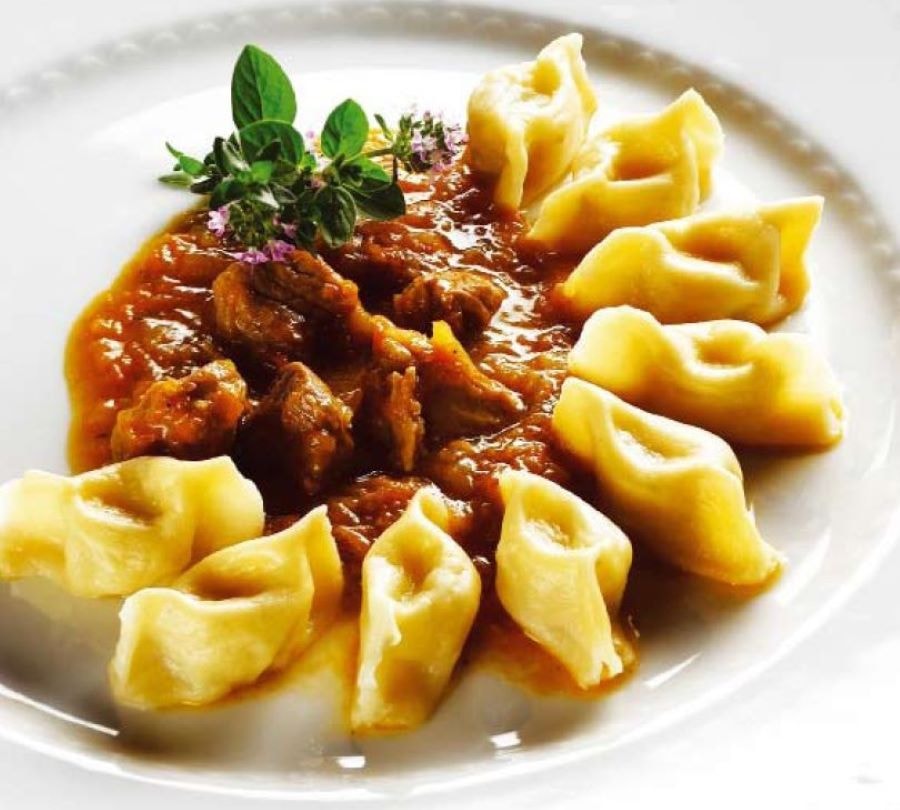
The final touch is a dent. After the dough has been folded around a small ball of filling and pinched at the sides, the cook presses a hollow into its crown. Two little ears stand out; a hat appears. This is how Idrija žlikrofi acquire the silhouette that makes them recognizable before a fork has revealed the potato inside.[1]
There is something pleasingly disproportionate about that care. Each mouthful of potato, onion, fat and herbs must be filled, closed and shaped before disappearing almost immediately. Ordinary ingredients receive extraordinary attention.
The potato belongs in the middle
In the presidency cookbook's recipe, boiled potatoes are peeled and mashed while warm, then combined with fried onion, pork fat or smoked bacon, chives and marjoram. The mixture is rolled into balls about the size of hazelnuts. A separate flour-and-egg dough supplies the wrapper.[2]
That separation matters on the plate: the potato is a soft, seasoned interior held inside pasta. Onion, herbs and fat belong to the filling. Here, a potato dumpling is not necessarily made from potato dough.[1]
The local žlikrofi festival's account treats that filling as a constant. Its ingredient list includes potatoes, onion, pork fat, marjoram and chives; the freedom to invent is directed chiefly toward what accompanies the parcel.[3] For a chef, that is an attractive constraint. Recognition can survive a new preparation because the diner still meets something familiar at its center.
A hat made to go through boiling water
The 2021 Slovenian Presidency Recipe Book gives the parcel a modest scale: about three centimeters long and two high. The sealed, indented dumplings cook in salted boiling water until they rise, then go straight to the table.[2]
Read as a sequence, the shape is less mysterious than it looks. Closing precedes decorating: a beautiful hollow would be little use if the filling escaped into the pot.[1]
It is tempting to turn such a distinctive shape into a tidy origin story. The festival organizers explicitly say its precise origin is unknown.[3] The hat can remain a hat without being evidence that a particular traveler, soldier or cook invented it.
Let the sauce change the conversation
The traditional partner is bakalca, a mutton sauce. The festival's description makes the division of labor explicit: the ingredients of the dumpling remain consistent while the sauce can give the plate a different flavor.[3]
The presidency cookbook offers a particularly substantial example. Its bakalca uses mutton or rabbit with onion, carrot and garlic, then bay, thyme, pepper and cloves. Wine or vinegar contributes acidity; the meat simmers until tender. This is a ragout with pieces to eat, not merely a spoonful of gravy for shine.[2]
Consider the contrast it sets up. A smooth potato center and its thin wrapper meet meat, vegetables and a sharper liquid seasoning. The dumpling brings a repeatable bite; the sauce interrupts the repetition. That is the appeal of serving several small parcels together: each offers another encounter with the same filling, in a slightly different balance with what surrounds it.
The town comes with the parcel
Idrija sits in western Slovenia, in a landscape marked by mercury mining. UNESCO's account of its geopark places žlikrofi within that local heritage, traces the recipe to the mid-nineteenth century, and acknowledges the limits of the historical record. It also describes a remarkably flexible dish: an appetizer, a companion to meat, or a meal in its own right, sometimes dressed with browned breadcrumbs.[4]
Those different roles matter. A few dumplings in a restaurant course and a generous household serving can belong to the same tradition. Portion size changes the occasion without requiring the filling to change its identity. The dish has room to travel between kinds of table.
At Kendov Dvorec in Spodnja Idrija, that journey reaches a restaurant that names both žlikrofi and bakalca among its specialties. The kitchen describes its cooking as a contemporary treatment of local recipes and identifies nearby Ledine as a source of potatoes and other vegetables. Its published offer includes five-course menus as well as individual dishes, with menus changing daily.[5]
That is evidence of a dining approach, rather than a promise that one particular sauce will appear tonight. It also suggests a useful way to judge the dish in a formal setting: pay attention to the dumpling before admiring what has been arranged around it. Does the parcel keep its shape? Can the filling still speak through its accompaniment? Has the small handmade object remained the reason for the plate?
Žlikrofi offer fine dining a luxury that is easy to overlook: work repeated on something inexpensive. The potato does not need to disappear from the story when the table gets dressed. It already has its own little hat.
Sources
- Vesna Žarkovič, “Idrijski žlikrofi,” Slovenia.si, October 28, 2019 — filling, shaping method and photograph credited to Tomo Jeseničnik.
- Government Communication Office of the Republic of Slovenia, The Slovenian Presidency Recipe Book (2021), p. 39 — Nikolina Rop's recipe for žlikrofi and bakalca; food prepared by chef Uroš Štefelin.
- Idrija Žlikrofi Festival, “Idrija žlikrofi” — traditional ingredients, uncertain origins of the shape and the scope for varying sauces.
- UNESCO, “Idrija UNESCO Global Geopark” — regional setting, mining heritage, historical limits and ways of serving žlikrofi.
- Kendov Dvorec, “Kendov Dvorec's Cuisine” — local specialties, ingredient sourcing and the restaurant's changing menu format; consulted September 22, 2026.