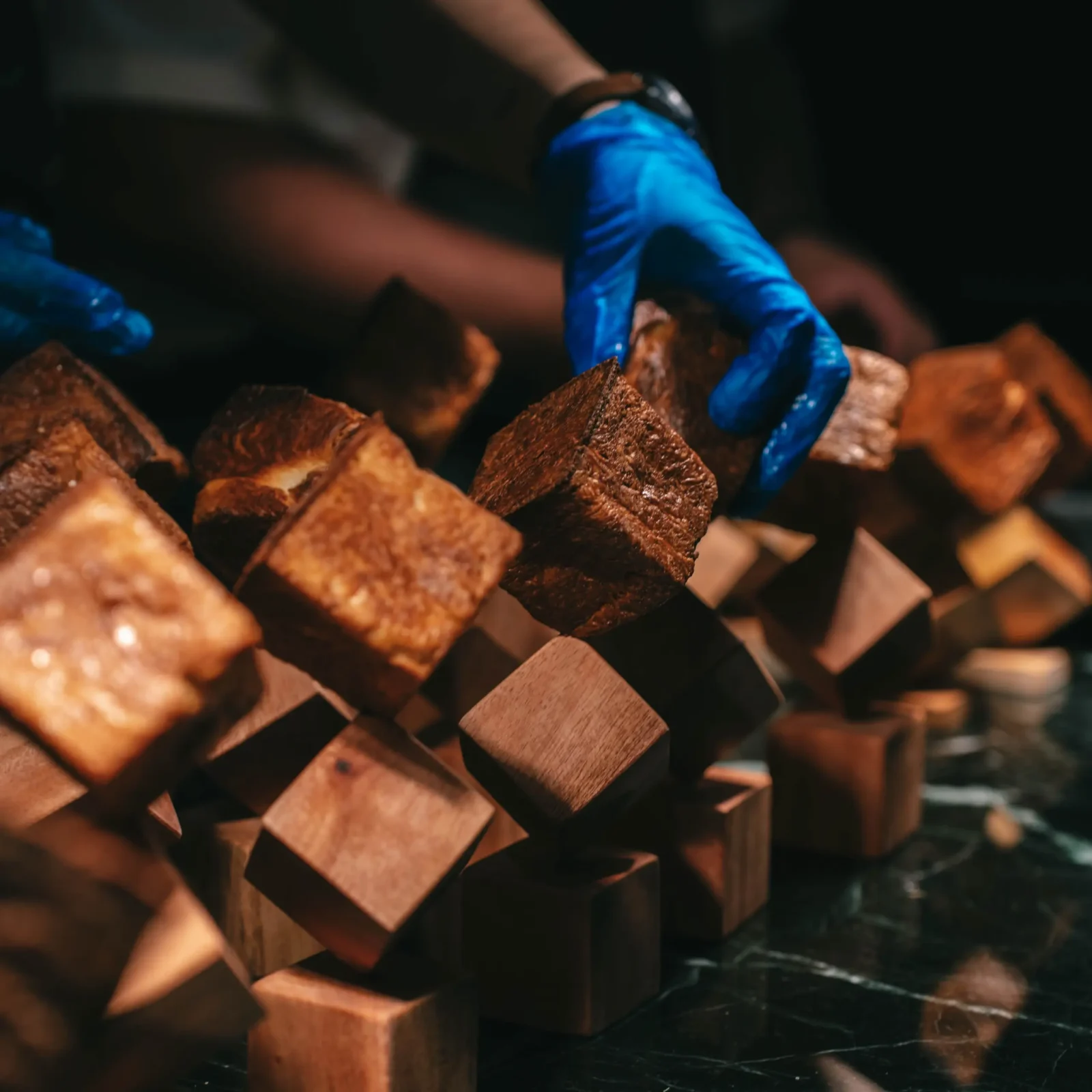
The course that best explains Tadhana Makati looks like a small piece of impossible carpentry. A laminated block of tinigib cornbread stands on a geometric wooden pedestal; underneath wait tinapa mousse and dalandan-sherry marmalade. The form belongs to the precise, photogenic language of a tasting menu. The flavor memory belongs to corn, smoked fish and citrus. Early accounts agree that the bread is one of chef Frances Tariga's clearest successes: Delish praises the marmalade's acid against the pastry's butter, while Vogue reports that the soft-opening table converged on it as a favorite.[2][3]
That agreement is more useful than the easy headline about a Filipino chef coming home. Tariga was raised in Sampaloc, built a career through Dubai and New York, opened the first Tadhana on Manhattan's Lower East Side, then returned the restaurant to Manila in May 2026.[3][4] The Makati menu does not pretend that those years abroad can—or should—be packed away at customs. It calls itself Filipino while leaving the passport open.
This is a synthesis of early coverage, not a claim to have eaten at Tadhana. The evidence runs from soft-opening reports in May to a July meal account, alongside the restaurant's own menu and a candid chef interview.[1][2][3][4][5] It is strong enough to identify the kitchen's idea and the dishes that first impressed writers. It is not mature enough to establish long-term consistency, service rhythm or value across repeat visits. The honest verdict is therefore provisional. My reading of that early record is that Tadhana's homecoming already has a persuasive flavor grammar—and that acid is a recurring editing tool, not merely a garnish.
Home is not the same thing as local
The menu begins with names that need no passport stamp in Makati: Binatog, Kwek Kwek, Kilaw, Sinuglaw, Ginat-an, Tinapay, Sinigang sa Bayabas, Tocilog, Inihaw at Gulay, Maja Blanca and Turon. Recognition arrives before explanation. The official opening menu then fills in a much wider map: truffle and Comté, miso honey, sawara, olives, Wagyu, Kaluga caviar, sherry, furikake, Iberico pork, banana mole and feta.[1]
It would be easy to treat that pantry as a contradiction—to ask how a homecoming can lean on imported luxury products and techniques. The early reporting suggests a better reading. Tadhana is not a terroir restaurant making a purity claim. It is an autobiographical restaurant. Tariga describes the menu as the record of a Manila childhood filtered through kitchens in the United Arab Emirates and the United States.[4][5] One opening pair makes the point almost too neatly: Kwek Kwek remembers the orange-dusted street snack, while the accompanying Ensalada turns toward Dubai with lavash, baba ganoush and mulberry.[1][2]
The difference matters. "Local" asks where an ingredient was grown. "Home" can also ask where a cook learned to desire it. Tariga's Makati food becomes most legible when it does not conceal that distinction. Delish describes this branch as more personal and less inclined to soften Filipino flavor for an unfamiliar audience; Vogue says the menu is driven by memory more than by a single method.[2][3] Neither account portrays a chef reversing her travels. They show her arranging them around Filipino dish names.
Acid edits the autobiography
Biography can make a menu meaningful, but it cannot make a rich course feel light. Read across the early plate-level praise, sourness emerges as a practical device even though none of the sources declares it an official house doctrine.
The Tinapay has dalandan marmalade to cut laminated dough and smoked-fish mousse. Sinigang sa Bayabas builds its sourness from guava and batuan around maya-maya: the official card lists whipped gabi, while Delish emphasizes a light, foamy broth and acidity that opens gradually enough to preserve the fish's delicacy.[1][2] Kilaw gathers suha, kamias and olives around sawara. A kamias granita clears the way before the final savory course. Inihaw at Gulay puts pickled pakbet vegetables beside fatty Iberico secreto, banana mole and char.[1]
These are not repetitions of one fashionable citrus note. Each acid has a different job. Dalandan rescues butter from heaviness. Guava and batuan make a composed fish course read immediately as sinigang. Pickled vegetables give the Iberico a reason to be more than an expensive cut. Kamias works as an explicit pause. Delish singles out both the sinigang and the pork course for balance; PhilSTAR Life also treats the Inihaw at Gulay as the menu's strongest statement of intent.[2][5]
In this article's reading, that through-line is the most convincing response to the tired verb elevate. Tadhana does not improve everyday Filipino food merely by adding caviar, Wagyu or Iberico. Its sharper move is structural: familiar sourness controls the richer textures and imported products that fine dining brings to the table. The pantry may travel, but the meal's internal logic still speaks in dalandan, batuan, kamias and pakbet.
The bread refuses a false choice
Tinapay deserves its early consensus because it holds several apparent opposites without turning into a lecture. Tinigib, a white corn associated with the Visayas, enters a laminated dough. Tinapa becomes a mousse. Dalandan meets sherry in a marmalade. The restaurant presents the bread with enough geometry to stop a camera. Delish describes flaky layers, butter and bright marmalade; Vogue reports that the soft-opening table loved the course and notes the tinapa mousse served with it.[2][3]
Nothing here is untouched tradition. Nothing needs to be. The course does not ask whether laminated pastry is authentically Filipino; it asks whether that technique can make corn, smoked fish and local citrus more vivid together. According to the strongest overlapping evidence in the opening coverage, it can.
That is a more generous model of modern Filipino cooking than replacing a familiar dish with a luxury ingredient and calling the exchange progress. Tariga lets the humble reference remain audible. The fine-dining craft changes texture and sequence, not the ownership of the memory.
Luxury should remain supporting cast
The risk is visible on the same menu. A diner encounters truffle-Comté espuma, Wagyu, caviar, sawara and Iberico before the sweets arrive.[1] Any one of those ingredients can contribute flavor. In accumulation, they can also start performing the old, dull work of luxury signaling: reassuring the room that a tasting menu deserves its status because expensive nouns appear in print.
The early reviews are most persuasive when they describe those products as subordinate. In Ginat-an, PhilSTAR Life finds the blue crab, coconut custard, seafood velouté, squash and caviar creamy and comforting—the caviar is part of the sentence, not its subject.[5] Delish reads the Iberico through its relationship with pickled vegetables, not through pedigree alone.[2] Vogue's table favorite is bread.[3]
That pattern does not prove every course succeeds. The present coverage is heavily affirmative, much of it produced around opening, and several stories mix tasting notes with Tariga's own account of the concept. Rolling Stone Philippines provides unusually frank context on the cost, staffing and emotional labor behind the restaurant, but it is a chef interview rather than an anonymous review.[4] There is not yet enough independent, repeat-visit criticism to judge whether every luxury flourish earns its place.
Still, the hierarchy is promising. When a corn bread, a guava soup and pickled pakbet carry more critical weight than the caviar, the menu's values are pointing in the right direction.
Ten courses need more than a story
The official card compresses numerous preparations into a ten-course framework: opening bites arrive in pairs, Tinapay sits inside the savory run, and a sweet selection gathers mango, maja blanca, turon and pili at the end.[1][3] Even before portion size enters the calculation, that is a dense arc. Coconut custard, Wagyu, laminated bread, whipped gabi, squab, Iberico and several composed sweets can make a personal story feel physically over-written.
On paper, acid appears to be doing operational work. Kilaw refreshes; sinigang turns sourness into the center of a substantial course; kamias announces a reset; pickled pakbet lifts the last meat. That is an inference from the published sequence and tasting notes, but a plausible one: appetite must be edited as carefully as autobiography.[1][2]
Whether the dining room delivers that pacing every night remains outside the current evidence. The restaurant advertises two evening seatings, at 6:00 and 8:30, Wednesday through Sunday.[1] That schedule gives each table a real clock and makes choreography part of the product. The available sources say much more about individual plates than about handoffs, beverage timing or how the second seating feels. A future review should test those things rather than simply retell Tariga's career.
The early verdict
Tadhana Makati's first critical portrait is unusually coherent. Writers respond to the Tinapay, the controlled sourness of Sinigang sa Bayabas and the balance of Inihaw at Gulay. They also accept Tariga's premise that a Filipino tasting menu can contain Dubai, New York, contemporary technique and European luxury products without becoming less Filipino.[2][3][5]
The useful caveat is that this coherence may partly reflect the narrow opening window. Promotional material, soft-opening access and chef interviews are good evidence for intention, not for durability. There is still too little reporting on repeatability, service and the bill to call the restaurant a finished success.[1][2][3][4][5]
What can be said now is more specific and more interesting. Tadhana does not come home by erasing the route that brought Tariga back. It comes home by letting Filipino flavors organize everything she collected on the way. When dalandan cuts butter, batuan steadies fish and pickled pakbet disciplines Iberico, the passport remains open—but the destination is unmistakable.
Sources
- Tadhana MNL, official restaurant page and opening menu (accessed August 21, 2026) — current menu structure, ingredients, Makati location, service hours and reservations.
- Delish Philippines, Paolo Elwick, "Tadhana Makati: Chef Frances Tariga's New Filipino Fine Dining Restaurant" (May 13, 2026) — opening-menu tasting notes, chef context and Kim Angela Santos's photograph of Tinapay.
- Vogue Philippines, Audrey Carpio, "Chef Frances Tariga Is Bringing Tadhana Home" (May 13, 2026) — soft-opening report, career history and early response to the ten-course menu.
- Rolling Stone Philippines, Mel Wang, "Tadhana's Chef Frances Tariga Doesn't Want Fine Dining to Just Be Fine" (June 15, 2026) — extended interview on the autobiographical menu, restaurant economics, staffing and Tariga's return to Manila.
- PhilSTAR Life, Brooke Villanueva, "At Tadhana, you get to rediscover Filipino food and leave with a little more pride" (updated July 12, 2026) — later meal account and chef comments on Pa-Kwan, Ginat-an and Inihaw at Gulay.