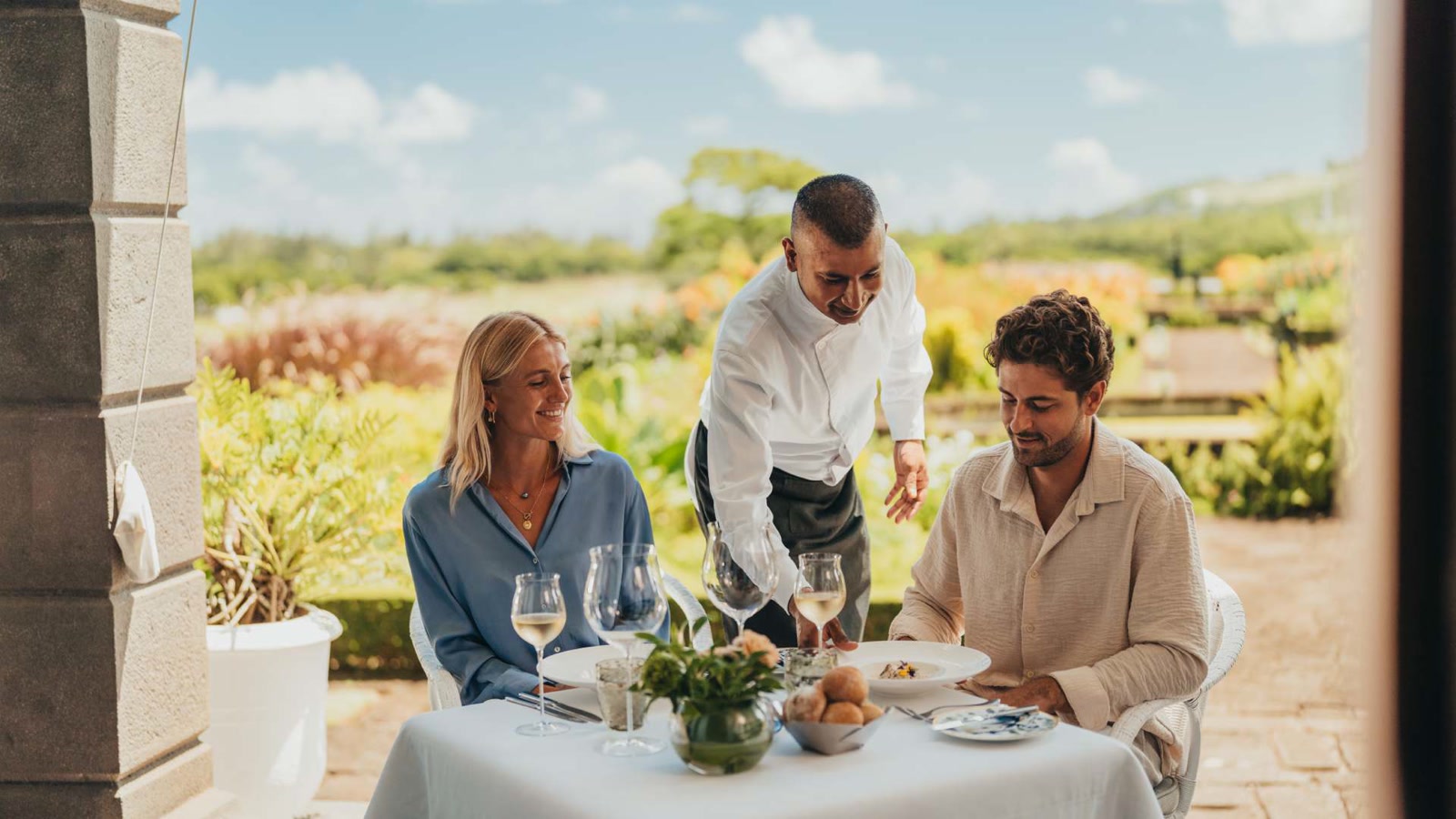
At noon, Le Château de Bel Ombre has less help from candlelight. The verandah, old trees, pale table linen and long garden views have to look convincing in full sun. So does the food. That exposure is exactly why the Rs 2,950 Discovery Lunch is the smartest first reservation at this Mauritian estate: it preserves the house, service and three-course idea while removing most of the financial pressure to turn dinner into a once-in-a-lifetime verdict.[1][2]
This is not a claim to have eaten there. It is a value analysis built from the restaurant's live menus, its current experience pages, a recent Mauritian profile and the estate's own history. Menus change, and execution cannot be priced from a PDF. What the documents can show is unusually useful: the lunch sits below even the cheapest possible three-course combination on the current à la carte card, includes 15 percent VAT, and costs far less than the five-course evening experience.[1][3][4] The trade is choice. Drinks are extra, the starter and dessert are fixed, and the middle course offers only sea bream or venison.[1]
That is a good bargain only if the constraint feels like editing rather than deprivation. Here, on paper, it does.
Rs 2,950 buys the whole room
The current à la carte lunch menu starts at Rs 1,150 for citrus quinoa, Rs 1,250 for pumpkin ravioli and Rs 850 for dessert. Assemble those least-expensive choices and three courses reach Rs 3,250. A more comparable seafood path—roasted prawns at Rs 1,450, grilled local snapper at Rs 1,850 and dessert at Rs 850—lands at Rs 4,150.[3]
The Discovery Lunch is therefore Rs 300 below the à la carte floor and Rs 1,200 below that seafood sequence. In percentage terms, the useful comparison is a range rather than one magic discount: roughly 9 percent below the cheapest three-course order and 29 percent below the prawn-snapper-dessert path. All of those listed prices include VAT; the set menu explicitly excludes beverages.[1][3]
The arithmetic matters because the setting does not shrink with the bill. The restaurant describes the same 19th-century manor, gardens and attentive service around both its à la carte and Discovery formats.[2] You are not being diverted to a bar counter or compressed pre-theatre room. Daylight may actually make more of the physical product available: trees, garden, verandah and architecture remain visible rather than dissolving beyond the table.
This is not cheap lunch disguised as luxury. Rs 2,950 is still a deliberate spend. Its value comes from buying the restaurant's expensive fixed assets—the historic house, grounds, table service and composed cooking—without paying for maximum menu breadth. That is a more meaningful form of access than simply counting courses.
The menu has one clean line through it
The live set menu begins with half-cooked prawn, garden herbs, avocado loosened with coconut milk, passion-fruit vinaigrette and lime sorbet. The main forks: delicately pearled sea bream with tomato, basil and Romanesco emulsion, or confit venison-shank parmentier with cumin-scented carrot, glazed carrots and red-berry sauce. Pineapple closes the meal as carpaccio with tamarind syrup, caramelized roast fruit and sorbet.[1]
There is a pleasing editorial economy to that sequence. The prawn course establishes richness, tropical acidity and cold refreshment in one plate. Sea bream keeps the route maritime and bright; venison turns inland and darker without abandoning fruit or spice. Pineapple then repeats the menu's acid-sweet register while changing temperature and texture. No course needs an imported prestige noun to justify the room.
The menu also avoids pretending that “Mauritian” means one untouched recipe. Coconut, passion fruit, lime, tamarind, venison and pineapple make the island legible, but French fine-dining verbs—half-cooked, confit, parmentier, mousseline, emulsion—remain visible. The value proposition is not authenticity theatre. It is translation with a short enough sequence that a diner can still taste the sentence.
That sentence has changed before. A December 2025 Mauritian profile described an earlier Rs 2,950 lunch built around dorade roulade, lagoon fish or poultry rougaille boucané, and a different pineapple construction. It also recorded chef Ram Appadoo's effort to use fish heads, bones and remaining flesh across broth and ravioli.[5] The current official PDF lists a new prawn opening and sea-bream-or-venison choice.[1] That difference is a feature, not a discrepancy to smooth away: the price has held while the menu has moved. For anyone booking now, the live restaurant document—not an older feature—is the operative card.
Fixed means fixed
The strongest reason not to choose the Discovery Lunch is also printed clearly on it. There is no vegetarian starter or main. Shellfish opens the sequence; fish or venison follows.[1] By contrast, the à la carte menu offers citrus quinoa, pumpkin ravioli and several desserts, and therefore gives a vegetarian diner an actual route through lunch.[3]
Choice matters for omnivores too. À la carte lets one person stop after a starter and main, spend on Angus beef, or build a deliberately vegetable-led meal. The set menu saves money by asking the kitchen and dining room to execute one narrow path. If you fight that path with substitutions, its value can evaporate in both experience and price.
The sensible booking question is therefore not “Which menu is best?” It is “Do these three courses already sound like my lunch?” If prawn, sea bream or venison, and pineapple form an appealing arc, take the fixed menu. If a dietary need or one coveted à la carte dish is driving the visit, pay for control. A discount on the wrong meal is not value.
Dinner sells expansion and darkness
The current dinner card prices its five-course tasting menu at Rs 7,900, VAT included.[4] That is Rs 4,950 more than lunch, or about 2.7 times the Discovery price. It would be crude to divide each bill by its course count and declare a winner. Dinner is selling a different event: two more courses, evening atmosphere and a broader sense of procession.[4]
The à la carte dinner menu also carries a much wider luxury vocabulary: duck foie gras, crab, yellowfin tuna, reef lobster, Wagyu, wild boar and several individual desserts.[4] A diner who wants the Château to behave like a grand occasion may reasonably prefer that density. The premium buys scope and ceremony, not simply additional food.
But scope creates risk. More courses ask more of appetite, service consistency and beverage judgment. Because drinks sit outside the Rs 2,950 lunch price, a water-led or single-glass lunch keeps the cost boundary visible.[1] An evening built around wine and five courses can be richer and more memorable; it can also make the bill and the restaurant's claims harder to separate.
For a first encounter, lunch is the cleaner diagnostic. Can the kitchen make prawn, a main-course fork and pineapple feel like a coherent Mauritian expression? Does service animate the mansion rather than let the building do all the work? Does the setting still feel special when fully visible? Three courses are enough to answer those questions.
The house is not an innocent backdrop
Daylight should sharpen the historical reading too. A Heritage Resorts account traces the domain from an eighteenth-century concession into a sugar estate and states plainly that the plantation economy relied on enslaved and indentured labor.[6] The 19th-century Château arrived later, built for Hajee Jackaria Hajee Ahmed amid that long sugar-estate history.[2][6]
That past makes “heritage” more complicated than carved wood and romantic gardens. The restaurant is entitled to use the old house as part of its experience, but value cannot mean paying for amnesia. A good lunch in a plantation-derived estate should let the beauty and the labor history remain in the same field of vision.
This is another reason the current menu's ingredient language matters. A restaurant in such a house is more persuasive when Mauritian produce, spice and culinary memory lead the plate than when generic European luxury takes over. An independent expert-review digest likewise identifies the appeal as a historic setting paired with local ingredients and contemporary Franco-Mauritian treatment.[7] The Discovery Lunch's prawn, coconut, lime, sea bream or venison, tamarind and pineapple fit that obligation better than a parade of status products would.[1]
The first-booking verdict
Choose the Discovery Lunch if this is your first visit, the fixed seafood-or-venison path suits the table, and you want to read both the cooking and the estate in daylight. Its Rs 2,950 price is tax-inclusive, below the à la carte three-course floor, and bounded enough that beverages can remain a separate decision.[1][3]
Choose à la carte at lunch if dietary flexibility or control matters more than the saving. Choose the Rs 7,900 tasting dinner if the evening itself—expanded menu, changing light and ceremony—is the product you came to buy.[2][4]
The Discovery menu wins not because lunch is inherently better than dinner, and not because three courses can be reduced to a bargain ratio. It wins as a first purchase because daylight audits the luxury. The food cannot hide behind duration, the mansion cannot hide behind mood, and the diner can decide whether Le Château de Bel Ombre's most valuable course is the one on the plate or the house finally made legible around it.
Sources
- Le Château de Bel Ombre, Discovery Menu (accessed August 21, 2026) — live three-course lunch, current dishes, Rs 2,950 price, service window, VAT inclusion and beverage exclusion.
- Le Château de Bel Ombre, “Lunch at Le Château de Bel Ombre” (accessed August 21, 2026) — official description of the à la carte and Discovery formats, manor-and-garden setting, reservations and source page for the official lunch-service photograph.
- Le Château de Bel Ombre, À la carte lunch menu (accessed August 21, 2026) — current starter, main and dessert choices and VAT-inclusive prices used for the like-for-like lunch calculations.
- Le Château de Bel Ombre, À la carte dinner menu (accessed August 21, 2026) — current Rs 7,900 five-course tasting price, dinner ingredients, other experiences and VAT policy.
- Île Maurice Tourisme, “Le Château de Bel Ombre dévoile un menu signature célébrant l'âme mauricienne” (December 11, 2025) — Ram Appadoo profile, earlier Discovery-menu composition, whole-fish use and the menu's home-cooking premise.
- Heritage Resorts, “The Rich History of Domaine de Bel Ombre in Mauritius” (March 9, 2025) — estate chronology, sugar production, enslaved and indentured labor, ownership and the Château's construction context.
- Tripexpert, “Le Château de Bel Ombre” (accessed August 21, 2026) — digest of independent expert assessments emphasizing the historic plantation-house atmosphere, local ingredients and Franco-Mauritian cooking.