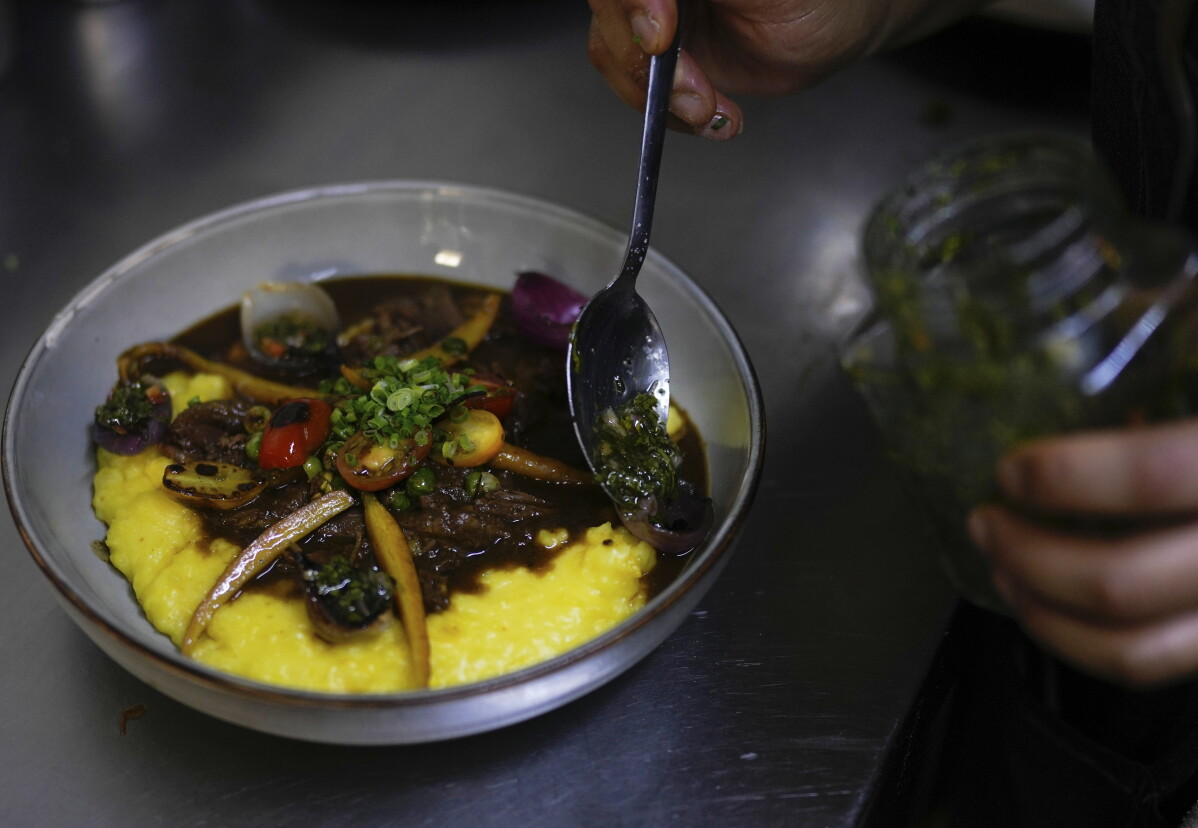
The most revealing photograph of La Rufina does not show chef-owner Dennis Llusco or an immaculate plate waiting for applause. It shows chef Carolina Chuquimia at work over beef and yuca in the restaurant's La Paz kitchen. Juan Karita made the image in March 2025 as part of an Associated Press photo essay that moved between street stalls, market dining rooms and La Rufina.[4] The cook remains inside the frame; so does the labor.
The current menu takes the same approach to its food. It puts anticucho, ispi, sopita de maní, relleno de papa, plato paceño and pique in large type, then lets restaurant technique enter underneath.[2] The familiar dish is still the headline. A seven-chilli sauce may sharpen the grilled heart, parsley chlorophyll may brighten the peanut soup and demi-glace may deepen the oxtail, but none of those gestures is allowed to evict the meal people came to recognize.
That makes La Rufina a useful answer to one of fine dining's dullest habits: describing street food as something that becomes serious only after it is separated into components, shrunk into a tasting course and translated into the chef's vocabulary. Llusco's more interesting move is to increase control while keeping the dish whole. The heart still needs potatoes and peanut; the soup still wants noodles; the room still remembers the pensión.
What follows is a reported Q&A synthesis, not a newly conducted interview. The answers are written in the third person from Llusco's published interviews, La Rufina's current materials, local reporting and independent restaurant coverage. No first-person reply has been invented.
Why make the dish, rather than the ingredient, the unit of invention?
Because an ingredient can travel into luxury more easily than the relationships that gave it meaning.
Llusco told the Bolivian outlet Visión 360 that La Rufina works around complete dishes more than isolated products. Her team starts with something known—anticucho, stuffed potato or plato paceño—then changes the experience by intensifying an ingredient, altering the herbs or joining regional versions of a recipe.[3] That is a stricter brief than simply placing a native tuber beneath an imported fine-dining idea. The new plate still has to answer to an old appetite.
La Rufina's linked menus make the method tangible. Anticucho remains a direct assembly of flame-touched beef heart, Andean potatoes, peanut sauce and a salsa of seven chillies. Sopita de maní keeps vegetables and noodles inside its peanut consommé even as crisp sweet potato and parsley chlorophyll tune the textures and colour. Plato paceño holds tubers, fried cheese, corn and broad beans together, translating the beans into purée and the chilli into an emulsion without dissolving the combination. Pique is still crowded on purpose: beef, two sausages, onion, tomato, cheese, potato and locoto have to behave as a single, generous plate.[2]
Fine dining likes to advertise verbs—clarified, emulsified, slow-cooked, dry-aged. La Rufina lets the noun speak first. Technique can clean an edge, concentrate a broth or control tenderness, but it does not get to replace the dish's social memory with a chef's abstract signature.
That restraint also makes failure easier to detect. If the heart is tender but the peanut sauce loses its pull, the anticucho is less convincing. If a chlorophyll-green finish makes the soup look precise but the broth, noodle and peanut no longer comfort one another, polish has broken the thing it meant to refine. A recognizable name creates accountability.
Who is Rufina if the chef is Dennis Llusco?
Rufina is less a fictional muse than a remembered kind of host.
Llusco's partner Javier Veneros recalled a woman named Doña Rufina who ran the pensión where he used to eat. That memory supplied the restaurant's name.[3] Llusco has since described Rufina more broadly as representing the women who wear the pollera and sustain families by cooking and selling food, including the strong women in her own family.[5] The official restaurant story calls the project an homage to women who cook in the street.[1]
That lineage could be reduced to décor, especially in a restaurant seeking international attention. La Rufina's more consequential decision is operational: it keeps the pensión idea in the way the menu is built. Local reporting describes Llusco imagining herself as the keeper of a popular dining house whose job is to feed her regulars well, and it contrasts her conventional progression of individual starters, mains and desserts with a more rarefied tasting-menu model.[3]
The two current branches reinforce that breadth. Sopocachi runs continuously from noon into the evening on its service days; Calacoto divides lunch and dinner during the week and opens for a long weekend lunch. The Calacoto menu even makes room for children alongside dry-aged beef, singani cocktails and Bolivian wine.[1][2] Those details do not make the restaurant casual or automatically hospitable. They do show that the concept is built around repeatable meals rather than a single ceremonial route.
The room's cultural references therefore carry an obligation. If Rufina means a woman who feeds people, her name cannot function only as atmosphere while the actual restaurant becomes inaccessible theater. The menu has to remain legible as food: hot, sauced, filling and ready to be wanted again.
What did professional kitchens give Llusco—and what could they not give her?
They gave her more ways to control texture and service. They could not supply the subject.
Llusco was born in Guaqui on the shore of Lake Titicaca and studied gastronomy in La Paz. Her official biography traces work at Gustu and Ali Pacha in Bolivia, followed by experience at Lasai and Imakay in Brazil.[1] Visión 360 adds the domestic foundation: her family baked bread across generations, and she grew up eating products from the lake before returning from Brazil around the start of the pandemic.[3]
The restaurant did not emerge as a polished dining room fully formed. One account has Llusco using her family's bakery oven to make pizzas with local ingredients while she was stranded in Guaqui, then moving into stuffed potatoes and a takeaway project with Veneros. A June 2026 interview dates La Rufina's opening to July 21, 2021 and describes its first offer as takeaway rellenitos made from potato and plantain.[3][5]
That route matters because it reverses the usual prestige story. La Rufina was not conceived by discovering Bolivian ingredients after a foreign apprenticeship and arranging them under a tasting-menu spotlight. The known dishes were already the subject. Professional training expanded the available tools: temperature control for tongue, frying precision for trout, reduction for oxtail, a smoother emulsion under corn and cheese. Technique arrived in service of recognition.
This does not make every revision authentic by definition. Family memory can be selectively edited; a traditional name can still be used as marketing; an elegant plate can flatter a diner without satisfying somebody who knows the dish. The defensible claim is narrower. La Rufina publishes enough of each construction for the relationship to be tested, and Llusco names the street, home and pensión as authorities rather than treating them as raw material.[1][2][3]
What does “100% Bolivian” mean when the market thins out?
It becomes an exposure, not merely a slogan.
La Rufina says it uses entirely Bolivian ingredients, and its menus extend the claim into the glass with singani, local beer, Bolivian wine, coca-leaf liqueur, Amazonian gin and fruit drinks.[1][2] That is the restaurant's statement, not an independent audit of every delivery. The more revealing evidence comes from what happens when those deliveries become difficult.
In June 2026, Llusco described going into the farming area of Huaricana in Río Abajo while restaurants faced shortages and rising costs. One farmer, unable to move all her broccoli and cauliflower into the city, shared produce even while risking the loss of part of her crop. Other growers directed Llusco toward neighbours with corn, potatoes and onions. The account connects that journey to La Rufina's decision to keep both branches open and protect a team reported at 40 workers.[5]
The story ended not with a rare vegetable course but with 350 portions of lentil stew cooked by the staff and distributed in La Paz and at the Calacoto branch. Llusco's practical point was that a stew can feed many people from relatively little.[5] That is not proof that every supplier relationship is equitable, and one act of distribution cannot resolve a supply crisis. It does reveal what the restaurant thinks a whole dish is for.
Local sourcing in this account is not a purity badge. It ties the menu to weather, transport, market availability, producer survival, payroll and the possibility of mutual aid. The same commitment that makes a Bolivian pantry distinctive also makes the restaurant vulnerable to local scarcity. A serious regional restaurant should feel that tension rather than edit it out of the story.
What does a place in 50 Best Discovery prove?
It proves visibility, not a sensory verdict.
La Rufina's current Discovery entry praises its female ownership, Bolivian street-food foundation, national ingredients and modern handling of everyday dishes.[6] The listing helps explain why a small takeaway that became two dining rooms now travels beyond La Paz in the fine-dining conversation. It should not be inflated into a rank.
50 Best's own FAQ is explicit: Discovery is not an ordered ranking. A venue appears after receiving enough votes from members of the organisation's restaurant, bar, hotel or vineyard academies; listed venues are not scored against one another.[7] Inclusion is a useful signal that informed diners noticed La Rufina. It cannot establish how tonight's heart was grilled, whether service held its rhythm or whether a familiar dish felt newly vivid rather than merely dressed up.
The same boundary applies to this article. It is a reading of the restaurant's documented method, menus and published interviews, not a review based on a visit. Execution remains an open question. So does the harder long-term test: whether growth preserves the everyday generosity invoked by Rufina's name while supporting cooks and producers under pressure.
The public record nevertheless supports a clear reason to care. Llusco has found a form of modern restaurant cooking that does not require street food to audition for seriousness. At La Rufina, refinement is allowed to adjust the heat, texture and pace. It is not allowed to claim that the dish began when the chef took it apart.
Return to the anticucho. Heart, potato, peanut and chilli still arrive needing one another. That dependence is the point. The street dish keeps its shape, and fine dining is asked to rise to meet it.
Sources
- La Rufina, “Nosotros” — official account of the restaurant's street-food inspiration, Bolivian-ingredient claim, Dennis Llusco's background, room concept, two branches and service hours.
- La Rufina, “Menu” — current official page linking the Sopocachi and Calacoto menus, including dish compositions, drinks, prices and branch formats.
- Jorge Manuel Soruco Ruiz, “La Rufina y Mi Chola: explorando el potencial del sabor paceño,” Visión 360 (July 22, 2024) — local reporting and Llusco interview on whole-dish development, chilli and herb diversity, family baking, the pensión model and the restaurant's origin.
- Paola Flores and Juan Karita, “Bolivian street food finds its place at the fine dining table,” Associated Press (March 30, 2025) — reported profile, street-and-restaurant photo essay, Llusco interview and source of the documentary kitchen photograph used here.
- Noelia Rendón, “A veces el que menos tiene es el que más da,” Asuntos Centrales (June 16, 2026) — Llusco interview on La Rufina's 2021 opening, the meaning of Rufina, current sourcing pressure, staff, farmers and the 350-portion lentil-stew response.
- 50 Best Discovery, “La Rufina” — current La Paz listing covering ownership, street-food foundation, national ingredients, Llusco's training and representative dishes.
- 50 Best Discovery, “FAQs” — current explanation of the voting threshold, annual refresh and the distinction between Discovery inclusion and an ordered ranking.