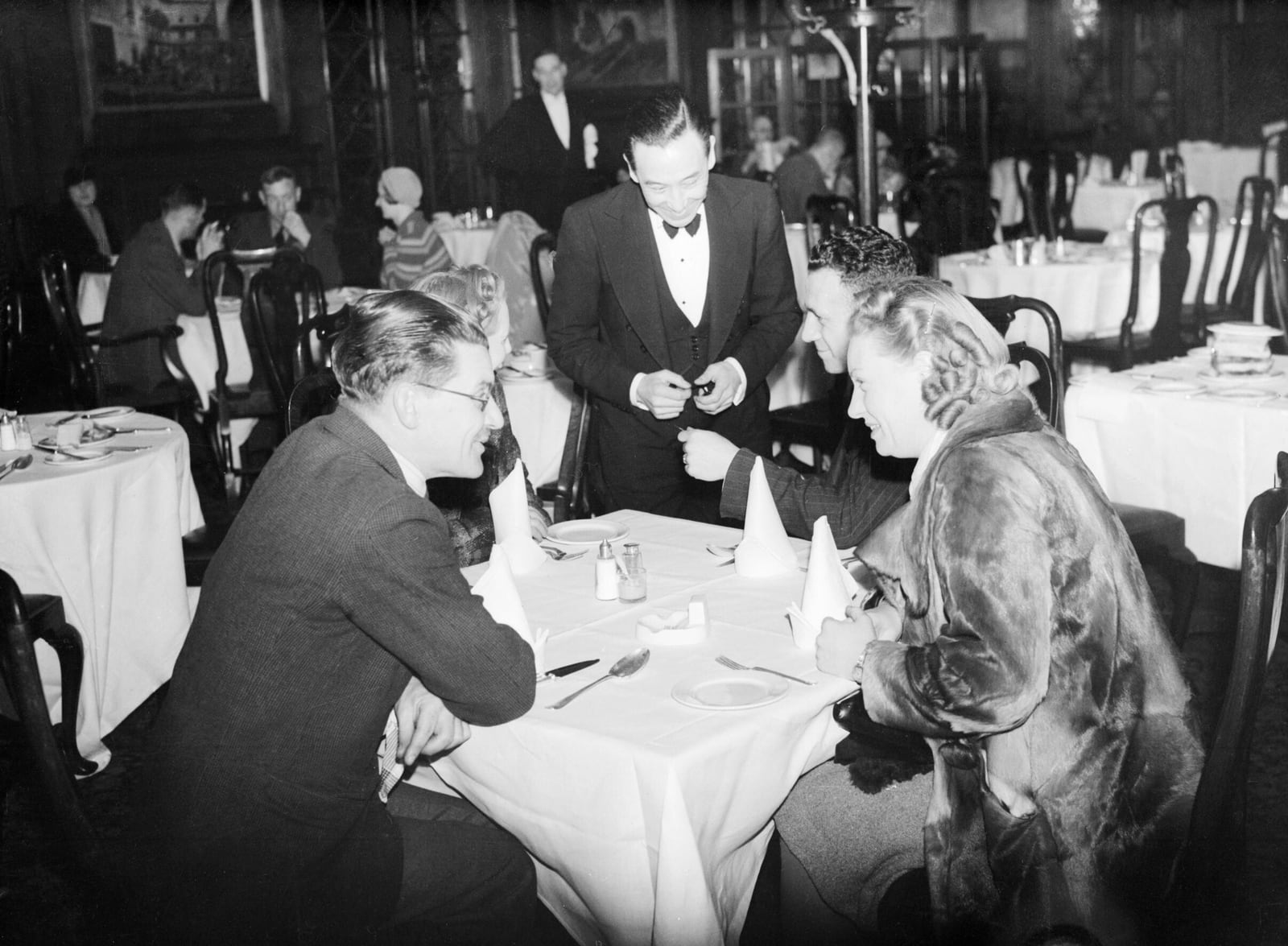
In a London restaurant in the spring of 1941, four friends lean toward a waiter’s order pad. Their dark coats merge with the dark chairs; glasses and silver catch the available light. Across the middle of the photograph, however, the tables form a bright white plane. The Imperial War Museums’ description calls the service unusually luxurious and points to the cloths and linen napkins as evidence.[5] Before the kitchen sends a plate, the textile has already told the room what kind of evening this intends to be.
The picture catches linen at its most flattering moment: smooth, dry, correctly sized and almost anonymous. It leaves the rest of the cast outside the frame. Somewhere else are the cloth from lunch with a wine shadow at its hem, the napkins being counted into a bag, the clean stack returning from the ironer, the spare set waiting for a spill and the damaged piece that should never return to a guest table.
That offstage circuit is the real subject. A tablecloth is not merely décor, and “white-tablecloth” is not only a shorthand for expensive dining. The cloth is soft equipment. It controls touch, sound and visual order; it also creates a recurring obligation to collect, sort, wash, finish, inspect, count and reset. A restaurant may reject tablecloths altogether and still practice exacting hospitality. Once it chooses them, though, every unmarked table becomes a small promise that the entire loop is working.
The hush begins under the visible cloth
Lay a plate on bare marble and the contact announces itself. Lay it on cloth and the landing becomes quieter, but the top layer is only part of the mechanism.
The National Council for Hotel Management and Catering Technology in India teaches a traditional layered construction: a thick cotton baize cloth sits on the tabletop, with the visible tablecloth over it. The baize absorbs small spills and reduces the rattle of flatware and crockery; a separate Uttarakhand Open University service text adds heat protection, grip and a softer edge for the diner’s wrist to that working list. The first guide calls for the tablecloth itself to fall roughly 12 to 18 inches from the edge.[2][6] Those measurements are training standards, not a universal law of beautiful rooms. Their value is that they expose how much apparently effortless softness depends on fit.
Too short a cloth looks borrowed. Too long a cloth catches knees and shoes. A skewed center fold makes a round table feel subtly off-balance before a diner could explain why. Underneath, the baize turns hard furniture into a more forgiving instrument: wrists meet a softened edge, a water glass lands without a click, and the cloth stays put when a server clears a side plate.[6]
This material work helps explain why linen can influence a meal before flavor has had time to establish itself. In a real-restaurant experiment at the Institut Paul Bocuse involving 247 diners, researchers compared fabric table linen with paper. Fabric lifted reported preference for the appetizer and improved judgments of service, ambience and overall experience; it did not significantly change liking for the main dish or dessert.[3] The authors acknowledge commercial linen-services company Elis for supporting the study and supplying the table linen, so this is useful evidence with an industry tie, not a disinterested verdict on fabric as a category.[3] The boundary is as interesting as the effect. Cloth can tune the first act. It cannot rescue dinner.
One room requires several rooms’ worth of linen
At 5:30 p.m., a stack of forty napkins may look like abundance. In a forty-cover restaurant, it is only one service.
Laundry operations describe stock in par levels. The ASEAN hospitality training manual defines one par of restaurant linen as enough cloths and napkins to cover every table for service, and says many hotels and restaurants carry an average of three to five par to keep the laundry cycle moving.[1] For a forty-cover room, one napkin par is forty pieces; four par is 160. That arithmetic is illustrative, not a prescription. The right buffer changes with laundry turnaround, days of operation, opening hours, off-site transport, banquet demand, loss and the number of pieces rejected for stains or damage.[1]
The useful image is not a cupboard filled four times over. It is motion. One set may be in the room, another soiled and awaiting collection, another in the wash, and another clean on the shelf. If the laundry truck misses a run or a private dinner consumes twice the expected napkins, “extra” stock becomes tonight’s service. If the team is constantly demanding an urgent wash, the manual advises treating that as a signal: either par is too low or the stock needs counting.[1]
This is why cheapening the reserve can be false economy. The same small pool returns to the washer more often, worn hems come back into circulation because there is nothing to replace them, and the dining room begins making aesthetic compromises under time pressure. A spare cloth is not dead inventory when it protects the restaurant’s ability to reset after a bottle spills across the first seating.
The count also has to respect shape. A square two-top cloth cannot solve a shortage at a large round table. The ASEAN manual notes that plain white tablecloths may be heat-stamped with their dimensions on the inside hem, a tiny label that lets the laundry and the restaurant return the right geometry to the right stack.[1] What a guest sees as a perfectly even drop begins with somebody reading that hidden number.
The laundry sorts what the dining room makes look identical
White suggests sameness. Commercial laundering depends on differences.
The ASEAN manual separates linen by fibre, colour, degree of soil and the wash process required. It specifies keeping soiled pieces apart from clean ones to reduce cross-contamination, and its example wash-program list distinguishes white table linen, polyester table linen, coloured table linen, napkins and rewash loads.[1] A dining room can call all of these pieces “linen,” but that word names an operating category, not necessarily one fibre. The Indian training text likewise describes expensive damask alongside more maintenance-tolerant blended cloth.[2]
This is the unglamorous intelligence of the loop. The crumpled bundle leaving the restaurant must become distinct loads before it can become a uniform white stack again. A stained piece needs another decision; a torn hem needs repair or retirement; a cloth that is technically clean but carries a stale odour has failed the room. Folding a blemish under a bread plate does not restore the par level. It merely transfers a laundry problem to a guest.
White has long made this tension visible. The Rijksmuseum holds more than 3,500 white linen objects and describes white table linen as a status symbol that was washed after use and often bleached. Its conservators are now studying how to remove conspicuous stains and discoloration without damaging historic cloth, because aggressive local treatment can be slow and destructive.[4] A museum textile and a working restaurant napkin have radically different lives, but they share one stubborn fact: the demand for whiteness is also a demand to survive repeated cleaning.
That is why a restaurant should be wary of making a sustainability halo out of cloth alone. Reuse avoids treating every napkin as disposable, but each return also commits water, heat, chemistry, transport and labour. The responsible question is not whether fabric sounds virtuous. It is whether the restaurant buys durable pieces, runs full and appropriate wash processes, maintains enough stock to avoid punishing overuse, and keeps cloth in service for as long as condition and hygiene allow. The laundry loop has to be managed before it can be praised.
The ironer writes the room’s geometry
After washing, flat linen has to become flat again. In an industrial laundry, damp cloth can pass through a heated flatwork ironer that dries and presses it in one continuous movement. The ASEAN manual’s description of manual feeding is strikingly physical: two operators present the washed piece to the machine together, keeping it aligned as the rollers take it.[1] A fold or skew introduced here can travel all the way to pre-service.
The dining-room team receives the result as a stack of compressed decisions. Size, edge, center line and finish have already been established. During setup, the cloth should open with as little handling as possible, settle over the undercloth, and finish with an even drop. Then comes inspection in the light of the actual room. Candlelight may forgive a crease; it does not make a grease mark clean. A pinhole that disappears in the linen cupboard may open visibly over dark wood.
Resetting is the same test at speed. Between seatings, the table may still hold warmth from the last plates while the host is already watching the door. The graceful reset is not the fastest possible toss of a fresh cloth. It is a short, repeatable sequence: clear completely, check the underlayer and tabletop, remove the soiled textile without turning it into a sail, inspect the replacement, find the center and rebuild the cover. Speed comes from agreement about the sequence and from having the correct cloth within reach.
Guests should not have to admire this choreography. They should feel its consequences: no damp corner, no chemical perfume, no plate rocking over a hidden fold, no panic when a glass goes over. Linen is successful when touch registers before maintenance does.
Whiteness is a standard, not the hospitality itself
The worst tablecloth can be immaculate and still make a room feel forbidding. The best bare table can feel generous, calm and precise. Fine dining no longer needs a white field to prove seriousness, and a restaurant should not keep one merely because the category once demanded it.
But cloth remains compelling when the room uses its actual properties. It softens contact. It quiets the tabletop. It creates contrast around glass, glaze and sauce. It lets a dining room reset its visual surface completely between strangers. The perception study suggests that diners really do read those cues, especially at the beginning of a meal, while also showing the limit of the spell: later courses must earn their own affection.[3]
Return to the 1941 photograph and the white tables look almost still. In practice, that stillness is produced by circulation. Every cloth has come from somewhere and is already headed somewhere next: laundry bag, sorting table, wash program, ironer, shelf, dining room, then back again. Luxury resides less in the whiteness than in the restaurant’s refusal to let the circuit show strain.
A white tablecloth begins its shift in the laundry. At its best, it ends by disappearing beneath dinner.
Sources
- Association of Southeast Asian Nations, Maintain and Operate an Industrial Laundry (2012) — hospitality training manual covering restaurant par levels, size identification, sorting, wash programs, flatwork finishing, stocktaking and clean/soiled separation.
- National Council for Hotel Management and Catering Technology, Foundation Course in Food & Beverage Service I — Government of India training material on baize, tablecloth fit, linen types, spill absorption and sound reduction at the layered table.
- Jing Liu, Estelle Petit, Anne-Cécile Brit and Agnès Giboreau, “The impact of tablecloth on consumers’ food perception in real-life eating situation,” Food Quality and Preference 71 (2019) — restaurant experiment comparing fabric and paper table linen across food and experience ratings.
- Rijksmuseum, “Brightening white linen” — conservation-research note on its collection of more than 3,500 white linen objects, historic washing and bleaching, and the difficulty of stain removal without textile damage.
- Imperial War Museums via Wikimedia Commons, “A group of diners give their order to the waiter at a restaurant in the West End of London, spring 1941” — Ministry of Information photograph D 2957 and the archival image used for this article.
- Uttarakhand Open University, Food & Beverage Service Foundation II — hospitality course material on baize as heat protection, sound deadening, tablecloth grip and wrist cushioning.