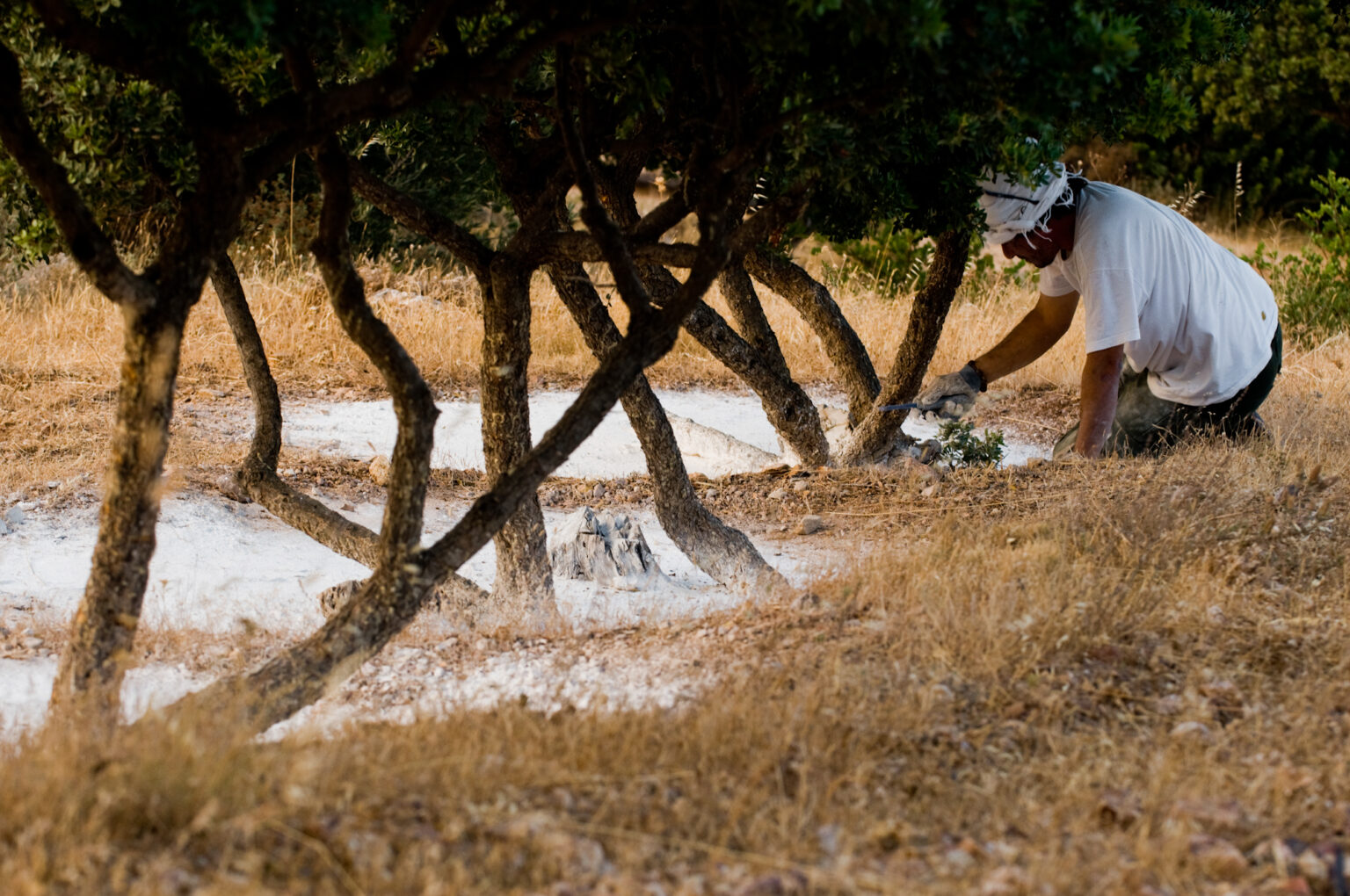
In Klairi Moustafelou’s photograph from Armolia, the summer grove seems to have caught patches of snow. A grower crouches under the low, tangled canopy of a mastic tree while circles of white earth shine against the dry gold grass.[7] The white is not scenic decoration. It is a clean landing surface, prepared before the bark is cut so that the resin can fall, set and be gathered without disappearing into ordinary soil.
Only much later does the harvest look like an ingredient: pale, irregular tears that click against a jar. Crush one and the quiet object becomes almost aggressively aromatic—green wood, pine, citrus peel, something cool and incense-like. In a cream or a broth, that perfume can feel startlingly lucid. Add too much and it can turn bitter, medicinal or closer to furniture polish than dinner.
That narrow margin is why Chios mastiha deserves more than a romantic provenance speech. Its quality is built through a sequence: winter pruning, summer ground preparation, repeated shallow incisions, time to harden, several kinds of gathering, domestic cleaning and cooperative sorting.[1][2] The chef receives the end of an agricultural sentence. Fine dining does the ingredient no favors when it reads only the last word.
The real luxury here is not that resin sounds exotic. It is that the path from living bark to a nearly invisible dose can remain legible on the plate.
First, make a floor beneath a tree
Mastiha comes from Pistacia lentiscus var. chia, an evergreen shrub trained into a low tree in the southern part of the Greek island of Chios. The resin does not arrive as a single annual tap. According to the Chios Mastiha Growers Association’s cultivation calendar, fertilizing begins in December; lower branches are pruned from mid-January through February to admit air and light; and the ground around each trunk is cleared from mid-June into early July.[2]
Then comes the strangely beautiful act visible in the photograph. Growers sweep and level the soil and press a fine white powder into a smooth surface beneath the branches.[2][7] The prepared ground is practical infrastructure. A translucent tear would be difficult to distinguish from stones, leaves and dust on a rough grove floor. Against white, it can harden cleanly enough to find.
In July, the kentos begins. Using a small grooved iron tool called a kentitiri, growers make short incisions in the trunk and principal branches, starting low and moving upward over successive visits. Cutting continues through August and sometimes into late September. The association says the resin generally needs 15 to 20 days to solidify after the first scoring, with the first gathering taking place after August 15.[2]
This is careful provocation, not extraction by force. Too little scoring yields little; careless cutting asks the tree to absorb damage for the sake of this year’s crop. The knowledge lies partly in seeing how one particular tree has responded and knowing where the next incision belongs. That is why UNESCO inscribed the cultivation know-how—not merely the substance—on its Representative List of the Intangible Cultural Heritage of Humanity in 2014.[1]
UNESCO’s account also describes the work as a family and community practice distributed through the year. It records men traditionally taking responsibility for winter fertilizing and pruning, women preparing the ground and later cleaning the tears, and older growers teaching incision and harvest skills to younger people.[1] That description should not be treated as a job chart for every present-day household. Its more durable point is that mastiha is not made by a solitary forager finding a rare tree. It depends on repeated, shared work whose most exacting stages are learned beside someone else.
The harvest becomes an ingredient twice
The first transformation happens in the grove: fluid resin becomes a tear. The second happens after collection, when a mixed harvest becomes something a kitchen can dose.
Larger pieces are lifted first. Smaller tears are swept or picked up later, then placed in wooden boxes and kept cool. The cleaning continues after harvest: loose debris is removed, the resin is washed and dried, and remaining foreign matter is picked out by hand. UNESCO describes larger tears being selected first and stored cool; the growers’ association details the later processing, packaging and sorting by size.[1][2][7]
That sequence complicates the seductive phrase “tears of Chios.” A tear suggests an effortless drop. The finished spice is closer to an edited collection. White earth makes recovery possible; hands separate resin from ground; water, drying and scrutiny make it fit for use; grading decides what form of the harvest enters which market.
The name also has a legal boundary. The EU geographical-indication register lists Μαστίχα Χίου / Masticha Chiou as a Greek Protected Designation of Origin, registered with a priority date of January 24, 1997, in the category of natural gums and resins.[3] PDO is useful here because it prevents a chef from turning “Chios” into a free-floating mood. If a menu names Chios mastiha, the ingredient should be the protected product, not an anonymous resin with an Aegean story attached.
But the seal cannot season a dish. It verifies origin; it does not guarantee that a pastry team stored the resin well, ground it evenly or stopped at the right dose. Provenance gets the ingredient through the kitchen door. Judgment decides whether it should be perceptible as a cool green lift or identifiable from across the room.
Pine is only the loudest note
Calling mastiha “piney” is accurate in the way calling an orchestra “brassy” can be accurate. It identifies the voice that arrives first and misses the arrangement behind it.
In a 2019 molecular-sensory study, Marina Rigling and colleagues described Chios mastic gum as intensely sourish, green, resinous and woody, with hints of citrus and pine. They identified 25 odor-active compounds. Alpha-pinene dominated by quantity, but recombination and omission tests showed that lower-level compounds—including beta-myrcene, limonene, beta-linalool and perillene—were indispensable to the full aroma.[4]
That finding gives a chef a more useful map than “forest flavor.” Resin and wood supply depth. Limonene helps explain why lemon and orange can make mastiha feel brighter rather than merely louder. Linalool opens a floral register. Green and sour-smelling components keep the perfume from settling into sweetness alone.[4] The ingredient is complex enough to move between pastry and savory cooking, but only if the dish leaves room for its minor voices.
The growers’ association’s recipe collection, edited by Diane Kochilas and built from contributions by Greek chefs, makes that range concrete. It moves from yogurt, honey, beet and apple to bream carpaccio, sole with mastiha liqueur, cod fritters with foamed skordalia, braised goat, semifreddo and bitter chocolate cake.[5] This is an interested party’s publication, not an independent verdict on every pairing. It is still valuable evidence that mastiha’s working culinary vocabulary extends far beyond chewing gum and ice cream.
The most convincing combinations do not use resin as a novelty alarm. Cultured dairy gives its sharp perfume a soft background. Citrus catches its brighter volatiles. Tomato and olive oil pull it toward herbaceousness. Chocolate gives the woody register somewhere dark to land. Fish can accept the green-citrus side, but a heavy hand makes delicacy taste sanitized. These are pairing hypotheses, not rules; the actual batch and dish must decide.
Choose the form before the course
A kitchen does not buy one abstract thing called “mastiha.” It chooses among whole tears, ground powder, essential oil, distilled water and liqueur, and each form solves a different problem.
Whole tears offer the clearest identity and allow grinding to order. They are also sticky. The association’s culinary guide advises pounding them with a little sugar for sweets or salt for savory preparations, which keeps the resin moving through the mortar or grinder and helps distribute a minute amount through a larger mixture. It repeatedly warns that a little goes far and that an excessive dose leaves bitterness that cannot be taken back.[5]
Powder is easier to disperse through dough, custard or a dry seasoning, though the kitchen should know whether a commercial powder contains a carrier. Essential oil is more concentrated: it belongs in drops, not spoonfuls. Distilled mastiha water is gentler and more diffuse. A Michelin Guide ingredient survey describes it as slightly herbal and notes its use as a mealtime drink; in a kitchen, that quieter form can scent a clear liquid or cold preparation without adding grit.[6] Liqueur brings mastiha together with alcohol and sugar, which may be exactly right for a sauce or dessert and exactly wrong if the recipe has already found its sweetness.
The form therefore belongs in recipe development before the garnish sketch. Ask what needs to happen. Should the aroma survive baking? Bloom in fat? Travel evenly through a frozen base? Lift a broth without clouding it? Arrive in a drink with its sweetness already built in? A chef who decides “mastiha course” first and dosage system later has reversed the important choices.
Restraint need not mean timidity. It means giving the aroma an edge to appear against. One mastiha-inflected course in a tasting menu can reset the senses because its resinous coolness is unlike vanilla, citrus or anise. Repeating it in bread, fish, pre-dessert and petit four turns a specific agricultural product into house fragrance.
Put the work in the tableside sentence
Mastiha attracts the kind of language fine dining should distrust: ancient, miraculous, precious, unique. Some of those words point toward real history; none tells a guest why the spoon in front of them tastes the way it does.
A better explanation is short and physical. The resin comes from southern Chios. Growers prepare the earth white, score the tree in summer, wait for the tears to harden, then collect, wash and clean them by hand before cooperative sorting.[1][2] The kitchen has ground a small amount with sugar or salt, or chosen a distilled form, because the perfume is powerful.[5] That sentence connects the grove to the bite without converting labor into folklore.
It also keeps the evidence boundaries visible. UNESCO recognition belongs to the cultivation knowledge, not to a claim that every mastiha dessert is culturally important.[1] PDO status protects origin, not deliciousness.[3] Aroma chemistry can explain why “pine” is incomplete, but it cannot choose the right concentration for a particular custard.[4] The restaurant still has to taste.
Look again at the Armolia photograph. The grower is partly hidden by the tree, working low to the ground. There is no gleaming dining room, no smoke-filled cloche, no rare-spice tableau. The striking thing is the white surface under the branches: a small piece of agricultural design made to catch what would otherwise be lost.[7]
That is the standard mastiha sets for fine dining. Make every invisible step serve the ingredient. Prepare the landing. Preserve the volatile details. Then use so little that the guest notices a new shape in the dish before noticing the spice by name.
Sources
- UNESCO, “Know-how of cultivating mastic on the island of Chios” — 2014 inscription record and account of the annual work cycle, family roles, hand cleaning and intergenerational transmission.
- Chios Mastiha Growers Association, “Cultivation” — official production calendar covering pruning, white-ground preparation, kentos, solidification, gathering, storage and cooperative processing.
- GIview, “Μαστίχα Χίου / Masticha Chiou” — official geographical-indication record showing Greek PDO status, registration date, file number and product classification.
- Marina Rigling et al., “Aroma Investigation of Chios Mastic Gum,” Journal of Agricultural and Food Chemistry 67 (2019) — PubMed record and abstract covering sensory descriptors, 25 odor-active compounds and the importance of minor odorants.
- Chios Mastiha Growers Association, Chios Mastiha PDO: More than 20 Great Recipes — Diane Kochilas-edited culinary guide to forms, grinding, dosage and sweet and savory applications.
- Azimin Saini, “These 5 Greek Ingredients Showcase the Country’s History, Culture and Terroir,” Michelin Guide — restaurant-facing description of mastic resin and distilled mastic water.
- Travel.gr, “Mastic of Chios, the precious resin tears originating from Greece” (October 25, 2021) — field report and source of Klairi Moustafelou’s Armolia harvest photograph used as the article image.