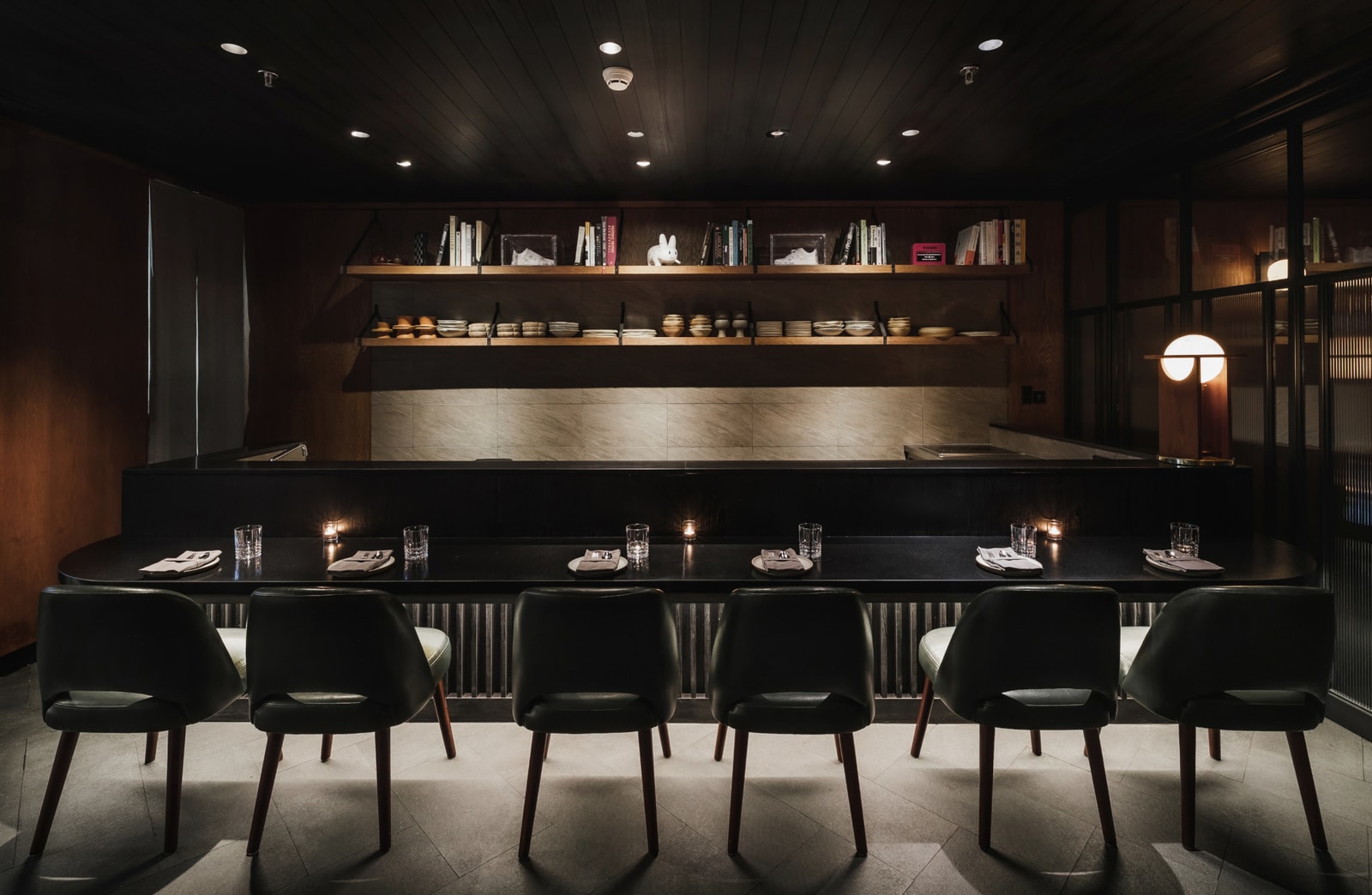
The most revealing seat at August may be the one facing dessert. A dark counter runs along the pastry kitchen; beyond it, shelves of handmade bowls wait under a low amber light. The restaurant recommends this position to solo diners and pairs who want a close view of the pastry work.[1] It sounds like a promise about the final courses. In practice, it offers a clue to the whole menu.
At August, starch is not the anonymous interval between premium proteins. It is the route. Spent-grain milk bread opens the meal; noodles can carry smoke and brine; breadfruit is made crisp enough to command its own course; sticky rice, sourdough and fermented fruit give the pastry section an Indonesian vocabulary without forcing dessert to become a flag.[2][3][4] The tasting menu comes home through texture before it does through explanation.
That is an important distinction at a restaurant with a large public story. Chef Hans Christian and hospitality specialist Budi Cahyadi began August as private dinners in a South Jakarta apartment in 2019, then opened the restaurant in Sequis Tower in late 2021.[1][3] In 2026, Asia's 50 Best ranked it No. 42 and named it The Best Restaurant in Indonesia for a third consecutive year.[2] Those accolades invite a grand national reading. The meal itself works better at a smaller scale: one soft roll, one cold noodle, one crisp shell, one spoonful of rice.
This is a walkthrough of that structure, not a guarantee that every named dish will share a table. August changes its menu by season. The late-2025 Season 9 account and the restaurant's 2026 profiles capture different iterations.[2][3][4] Read together, however, they reveal a stable piece of grammar: starch receives flavor, memory and craft, then passes them forward.
The first course lowers its voice
Asia's 50 Best describes the current opening as a miniature milk bread made with spent grain and served with seaweed butter.[2] The form is deliberately familiar. It arrives before the menu needs to prove how progressive it can be, and its pleasures are basic ones: softness, warmth, fat and salt.
Spent grain complicates that comfort without turning it into a lecture. An ingredient left after another process becomes the material for a fresh loaf. Seaweed butter pulls the bite toward the coast. The bread therefore introduces two ideas quietly: Indonesian flavor at August can arrive through an ingredient relationship rather than a reconstructed canonical dish, and refinement can begin with reuse rather than rarity.
An earlier menu made the same point from a different direction. During CNA Luxury's visit to Season 9, a starter bread was filled with natural cheese from Mazaraat in Yogyakarta.[3] The supplier was not buried in a footnote; the collaboration entered the sequence as something warm and immediately legible. August's official statement of values calls the restaurant a vessel for local artisans, suppliers and sustainable ecosystems.[1] Bread is where that language becomes edible before it becomes lofty.
The opening also establishes proportion. If a tasting menu begins at full volume—with caviar, smoke, tableside vapor and a speech—every later course has to shout. A small loaf gives the room somewhere to go.
Acid clears space for the map
The next movement is less about adding weight than sharpening the edges. The 2026 menu profile pairs kalamansi-marinated tomato and cured ruby snapper with black-tea jelly and cultured cream.[2] Nothing in that construction needs to impersonate a traditional dish. Its Indonesian argument sits in the calibration: tropical citrus against fish, tannic tea against cream, cure against freshness.
Season 9 used a cold noodle course to create similar friction. Bakmi Tiga Marga, a Jakarta noodle maker, supplied the chewy strand; the kitchen paired it with white balsamic, smoked skipjack tuna and marinated jellyfish.[3] Wheat carries the dish, but it does not flatten it. Smoke, acid, snap and chew arrive on different clocks. The noodle is the common surface that lets those sensations remain in conversation.
That course also shows why August is more convincing as a Jakarta restaurant than as a miniature atlas of Indonesia. Christian told CNA that the menu was using the capital as a hub: white fish from Lombok, octopus from Natuna, pohpohan leaves from West Java, ginger flower, Manadonese woku and Central Javanese garang asem could meet in one dining room without pretending they came from one regional pantry.[3] The menu does not erase distance. It edits distance into a sequence.
Laksa brings depth without becoming the summit
Then the flavors broaden. Asia's 50 Best singles out grilled octopus with a three-layered laksa sauce and Thai basil.[2] “Three-layered” could easily become fine-dining code for excess. Here the useful word is laksa. A sauce with aromatic, spicy and coconut-rich registers can surround a charred ingredient while still leaving the menu somewhere to travel.
The course matters because tasting menus often confuse progression with escalation. Each plate becomes richer, rarer and more ornate until the diner is asked to admire rather than taste. August's published menu snapshots suggest an alternative rhythm. Fermented acidity can follow cream; smoke can enter through skipjack and then recede; a deep sauce can be followed by something crisp and sour.[2][3][4] The arc rises and falls.
Even the drinks support that reading. The 2026 profile mentions a non-alcoholic pairing that includes a fermented black-tea stout.[2] Fermentation supplies darkness and bitterness without requiring the alcoholic weight of a conventional stout. It is another way to give the middle of the meal depth while preserving movement.
Breadfruit gets the architecture usually reserved for meat
A 2026 report from Indonesia's public broadcaster describes one of August's most telling constructions: breadfruit and braised daikon are formed into a sukun “hash,” coated in a thin tapioca batter, then served with pickled celery and mushroom cuko sauce.[4] The plate is built from modest materials, but its architecture is exact.
Breadfruit supplies a dense, starchy center. Daikon loosens that density. Tapioca creates the brittle boundary. Pickled celery cuts across the fry, while mushroom cuko brings earth and tang. The effect can be understood before any server explains the reference. Soft meets crisp; deep meets sharp; the next bite remains desirable.
This is where the menu's starch argument becomes clearest. A conventional luxury progression might use breadfruit as a garnish beneath an expensive protein. August gives it the engineering normally reserved for the centerpiece. The value comes from transformation and balance, not from asking a humble ingredient to wear a luxury disguise.
The contrast with the restaurant's Foie PB&J is useful. Asia's 50 Best lists that playful signature as an optional addition to the tasting menu.[2] The placement keeps the joke honest. Foie gras and nostalgia can be purchased as an extra flourish; they do not have to become the spine of the night. The core menu can make its case through grain, noodles, roots, leaves, seafood and sauce.
Pastry returns refinement to the pantry
By dessert, the view from the chef's counter finally explains itself. Ardika Dwitama, named Asia's Best Pastry Chef in 2026, works in a section visible to the seats directly in front of it.[1][2] The openness matters because his reported desserts are less about decoration than controlled changes of state.
The 2026 RRI account names three combinations from Dwitama's repertoire: jasmine sencha with orange and yogurt; sourdough ice cream with mulberry and cashew; and sticky-rice pudding with passion-fruit granita and fermented-pineapple jelly.[4] Read as a closing movement, they repeat the menu's earlier logic. Tea brings tannin back after the black-tea jelly. Sourdough turns cultured acidity into cold creaminess. Sticky rice returns starch in its softest form, while granita and fermented fruit prevent comfort from becoming heaviness.
There is wit in ending an ambitious tasting menu near rice pudding. But it is not a wink at simplicity. Rice must still be cooked to the right tenderness; fermentation has to stop at brightness rather than funk; a frozen element has to melt at the pace of the spoon. Pastry technique does not elevate the pantry by making it unrecognizable. It makes familiar materials hold a more precise temperature, texture and duration.
Read the sequence, not just the signatures
August protects this arc with unusually explicit rules. The full table must choose the same menu because each option has its own flow. Dietary restrictions need to be raised at least 72 hours ahead, and the kitchen says it cannot offer a dairy-free menu. The last seating is 8:45 p.m.[1] These are practical constraints, but they also reveal the restaurant's priorities: sequence is part of the product, and improvisation has boundaries.
For a solo diner or a pair, the pastry-facing counter makes the craft easiest to see. For everyone else, the better way to read August is to resist collecting only the famous plates. Notice what performs the handoffs. Bread makes local sourcing intimate. Noodles let smoke and acidity share a surface. Breadfruit turns a vegetable course into an event. Sticky rice brings the meal back to comfort without surrendering precision.
Jakarta does not need a tasting menu that proves Indonesian ingredients belong in fine dining; that argument is already stale. August's more pleasurable claim is that they can control the rhythm. Starch carries the meal because it absorbs, binds, crisps, stretches, ferments and softens. Luxury arrives not when the menu escapes those everyday materials, but when it listens closely enough to let them lead it home.
Sources
- August Jakarta, official restaurant site — founding history, chef and hospitality backgrounds, seating areas, values, hours, menu-flow policy, dietary notice and the official chef's-counter photograph used for this article.
- Asia's 50 Best Restaurants, “August” (2026) — No. 42 ranking, Best Restaurant in Indonesia recognition, current menu examples, dining-room context, non-alcoholic pairing and pastry-chef recognition.
- Cristian Rahadiansyah, “Meet the duo behind August, one of Jakarta's hottest fine dining restaurants,” CNA Luxury (January 1, 2026; updated January 23) — reported account of the founders, apartment dinners, Season 9 ingredients, suppliers, menu pacing and service culture.
- Voice of Indonesia / RRI, “Two Indonesian Restaurants Shine in Asia's 50 Best Restaurants 2026 List” (March 28, 2026) — 2026 ranking confirmation plus the breadfruit course and Ardika Dwitama's reported pastry combinations.