Many luxury restaurants still sell control first. The menu is fixed, the signatures are known in advance, and the diner is buying the comfort of repetition.
Table by Bruno Verjus works on a riskier premise. It sells judgment under pressure. As of April 2, 2026, The World's 50 Best Restaurants 2025 places Table at No. 8, while MICHELIN continues to list it as a two-star Paris restaurant.[2][3] Those are strong prestige signals, but they are not the real story. The real story is that Bruno Verjus has built one of Paris's most desired rooms around a supply idea: buy brilliantly, buy close to the day, avoid forcing producers into artificial abundance, and let the menu absorb what arrived in its best condition.[1][2][4]
That is why Table is more useful to read as an ingredient report than as a generic review. The luxury on offer is not only flavor or status. It is a procurement system that stays visible all the way to the pass.
1. The chef's role is closer to intermediary than auteur-myth
The official site gives away the restaurant's whole operating philosophy almost immediately. It says the story of Table begins with respect for products, and that artisans enter the room through the exceptional ingredients they send.[1] MICHELIN sharpens that idea even further by describing Verjus as a kind of "middle man" for raw materials: his job is to source outstanding produce, avoid over-ordering from suppliers, and stay faithful to ingredients shaped by minimal intervention and wild nature.[2]
That combination matters because it changes the usual hierarchy of fine dining. In many prestige kitchens, producers are thanked, named, and photographed, but the menu still behaves as if the restaurant were the unquestioned center of authorship. Table reads differently. The restaurant's public language suggests that authorship begins upstream. Verjus is still editing, seasoning, sequencing, and plating, but the nightly argument starts with what the product can honestly do that day.[1][2]
This is also why the room feels current rather than nostalgic. Paris has no shortage of restaurants capable of classical polish. Table matters because it reframes polish as attentiveness. The kitchen is not trying to prove domination over ingredients. It is trying to prove responsiveness to them.
2. Couleur du Jour is the clearest proof that arrival governs format
The most revealing format detail on the official site sits in the FAQ rather than in a manifesto. The Couleur du jour menu is currently listed at EUR480 for both lunch and dinner, with about 10 to 14 dishes and a minimum duration of 2 hours 30 minutes.[1] On its own, that could still describe many contemporary tasting counters. What makes Table distinct is how The World's 50 Best Restaurants 2025 profile describes the room's signature rhythm: diners can watch every gesture at the wave-shaped counter, including Colours of the Day, a daily changing dish built from the most seasonal herbs and vegetables.[3]
The 50 Best Talks feature from 2025 makes the logic even more explicit. In that piece, Verjus is framed as a chef who invents a daily menu from what reaches him fresh from artisan producers.[4] Read together, those sources show that Couleur du Jour is not decorative branding. It is the operational center of the restaurant. The format announces, in public, that tonight's sequence is a response to arrival.
That makes Table's luxury unusually perishable. You are not buying a museum ticket to a fixed repertoire. You are buying access to one night's successful reading of the market, the field, and the fishing line.
3. The counter matters because sourcing has to stay legible
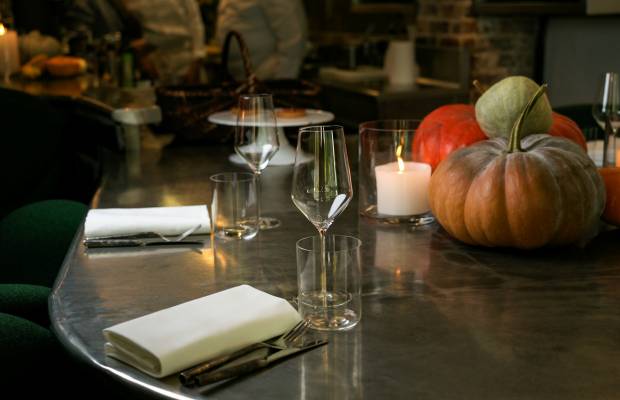
If Table hid this system behind a remote dining room, some of its power would disappear. The 50 Best profile is especially useful here because it emphasizes physical design: a long counter shaped like a wave, private pockets within that curve, and an open kitchen where diners can follow plating in real time.[3] That architecture is not neutral. It makes procurement visible.
Once diners can see the kitchen working, supplier talk stops being brochure language. 50 Best notes that Verjus's team is happy to discuss producers, wines, and dishes with guests.[3] That detail might sound small, but it is central to the restaurant's credibility. A sourcing-first restaurant has to make its chain of judgment intelligible. Otherwise "daily" becomes a vague romance word instead of a standard the diner can actually feel.
The beverage side follows the same logic. The official FAQ lists three add-on pairings: EUR300 for wine, EUR400 for champagne, and EUR200 for rare teas.[1] Meanwhile, the 50 Best Talks feature notes that the wine list changes every two to three weeks.[4] That is the same philosophy expressed in liquid form. Table does not want the drinks program to harden into a static luxury cabinet while the food remains alive to the day.
4. The booking rules reveal how much the room depends on live product
Restaurants often hide their operational demands behind soft language. Table does the opposite. The official site says reservations open up to three months ahead, service runs Tuesday to Friday, the first lunch reservation is at 12:00, the first dinner reservation is at 19:30, and the booking ticket is a EUR200 per-person deposit that is deducted from the final bill but lost in case of cancellation or no-show.[1]
Those facts are worth reading alongside the sourcing philosophy, not separately from it. A restaurant that buys close to service and structures dinner around fresh arrivals cannot treat attendance discipline as a side issue. The reservation system is one more way Table protects the product chain. Guests are being asked to commit because the restaurant itself is already making commitments on their behalf.
This is where Table separates itself from the softer language of "chef's choice" used by many tasting counters. At Table, choice is not merely being transferred from guest to chef. It is being transferred from guest to chef and then, one level further, from chef to producer reality. That extra step is what gives the room its charge.
5. What Table is actually selling in 2026
The easiest mistake is to think Table's appeal comes mainly from celebrity scarcity. There is scarcity, of course. A dining room in Paris with two stars, a top-10 global ranking, and a chef-patron who only entered the profession later in life will attract curiosity by default.[2][3][4] But the stronger reason people care is structural.
Table is selling a tight loop:
- producers and artisans determine the night's best possibilities[1][2][4]
- the kitchen edits those possibilities into a 10-14 dish sequence[1]
- the counter lets diners watch the edit happen live[3]
- the beverage program stays mobile enough to keep pace with the food[1][4]
That loop explains why Table feels like more than another fashionable Paris counter. It turns product quality into format, format into room design, and room design into trust.
For diners, that makes the restaurant a better fit for some appetites than for others. If your ideal grand dinner depends on deep premeditation, heavy ceremonial distance, and a sense that every course has been canonized long before you sit down, Table may feel too alive. But if what you want from luxury is contact with today's best version of a product, filtered through a kitchen that knows when to intervene and when to stop, then Table remains one of the clearest answers in Paris.[1][2][3][4]
That is the real logic of Couleur du Jour. It is not a poetic title attached to a vegetable course. It is a statement of method. The day arrives first; the menu follows.[1][3][4]
Sources
- Table by Bruno Verjus official site. Main page and FAQ sections covering the product-first philosophy, reservation window, EUR480 Couleur du jour menu, 10-14 dishes, service times, deposit, and pairing prices.
- MICHELIN Guide, "Table - Bruno Verjus." Current Paris listing describing the restaurant as a "middle man" for raw materials, its anti-overordering stance, and its minimal-intervention product philosophy.
- The World's 50 Best Restaurants 2025, "Table by Bruno Verjus." Current ranking page covering No. 8 status, the wave-like counter, open kitchen, Couleurs of the Day, and the team's supplier-facing hospitality.
- The World's 50 Best Restaurants, "50Best Talks: The Flavour Files - The World's 50 Best Restaurants 2025." Bruno Verjus section covering artisan producers, daily-menu logic, and the wine list changing every two to three weeks.