Most signature pasta dishes flatten with fame. They become visual shorthand: one photograph, one anecdote, one sentence about luxury Italian simplicity, and then the plate starts living on reputation more than on cooking.
Lido 84's rigatoni cacio e pepe en vessie has lasted because it works in the opposite direction. The more famous it gets, the clearer it becomes that the dish is not memorable for nostalgia alone. It is memorable because it turns uncertainty into the main ingredient. The pasta cooks inside a pig's bladder, cannot be watched directly while it cooks, and reaches its final state through touch, timing, and the cook's judgment about how today's cheese and today's bladder are behaving.[3][4]
That is what makes the dish worth studying in 2026. Cacio e pepe is usually invoked as proof that great pasta should be simple: a few ingredients, no tricks, no decorative overthinking. Riccardo Camanini uses that same foundation to make a harder point. Simplicity is not the absence of technique. It is technique compressed so tightly that every small variation starts to matter.[4][5]
1. The bladder is not the gimmick; it is the cooking chamber
The World's 50 Best profile is useful here because it does not describe the dish as spectacle first. It describes a process: the rigatoni is cooked in a pig's bladder, the result has to be assessed blindly by touching the surface, and the bladder's own juices, once gently shaken with the cheese, form the emulsion that gives the finished dish its creaminess.[3] That is not a party trick. It is a different heat-and-moisture system.
Fine Dining Lovers frames ordinary cacio e pepe as a deceptively simple four-ingredient dish that depends on emulsion control, pasta texture, and precision rather than abundance.[5] Camanini's version keeps that exact logic but moves it into a more volatile vessel. A steel pot gives you predictability. A bladder gives you a chamber that changes from service to service. The dish therefore becomes a test of whether a kitchen can keep a sauce alive while surrendering some direct visual control.
That is why the plate still feels modern. Many famous pasta signatures from the last decade survive mainly as plating memories. This one survives because the mechanism is still interesting. The cooking container changes the texture argument of the entire dish.
2. Why imperfection is the whole point
The best source on this is Camanini himself. In the 50 Best interview from 2019, he says the dish is "imperfect" because it is a form of blind cooking: the cook cannot open the container midstream, the pecorino changes from day to day, the bladders are not always the same thickness, and the rigatoni therefore cannot cook in a perfectly identical way every time.[4]
That admission matters because most fine-dining signature dishes are sold as proofs of total repeatability. Camanini is describing something subtler. Repeatability still exists, but it sits one level higher. The goal is not to force every service into mechanical sameness. The goal is to produce the same kind of pleasure from materials that remain slightly alive and variable.
This is where the dish stops being a clever update of Roman pasta and becomes a statement about craft. The kitchen is not mastering cacio e pepe by removing instability. It is mastering cacio e pepe by learning which instabilities can be trusted. Cheese moisture, bladder thickness, and internal pressure are not noise in the system. They are the system.[4][5]
Camanini's explanation of the dish's ancestry sharpens that further. In the same interview, he traces the inspiration to Apicius, with pig bladders used as containers in Roman practice, while also admitting that the actual cooking method is something "learned from the French" and then applied to a Roman recipe.[4] That combination is exactly why the dish travels so far. It is not a purity play. It is a historically informed hybrid whose whole power comes from crossing traditions without making the result feel confused.
3. The room around the dish is doing real work
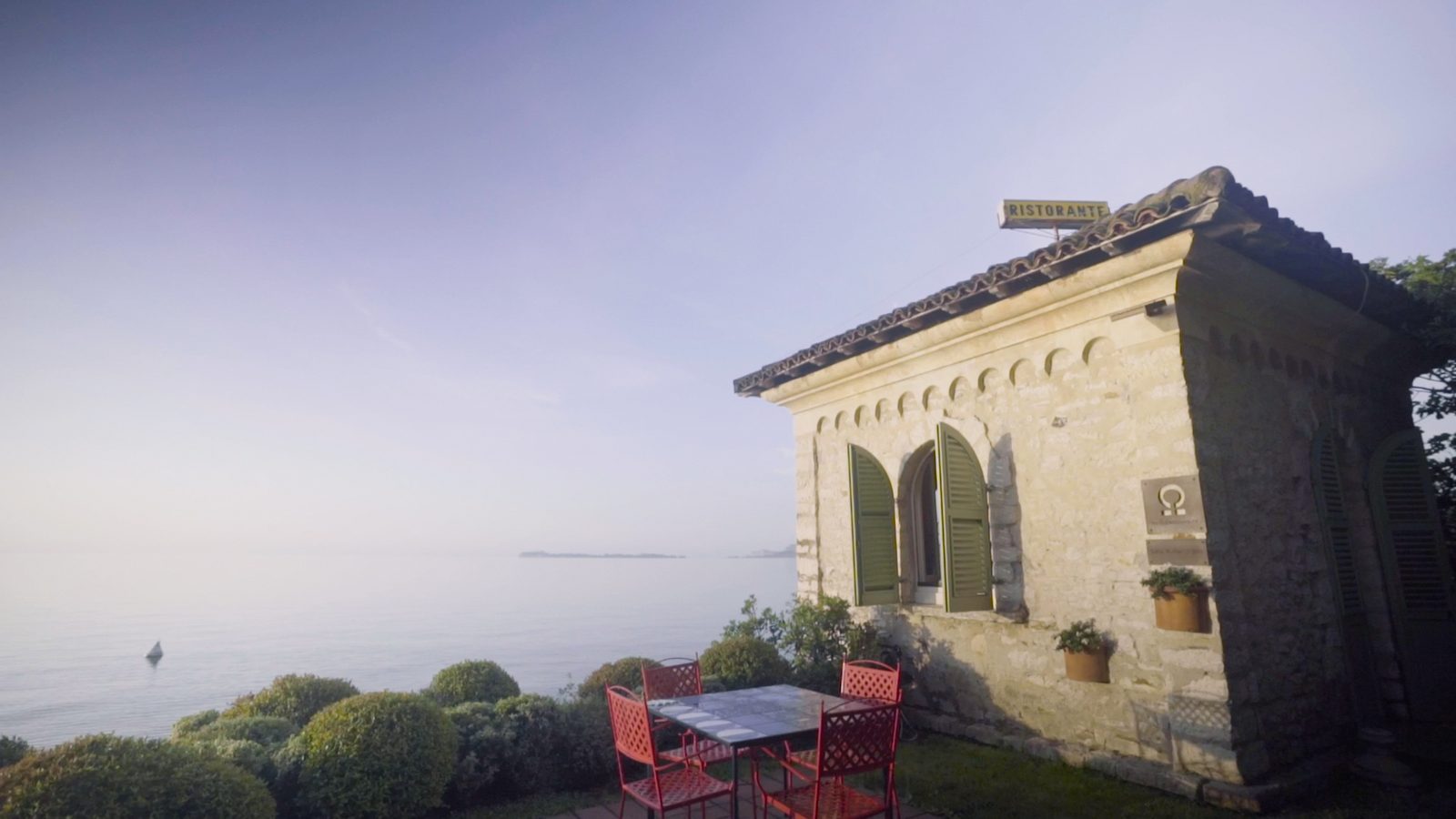
This pasta would read very differently in a cold, hyper-minimal room. Lido 84 gives it another atmosphere. The official English site places the restaurant in Gardone Riviera on the western shore of Lake Garda, at the beginning of the "Lemon Trees Riviera," and describes Giancarlo Camanini as the figure who gives the dining room its idea of conviviality while the kitchen staff themselves introduce the dishes.[1] That matters. The dish is technical, but the house does not present technique as intimidation.
The 50 Best profile fills in the physical setting. The building was once a lido, bought by the brothers in 2013 and transformed into the restaurant that opened in March 2014; when the weather is good, tables sit on a terrace overlooking the lake.[3][4] Those details are not ornamental. They explain why cacio e pepe en vessie lands as hospitality rather than as a laboratory demonstration. The lake, the converted leisure building, and Giancarlo's dining-room warmth all keep the dish attached to pleasure.
That balance is one of the hardest things for modern fine dining to achieve. Many technical dishes make diners admire the kitchen while feeling held at a distance from it. Lido 84 appears to want the opposite effect. Even on the official site, the restaurant frames an unforgettable meal as not just eating well but understanding how the kitchen arrived at the recipe and the story of its components.[1] The dish fits that philosophy exactly. It teaches while it feeds.
4. Why this one dish still explains Lido 84
If you only had one plate through which to understand Lido 84, this would still be the best candidate. Public ranking signals help explain why. As of April 2, 2026, the current 50 Best list page still presents Lido 84 at No. 16 in the 2025 ranking.[3] But the stronger reason is internal. Cacio e pepe en vessie condenses the restaurant's deeper grammar.
Riccardo Camanini's official biography runs through Gualtiero Marchesi, Raymond Blanc, Jean-Louis Nomicos, and the Alain Ducasse orbit before settling in Gardone Riviera and opening Lido 84 in 2014.[2] You can feel that training structure in the dish. Marchesi's seriousness about Italian form, French sauce discipline, and Camanini's own willingness to rethink classics all arrive on one plate. Nothing about it is casual, but nothing about it feels ornamental either.
That is why the dish continues to matter after the initial wave of attention. It does not survive because it is the "famous one." It survives because it makes the restaurant legible. You can see Camanini's whole argument in it: history should be used, not worshipped; a classic should become more alive after technique touches it, not less; and the dining room should receive complexity as pleasure, not as homework.[1][2][4]
So the right way to read cacio e pepe en vessie is not as an eccentric luxury pasta. It is as a calibration device. It measures whether a fine-dining restaurant can take a dish every diner thinks they already understand and return it with more texture, more risk, more sauce intelligence, and more hospitality than the original expectation allowed.
Lido 84's version still passes that test. That is why it remains one of the few fine-dining pasta signatures that feels richer the more closely you look at it.[3][4][5]
Sources
- Ristorante Lido 84, "English Home" - official English page covering Gardone Riviera, the Lake Garda setting, Giancarlo Camanini's dining-room role, the house idea of conviviality, and the official site image used here as provenance.
- Ristorante Lido 84, "Riccardo Camanini" - official chef biography covering Camanini's training with Marchesi, Blanc, Nomicos, and the Ducasse orbit before Lido 84.
- The World's 50 Best Restaurants, "Lido 84" - current profile covering the 2025 ranking position, former-lido building history, lakefront setting, and the technical description of the rigatoni cacio e pepe en vessie.
- The World's 50 Best Restaurants, "Meet the chef behind Lido 84, a restaurant you're about to start hearing a lot more about" - interview with Riccardo Camanini on why the dish is "imperfect," how blind cooking changes it, and why Apicius plus French vessie technique sit behind the recipe.
- Fine Dining Lovers, "Cacio e Pepe: Through the Eyes of the Chef Riccardo Camanini" - technique note framing the dish through four ingredients, emulsion control, and precision.