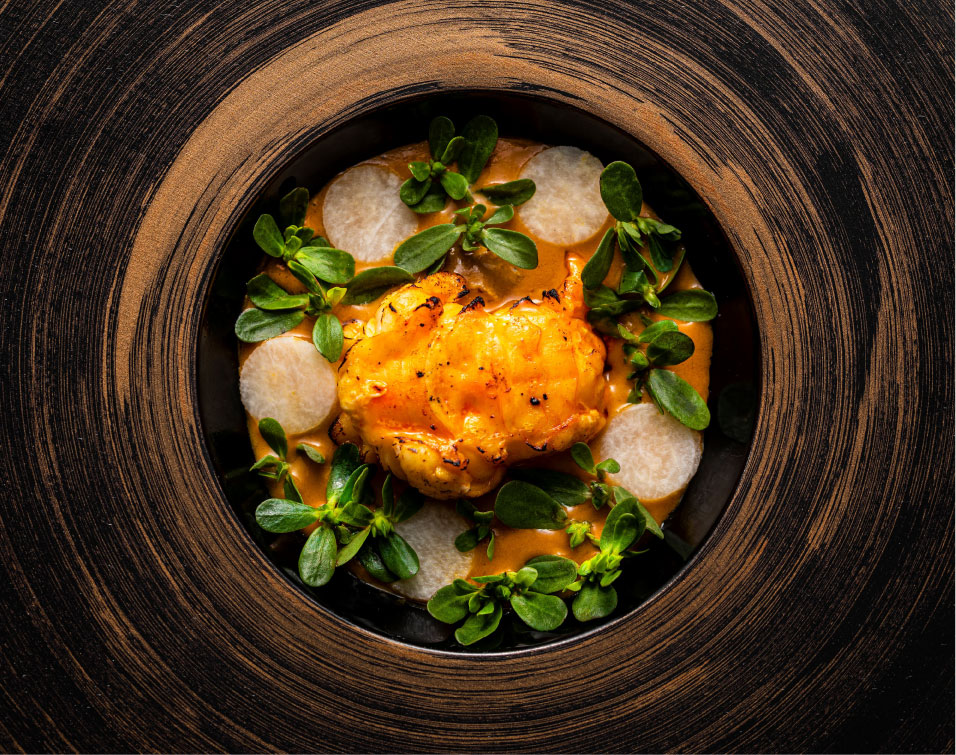
Sublime is easiest to misunderstand if you treat its tasting menu as a patriotic checklist. The Guatemala City restaurant is not simply asking a diner to move from ingredient to ingredient. It is asking the table to move through a country by way of places, eras, feelings, and remembered public objects.
That is why the menu works best as a map. Sublime's current tasting-menu page presents 12 steps and feelings of our land, organized around locations and historical moments across Guatemala.[1] Latin America's 50 Best gives the outside frame: chef Sergio Diaz and anthropologist Jocelyn Degollado shaped a tasting menu around Guatemalan essence, iconic events, and a progression that usually begins in pre-Columbian time, passes through colonial syncretism, and ends in the present.[3] The point is not to prove that dinner can summarize a nation. It is to show how a high-end meal can carry national memory without becoming a museum label.
The first movement starts with maize
The menu's opening logic is smart because it begins before luxury. Huehuetenango appears first, tied by Sublime to an ancient western Guatemalan maize-origin landscape and to the sacred place of maize in Maya creation memory.[1] That is a better first step than caviar, wagyu, or technical dazzle. It tells the diner that the meal's deepest value will not come from imported prestige. It will come from whether ordinary foundations can be made newly legible.
The second stop, Lake Peten Itza, keeps the opening expansive. Sublime links the lake to cultivation more than 4,000 years ago and to the region's importance for major Maya cities.[1] On a plate, that kind of reference should not feel like a lecture. It should feel like appetite turning toward settlement, water, cultivation, and possibility. The tasting menu's first job is therefore not to impress. It has to tune the table to time.
That tuning is the difference between a historical menu and a theme menu. A theme menu can point at corn and call itself rooted. A historical menu has to make the diner feel why corn is not just an ingredient, why water is not just a backdrop, and why the first bite has to carry enough restraint to leave room for the later stops.
Ruins are not the whole story
The next part of the route moves through Tak'alik Ab'aj, Zaculeu, and Iximche.[1] This is the section where Sublime has to avoid the trap of treating archaeology as flavor decoration. Tak'alik Ab'aj is presented on the restaurant's menu as a south-coast city associated with the transition from Olmec culture to Maya culture and with World Heritage recognition.[1] Zaculeu enters as a postclassic Mam capital and fortified place near modern Huehuetenango.[1] Iximche carries a sharper hinge: previously a Kaqchikel capital, it became the first Spanish city in what is now Guatemala in 1524.[1]
That sequence gives the menu a useful emotional progression. It moves from origin to city, from city to defense, from defense to conquest. The diner does not need every academic detail to follow the arc. What matters is that the middle of the meal should start tightening. The plates can no longer behave like pure landscape. They have to admit conflict, pressure, exchange, and translation.
This is where Sublime's collaboration model matters. The official team page says Diaz founded Sublime in 2019 and that his inspiration for each plate is history and time, developed with Degollado; it also describes Degollado's research background and the restaurant as a fusion of national history and gastronomy.[2] That partnership is the menu's load-bearing structure. Without the anthropological spine, the dishes risk becoming pretty place names. With it, the place names can behave like scenes.
The colonial middle needs motion
Puerto de Iztapa, Solola, and Tajumulco shift the menu into colonial and early textual memory.[1] Sublime identifies Iztapa as Guatemala's first official Spanish maritime port on the Pacific, then notes the beach's later public life.[1] Solola brings in the Memorial de Tecpan Atitlan, a Kaqchikel manuscript tradition concerned with origin myths and events from the 16th century.[1] Tajumulco enters through Francisco Antonio de Fuentes y Guzman's 1690 Recordacion Florida, with the volcano framed as an experience of fullness and exploration.[1]
This section is where the menu can become most interesting if the kitchen resists heaviness. Ports, manuscripts, and volcanoes are not the same kind of memory. A port suggests arrival, extraction, and exchange. A manuscript suggests voice, preservation, and retrospective grief. A volcano suggests scale, body, altitude, and awe. A strong tasting-menu walkthrough should feel those differences without turning them into three separate essays.
The risk is over-explanation. Fine dining often wants the guest to know exactly how much research has been done. Sublime's better path is subtler: let the room give just enough context, then let texture and sequence carry the rest. A port dish might need brightness, smoke, brine, or movement. A manuscript dish might need a quieter register, something layered or enclosed. A volcano dish can handle more altitude in the imagination, but only if the plate still tastes composed.
Modern memory gets to be playful
The final third is the menu's best argument against nostalgia. Livingston, MUNAE, the Inter-American Highway, and Xetulul-IRTRA move the route into Garifuna settlement, museum memory, road infrastructure, and amusement-park pleasure.[1] That is an unexpectedly generous ending. Sublime is not saying that Guatemalan identity stops with ruins, conquest, or colonial documents. It is saying that modern national feeling also lives in a Caribbean town, an archaeology and ethnology museum, a highway crossing, and a day out with funnel cake and fruit.
Livingston gives the menu the Garifuna coast and a sense of calm on Caribbean water.[1] MUNAE, founded in 1931, gives it the museum as civic container: thousands of archaeological and ethnological objects turned into public memory.[1] The Inter-American Highway, with Guatemala's section linked by the restaurant to 1969, gives it movement rather than monument.[1] Xetulul-IRTRA, tied to 2008 and to amusement-park sweetness, lets the meal end with popular joy rather than solemnity.[1]
That ending matters. Many ambitious national-cuisine restaurants become most comfortable when they can point backward. Sublime's sequence lets the diner land in the contemporary country, not outside it. The final movement says that cultural memory is not only what gets protected behind glass. It is also what people drive toward, visit, eat standing up, remember from childhood, or associate with a shared day of pleasure.
The room has to keep the map edible
Latin America's 50 Best ranks Sublime No. 19 on its 2025 list and names it The Best Restaurant in Guatemala 2025.[3] Those honors explain why the restaurant is visible outside its city, but they are not the most useful way to read the meal. The more useful detail is 50 Best's description of the house: a beautiful high-end-neighborhood setting, different dining spaces, a semi-open kitchen, contemporary Guatemalan art on the walls, Cocktail Lobby, and a casual terrace concept called Patio San Roman.[3]
Those room details matter because a 12-stop historical menu can become stiff if the hospitality does not breathe. A semi-open kitchen helps the menu feel made rather than recited. Art on the walls keeps the argument visual without requiring another lecture. Cocktail Lobby and Patio San Roman imply that the house is not only a tasting-menu classroom; it is a small hospitality compound with different speeds.[3] Relais & Chateaux's profile likewise frames Sublime as a fine-dining restaurant in Guatemala City led by Diaz, emphasizing terroir, welcome, and attentive service.[4]
The best version of Sublime, then, is not a national museum with better plates. It is a restaurant that knows dinner must stay bodily. The guest should feel maize before symbolism, smoke before conquest, sea air before port history, sweetness before amusement-park memory. The research gives the meal direction, but appetite has to keep it from freezing.
Why this walkthrough works
The cleverness of Sublime's tasting menu is not that it covers everything. It cannot. No 12-course meal can hold the full argument of Guatemala: Mayan languages, migration, class, civil conflict, coffee, textiles, Catholicism, evangelical modernity, Indigenous sovereignty, markets, diaspora, climate, and city life would all need their own books.
The cleverness is that Sublime chooses a route rather than a claim of totality. It starts with deep agricultural memory, moves through pre-Hispanic cities, enters conquest and colonial texts, then refuses to end in antiquity. It lets the highway and the amusement park stand beside the museum. That is a humane structure. It treats memory as lived sequence, not as a row of trophies.
For a diner, the practical advice is simple: choose the tasting menu if you want the restaurant's actual argument. The a la carte menu may be pleasant, and 50 Best notes it is worth exploring, but the tasting menu is where the house's grammar becomes clear.[3] Go in expecting a guided movement through place and time, not a neutral parade of signature dishes. The pleasure is not only in asking whether each plate is delicious. It is in noticing how the meal keeps changing the meaning of delicious as the map moves.
Sublime's name can sound abstract, but the menu is concrete. It points to maize, lake, city, fort, port, manuscript, volcano, coast, museum, road, and amusement park. Its best trick is making those things feel less like references and more like appetite. When the sequence works, Guatemala is not placed beside the dinner. It becomes the dinner's sense of direction.
Sources
- Sublime Restaurante, "Menu Degustacion" - official tasting-menu page with the 12-step route through Huehuetenango, Lake Peten Itza, Tak'alik Ab'aj, Zaculeu, Iximche, Iztapa, Solola, Tajumulco, Livingston, MUNAE, Interamericana, Xetulul-IRTRA, and the image source.
- Sublime Restaurante, "Team" - official page on chef Sergio Diaz, anthropologist Jocelyn Degollado, the 2019 creation of Sublime, and the restaurant's history-and-gastronomy concept.
- Latin America's 50 Best Restaurants, "Sublime" - 2025 No. 19 profile, chef and pastry-chef credits, Best Restaurant in Guatemala accolade, tasting-menu description, and room context.
- Relais & Chateaux, "Sublime Restaurant - Fine dining restaurant Guatemala City" - hospitality profile identifying chef Sergio Diaz and the restaurant's terroir, welcome, and service framing.