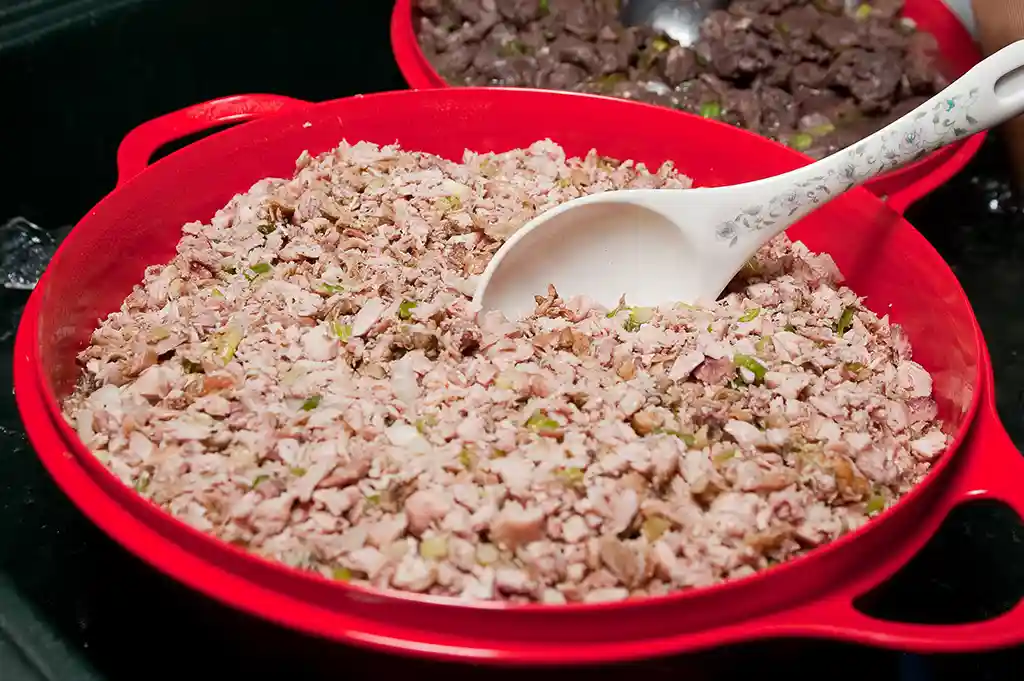
The red bowl is too full for negative space. Chopped chicken reaches almost to the rim; a white serving spoon rests in the middle; another bowl waits behind it. Guampedia's photograph is useful precisely because it does not make kelaguen behave like a pristine restaurant portrait. This is food prepared in enough volume for other hands to enter the frame.[1]
Look closer and the dish becomes less simple. The chicken has already met fire, but the flavors that define the finished bowl arrive after that encounter: lemon, salt, onion, hot pepper and, often, grated fresh coconut. Nothing becomes a smooth sauce. The meat stays chopped, the coconut stays tactile, and the acid reaches the new edges made by the knife.
That sequence is the key to kelaguen. It is often described through the dramatic idea that citrus “cooks” meat or fish, but one verb cannot cover every version. In chicken kelaguen, the grill handles heat and smoke before lemon supplies its cold, sharp finish. In fish or shrimp versions, acid may change the flesh's appearance and texture without becoming a reliable substitute for safe sourcing, temperature control or heat. The dish is not one trick. It is a carefully judged handoff.
One name, several routes to the bowl
Kelaguen is a family of preparations rather than a single protein with a fixed formula. Judy Flores's Guampedia account documents chicken, fish, shrimp, beef, deer, octopus, squid and even banana flower. Lemon juice, salt and hot pepper form the recurring structure; onion is common; grated coconut often joins chicken and seafood but is not compulsory.[1]
The cooking route changes with the main ingredient. Chicken is barbecued over charcoal or wood, or boiled, before it is deboned and chopped. Octopus and squid may be boiled first. Fish and shrimp have traditionally appeared in acid-treated versions, while Flores also records raw beef and deer preparations.[1] Those differences matter more than a chef's urge to force the whole category into the familiar shape of “island ceviche.” Kelaguen does not need another dish's name to explain its own logic.
Its history is similarly mobile. Guampedia places acid preparation within a wider Pacific practice that probably traveled from Southeast Asia, notes an early-twentieth-century description of a related fish dish called fala on Saipan, and traces later changes as meats and hot peppers entered the Marianas under Spanish rule.[1]
The result is continuity without purity theatre. A fish version can point toward an old maritime method; chicken kelaguen can be a fiesta staple; Spam kelaguen can sit in the back kitchen with the beer drinkers, as Flores memorably records.[1] The name survives because the seasoning relationship is strong enough to accept new subjects without making every subject taste the same.
Chicken gives fire the first shift
Chicken kelaguen makes the division of labor especially clear. The grill is not merely a safety prelude to the “real” citrus technique. It creates browned edges, renders skin and fat, and puts smoke into meat that will soon be cooled, chopped and pulled apart. Starting with unseasoned chicken, as Flores's recipe does, also prevents a sweet glaze or heavy marinade from crowding the later balance.[1]
Once the bones are gone, chopping multiplies surface area. Lemon can reach each ragged piece; salt can season more evenly; onion and pepper can distribute through the bowl instead of sitting on top. The pleasure comes from alternating registers inside one forkful: a dark edge from the grill, pale juicy meat, a wet flash of citrus, raw onion's snap, pepper heat and the soft drag of coconut.
Guam Visitors Bureau calls chicken the most common kelaguen and places it at fiestas, in restaurants and even in convenience stores.[2] That range is important. Fine dining does not confer legitimacy on the dish. It enters a field already stretching from family celebration to everyday snack.
For a restaurant, the useful question is therefore not how to “elevate” chicken kelaguen. It is how to keep the two shifts legible. If the chicken is cooked sous vide until uniformly soft, then lightly torched and minced into a neat mound, the kitchen may achieve tenderness while losing the contrast between fire and cold seasoning. A stronger plate keeps enough irregularity for diners to find the charred edge, the interior and the citrus-dressed cut as different events.
Lemon changes the bite; it does not erase risk
Quotation marks belong around the word “cooked” when citrus is doing the work. Acid can change how raw fish looks and feels. Research on acid-treated fish describes tenderizing effects from acid and salt and inhibition of spoilage organisms, but those effects vary with the acid, concentration, species, time and temperature.[4] That is sensory transformation and preservation pressure—not a universal kill step.
The University of Guam's extension guide makes the kelaguen-specific boundary explicit: marinating raw meat in lemon is not a critical control point for killing pathogens. It recommends fully cooking or blanching the meat or seafood, preventing cross-contamination and keeping the finished dish cold; its chicken guidance calls for an internal temperature of 165°F.[3] The CDC likewise lists raw or undercooked seafood, including ceviche, as a riskier choice and properly cooked seafood as the safer one.[5]
This does not make lemon decorative. It gives lemon a more exact job. In chicken kelaguen, heat has already handled doneness; the citrus can be adjusted for appetite. It brightens smoky meat, supplies the liquid that carries salt and pepper, and keeps coconut from reading as merely rich. In a carefully controlled fish version, acid helps create the desired texture and flavor. What it cannot do is turn a visibly opaque surface into proof of microbial safety.
That distinction belongs in service as well as in the kitchen. A menu should name the protein and method: grilled chicken, blanched shrimp, acid-treated fish. “Citrus-cooked” sounds romantic but conceals the only question that matters to a guest assessing raw seafood: was it handled as raw seafood? Precision is not mood-killing. It is hospitality.
Coconut makes sharpness linger
Fresh coconut changes kelaguen without turning it creamy. The grated flesh catches juice between its particles, adds a gentle chew and extends the flavor of pepper and lemon across the mouth. Its sweetness is quiet, closer to fresh nut and cool fat than to dessert. Against chopped grilled chicken, it softens the attack of the acid while allowing the finish to stay bright.
Flores advises adding coconut to chicken or shrimp in small amounts until the balance is right, with roughly one part coconut to four parts protein as a guide; she notes that fish may take grated coconut or coconut cream, while octopus is usually prepared without it.[1] Those are not arbitrary variations. Each main ingredient brings a different amount of fat, moisture and resistance. Coconut that cushions lean chopped chicken can blur a delicate fish if added with the same hand.
The official Visit Guam recipe from Proa chef de cuisine Ryan Chiguina makes the point through tiao, juvenile goatfish. His version combines the deboned fish with fresh lemon, grated coconut, yellow and green onion, hot pepper and salt, then keeps it chilled and serves it with flour or corn titiyas.[2] The ingredient list is short, but the cook still has to decide how finely to chop, how much liquid the fish can carry, when the coconut has become enough, and whether the pepper warms the finish or dominates it.
Titiyas complete the texture rather than acting as a neutral delivery system. A soft or lightly chewy piece can gather loose kelaguen, absorb the lemon-coconut juices and slow the bite. On a tasting menu, replacing it with a brittle decorative wafer may make the plate look more precious while making it less satisfying to eat.
The serving bowl is part of the dish
Guampedia describes kelaguen's place on a large party table with surprising specificity. Chicken typically follows barbecued meats; seafood versions gather with seafood; a large gathering may give several kelaguen preparations their own table.[1] Placement becomes a kind of informal taxonomy. Diners can understand the version by where it sits, compare bowls and take the amount that suits the rest of their plate.
An individual restaurant portion removes those cues. That can sharpen attention, but it also grants the chef control that the communal bowl normally gives to guests. The diner can no longer choose a charred piece, add another spoonful, take more titiyas or compare chicken with fish. If a kitchen miniaturizes kelaguen, it should return some agency elsewhere: serve the bread within reach, leave enough loose dressing to gather, or offer two distinctly named versions rather than one hybrid meant to summarize the entire tradition.
The red bowl in the cover image is therefore more than a container. Its abundance tells us that kelaguen has been mixed as a batch. The broad surface lets the cook taste across the bowl and correct it. The spoon says the final portion will be decided at the table, not at the pass.[1]
Fine dining often treats refinement as subtraction: fewer components, cleaner edges, smaller portions, more empty plate. Kelaguen proposes another kind of precision. Grill first when the protein asks for fire. Chop so the seasoning has somewhere to land. Add lemon for brightness without asking it to perform a safety miracle. Use coconut as texture, not padding. Keep the pepper alive. Bring titiyas. Make enough for the spoon to travel.
The finished dish can be cool and smoky, juicy and fibrous, sharp and gently sweet at once. None of those contrasts needs to be resolved. They only need to arrive in the right order.
Sources
- Judy Flores, “Kelaguen: Meat, Chicken or Seafood with Lemon.” Guampedia — history, protein variations, preparation, table placement, recipe guidance and the documentary chicken-kelaguen image.
- Guam Visitors Bureau, “Cook Like a Chamorro: Tiao Kelaguen” (July 31, 2017) — Proa chef Ryan Chiguina's fish version, ingredient proportions, chilling and service with titiyas.
- Jian Yang, Safe Kelaguen Preparation and Serving. University of Guam Cooperative Extension Service, 2009 — kelaguen-specific controls for heat, cross-contamination, acidity, time and temperature.
- Nora Logrén et al., “Effects of Weak Acids on the Microbiological, Nutritional and Sensory Quality of Baltic Herring.” Foods 11, no. 12 (2022) — food-science context for the textural and microbial effects of acid-and-salt treatment in fish.
- U.S. Centers for Disease Control and Prevention, “Safer Food Choices” (updated January 31, 2025) — current guidance distinguishing raw or undercooked seafood from properly cooked seafood.