St. JOHN is one of the rare fine-dining landmarks whose influence is easiest to misread because the room looks so little like a monument. The Smithfield restaurant opened in October 1994 inside a former smokehouse at 26 St. John Street, after Trevor Gulliver and Fergus Henderson were introduced and turned a worn building near the meat-market edge of London into a restaurant whose austerity became part of the argument.[1] The point was not anti-luxury theater. It was a different definition of seriousness: less garnish, less theatrical prettiness, more trust in animal parts, bread, wine, and appetite.
That is why St. JOHN still has force in 2026. Many restaurants now borrow the language of whole-animal cooking, but St. JOHN made that language feel like a complete operating system. Its own timeline is unusually clear: the Smithfield site opens in 1994; Henderson's Nose to Tail Eating appears in 1999; the bakery grows out of the restaurant's sourdough demand; St. JOHN Bread and Wine follows in 2003; Smithfield wins a Michelin star in 2009 and retains it quietly afterward.[1] Those are not just milestones. They show how one dining-room idea spread into books, bread, wine, and a wider restaurant vocabulary without losing the discipline of the original room.
The useful phrase is not "nose to tail" by itself. The useful phrase is conviction. St. JOHN did not simply make offal fashionable. It made thrift, appetite, and historical English cooking feel intellectually coherent enough for chefs, critics, and diners to take seriously again.[3][5] The restaurant's lineage matters because it made a plain white dining room near Smithfield feel more radical than many louder avant-garde rooms.
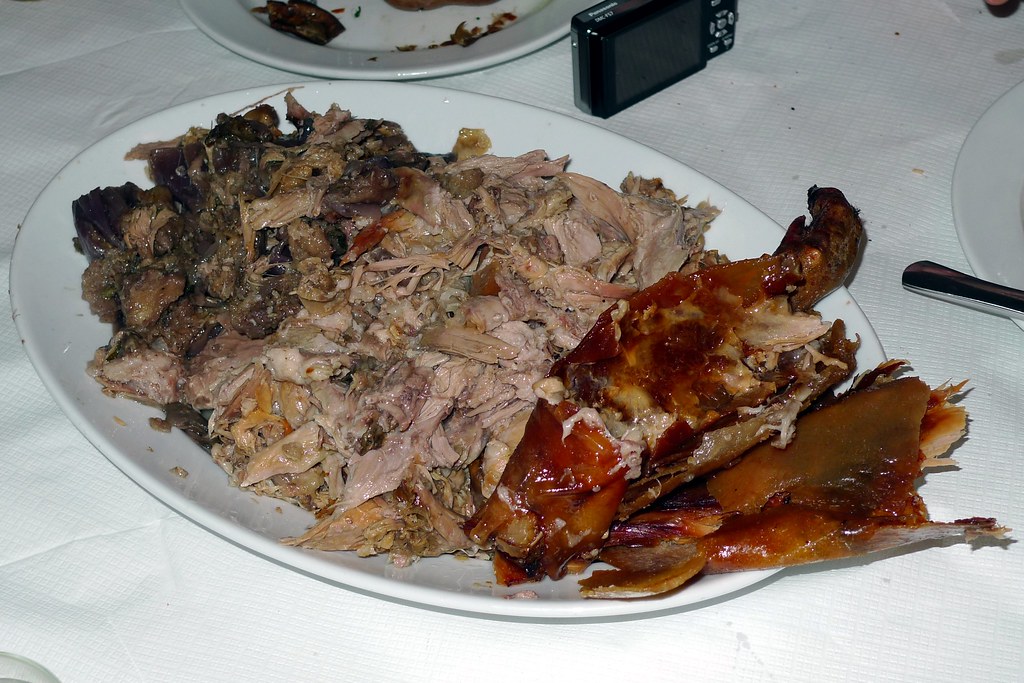
Image context: the cover photograph shows a carved suckling-pig course at St. JOHN in 2010. It is a real restaurant photograph, not a diagram or generated visual, and its bluntness is the point: the plate asks the diner to face the animal as food, craft, portion, and responsibility at once.[6]
1. Smithfield was not scenery. It was the right pressure system
St. JOHN's location matters because Smithfield gives the restaurant a civic logic before the menu starts speaking. The official history places the opening in a former smokehouse on St. John Street, in an area then described as somewhat decayed, between the City and High Holborn.[1] 50 Best Discovery sharpens that geography by identifying the building as a former bacon smokehouse near Smithfield meat market.[3] In another restaurant, that might be heritage dressing. Here it becomes structural.
The room did not need velvet, silver, or theatrical darkness because the building had already set the terms. A former smokehouse near a meat market makes meat harder to romanticize as an abstract luxury object. It puts the restaurant closer to supply, trade, butchery, and blunt appetite. That does not mean St. JOHN is a nostalgic market canteen. It means the restaurant's refinement comes from editing rather than concealment. White walls, clear menu language, strong bread, and unfussy plates make the meal feel accountable to the building.
This is where the St. JOHN lineage begins to differ from ordinary rustic revival. A restaurant can put old dishes on a menu and still treat them as costume. St. JOHN treated older British cooking as a live technical language. Faggots, ox liver, braised kid, bone marrow, madeleines, rare cuts, potatoes, greens: these are not deployed as curiosities, but as parts of a menu grammar in which pleasure comes from directness and timing rather than spectacle.[3][4]
2. Nose-to-tail became persuasive because it moved through dishes, books, and habits
The 1999 publication of Nose to Tail Eating is the key event after the restaurant's opening.[1] Cookbooks can freeze a restaurant into brand language, but Henderson's book did something more useful. In its American form as The Whole Beast: Nose to Tail Eating, Google Books lists it as a 2004 HarperCollins cooking book and describes a collection centered on dishes such as trotters, rabbit, bone marrow, Eccles cakes, and other recipes that made the restaurant's method portable.[5]
That portability is important. The St. JOHN idea did not spread because every restaurant wanted to copy the room exactly. It spread because the argument could survive translation. A chef in another city could read the book and understand that "less prized" parts were not lesser ingredients. A diner could eat roast bone marrow and parsley salad and realize that luxury might be marrow, toast, salt, and acidity rather than caviar architecture. A baker could see why bread mattered as infrastructure, not filler. A wine buyer could understand why direct grower relationships sat naturally beside a plain dining room.[1][2]
This is why St. JOHN's influence feels deeper than a signature dish. The restaurant altered the moral and sensory status of cuts that many modern dining rooms had treated as embarrassing. It did not do so by lecturing the table. It did it by making the food taste necessary. Once that happens, the ethical claim and the appetite claim reinforce each other: if an animal is killed for dinner, the neglected parts should not require apology; if they are cooked well, they also should not require solemnity.
3. The plain room made the food louder
50 Best Discovery describes St. JOHN as a no-frills, white-walled dining room where focus stays on the food, with Henderson's menu championing offal, rare cuts, and historical English recipes.[3] Michelin's current listing arrives at a similar conclusion from a guidebook angle: St. JOHN remains a place to try bone marrow, ox liver, and other dishes rooted in nose-to-tail cooking, while seasonality shows even through the apparently simple potatoes and greens.[4] The overlap between those two descriptions matters. One source reads the restaurant through influence; the other reads it through current guide standards. Both end up at the same discipline.
The room's plainness is not neutral. It changes how a diner reads the plate. In a heavily designed restaurant, offal can become transgressive theater: "Look what daring thing we are serving." At St. JOHN, the visual grammar goes the other way. A liver dish or marrow bone lands as lunch, supper, hunger, and craft. The absence of visual flattery makes the kitchen's judgment more exposed. If the cooking is poor, there is nowhere to hide. If it is right, the directness becomes its own luxury.
The current Smithfield page keeps that operating rhythm visible. Menus are updated daily and do not go online until 11:00am for lunch and 5:00pm for supper; lunch runs Monday to Saturday from 12:00pm to 3:00pm, Sunday from 12:00pm to 4:00pm, and supper runs Monday to Saturday from 6:00pm to 10:30pm.[2] Those details are mundane, but they are the restaurant's continuing proof of life. The St. JOHN idea depends on daily judgment: what came in, what should be cooked, what can be served plainly today.
4. Bread and wine made the philosophy bigger than meat
It would be easy to reduce St. JOHN to animal parts, but the restaurant's own history resists that simplification. Direct wine buying begins in 1996, the bakery grows out of demand for St. JOHN sourdough, Bread and Wine opens across from Spitalfields Market in 2003, and the Bermondsey bakery follows in 2010.[1] 50 Best Discovery now describes the group as three restaurants plus a bakery, winery, and wine company.[3] That growth matters because it shows the philosophy widening without becoming a conventional rollout machine.
Bread is central here because it keeps the argument grounded. Nose-to-tail cooking can become a slogan if it is separated from the rest of the table. St. JOHN's bread makes the meal more practical and more generous: marrow needs toast, sauces need something to catch them, lunch needs structure. Wine works similarly. Gulliver's direct buying from French growers was not a decorative side project; it made the glass part of the same plainspoken system.[1]
This is the part of St. JOHN's lineage that many imitators miss. The restaurant is not simply "the offal place." It is a whole model of restraint: a room stripped down enough to make food visible, a menu flexible enough to follow supply, bread serious enough to become its own institution, and wine buying close enough to producers to avoid luxury markup as the only signal of taste.[1][2][3]
5. Why the lineage still matters
St. JOHN's continuing relevance comes from a contradiction it resolved early. Fine dining often sells distance: distance from the animal, distance from labor, distance from ordinary appetite, distance from the mess of supply. St. JOHN sells proximity, but it does so with enough precision that proximity becomes elegant rather than crude. That is a hard balance. Too much polish and the philosophy becomes branding. Too little craft and it becomes affectation.
Condé Nast Traveler's capsule captures the social afterlife: chefs and serious eaters still treat the flagship as an iconic destination for nose-to-tail dining.[7] Michelin's current guide status keeps the pressure on the restaurant as a present-tense dining room, not just an influential memory.[4] 50 Best Discovery preserves the historical frame: former bacon smokehouse, Smithfield, pioneer since 1994, offal and rare cuts, no-frills room.[3] The sources line up because the restaurant's argument has stayed unusually legible.
The lesson is not that every ambitious restaurant should serve more offal. That would flatten St. JOHN into fashion. The better lesson is that a restaurant becomes influential when its constraints are coherent enough to teach other people how to think. St. JOHN taught a generation that thrift could be a luxury language, that old English dishes could survive modern scrutiny, that bread and wine were not supporting cast, and that plainness could be more exacting than decoration.[1][3][5]
That is why the Smithfield restaurant still feels worth writing about now. It did not merely rescue neglected cuts. It changed the dining room's idea of respect: respect for the animal, for appetite, for historical recipes, for the workers baking bread and buying wine, and for diners who do not need luxury softened into prettiness before they can recognize it as pleasure.
Sources
- St. JOHN, "Our Story" - official timeline covering the 1994 Smithfield opening in a former smokehouse, the 1999 publication of Nose to Tail Eating, bakery growth, Bread and Wine, direct wine buying, and the 2009 Michelin star.
- St. JOHN Smithfield official page - address, daily menu-update note, lunch and supper hours, corkage, cakeage, and service-charge policy.
- 50 Best Discovery, "St John - London - Restaurant" - profile covering the former bacon smokehouse near Smithfield market, nose-to-tail influence since 1994, offal and rare cuts, historical English recipes, room style, average price, and current group footprint.
- MICHELIN Guide, "St. JOHN - London" - current restaurant listing covering nose-to-tail cooking, bone marrow, ox liver, seasonality, and the guide context.
- Google Books, Fergus Henderson, The Whole Beast: Nose to Tail Eating (HarperCollins, 2004) - bibliographic page and publisher description of the cookbook's nose-to-tail recipe scope.
- Wikimedia Commons, Ewan Munro, "St John Restaurant, Smithfield, London" (photographed March 2, 2010) - source page for the article image, showing a carved suckling-pig dish at St. JOHN Smithfield.
- Condé Nast Traveler, "St. JOHN" - travel-review page framing the flagship as an iconic London destination for chefs and food-focused diners interested in Fergus Henderson's nose-to-tail cooking.