Akoko is easy to misread if you approach it with the wrong question. The useful question is not whether a London tasting menu can make West African food "elegant." That frame starts from a bad assumption: that refinement arrives only when spice, smoke, palm, pepper, yaji, or jollof memory are softened into a more familiar European register. Akoko's stronger argument is the opposite. Its craft lies in keeping those signals vivid while giving them structure.
The restaurant's own public menu makes that clear before any course arrives. Akoko publishes a full tasting menu at 130 pounds, a shorter lunch menu at 65 pounds, a wine pairing at 100 pounds, and a soft pairing at 60 pounds, with lunch from Thursday to Saturday and dinner from Monday to Saturday.[1] That is not a casual West End format dressed up with a tasting-menu price. It is a controlled room with a limited number of paths, meaning the kitchen can sequence heat, acidity, smoke, grain, shellfish, meat, and sweetness with real pressure rather than letting the guest assemble a loose tour of flavors.[1][3]
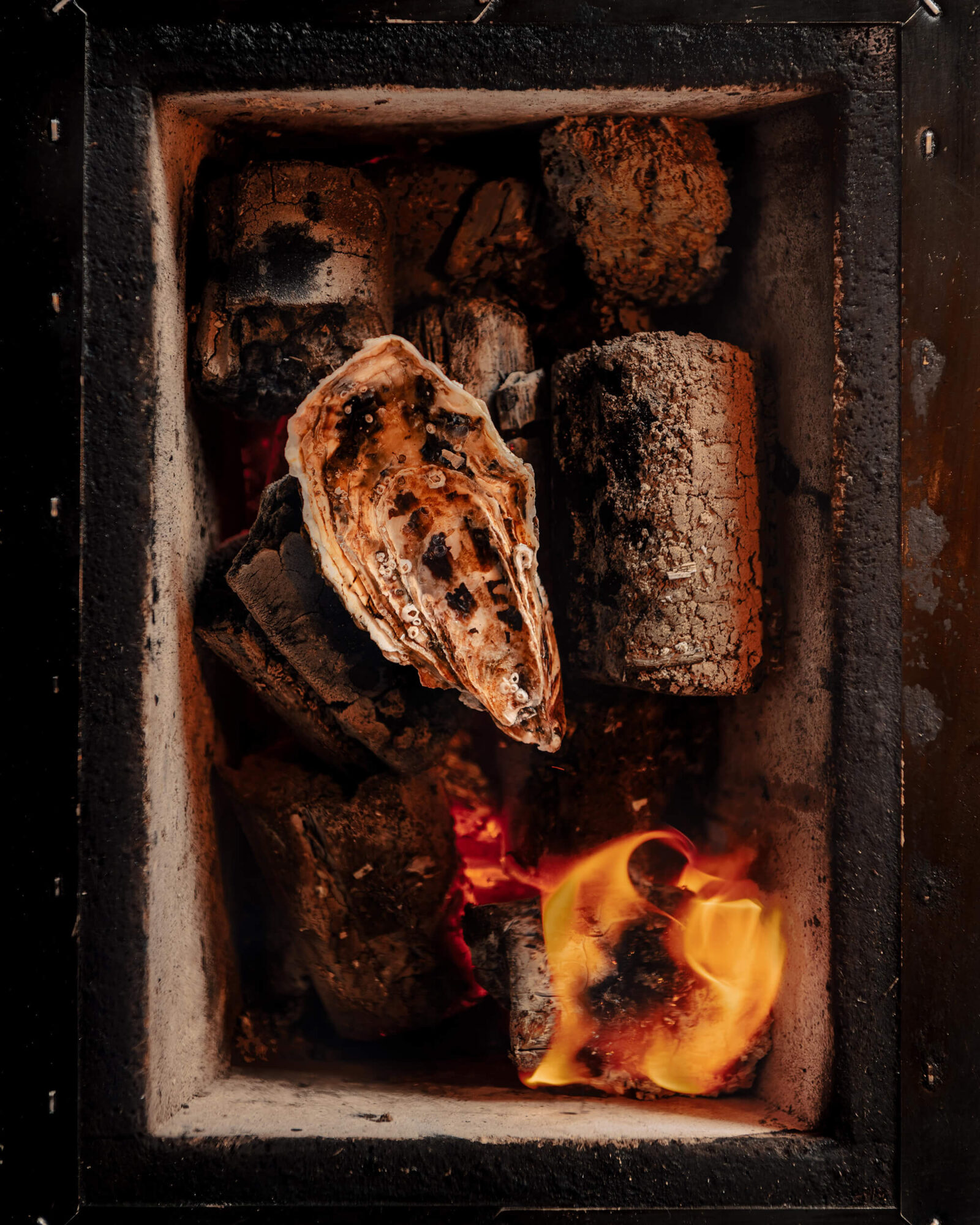
Image context: the cover uses Akoko's own oyster-over-fire photograph because it captures the restaurant's most important technical promise. The point is not simply that the food is dramatic. It is that shell, flame, dark surface, and tight plating all signal a kitchen trying to make intensity legible course by course.[1][6]
1. Fire is not just flavor here
The most useful way to read Akoko's food is as a set of heat-management problems. West African cooking traditions include many routes to depth: live fire, frying, slow stewing, smoking, fermenting, pounding, drying, and the layered use of alliums, chiles, grains, legumes, and seafood. A tasting-menu kitchen cannot simply copy those domestic or regional forms at restaurant scale. It has to translate them into smaller, faster, more precisely repeated bites without losing the reason they mattered.
Akoko's published sample menu shows how that translation works on paper. Dishes such as ojojo with yam, vegetable medley, and baobab yaji; ekuru with red mullet and black-eyed bean sauce; egusi with monkfish and okra; and jollof with beef, ox tongue, and mbongo sauce place luxury products and West African reference points inside the same sequence.[2] The craft challenge is that these references carry strong expectations. Yaji should not become a polite dusting of spice. Jollof should not become a generic tomato-rice accent. Black-eyed bean sauce and okra should not read as decorative nostalgia. Each element has to keep enough force to be recognizable while being tightened to the pace of a Mayfair dining room.[2][3]
That is where fire earns its place. Michelin's current listing describes Akoko as a polished, high-achieving room whose cooking draws from West African flavors and is delivered through a tasting-menu structure.[3] The important technical point is that live fire gives the kitchen a way to create bitterness, sweetness, smoke, and surface tension without relying only on chile impact. Char can make shellfish taste more mineral. Smoke can give a sauce weight before it becomes heavy. A grilled edge can make palm, pepper, tomato, legume, or fermented notes feel deeper without turning the plate muddy.
2. Jollof logic matters more than jollof nostalgia
The jollof reference is especially revealing. In a weaker restaurant, "jollof" would be a comfort-word garnish: a recognizable name used to warm up a fine-dining menu. At Akoko, it works better as a structural idea. Jollof is not only rice plus tomato. It is a lesson in how grain absorbs sauce, smoke, oil, pepper, and stock until flavor no longer sits on the surface. When Akoko places jollof with beef, ox tongue, and mbongo sauce on the sample menu, the move is not just cultural signaling.[2] It gives the meal a ground note after more delicate seafood and vegetable courses.
That matters because tasting menus often fail when every course tries to be a peak. Akoko's strongest public menu signals suggest a different rhythm: a mussel or red mullet course can carry brightness and perfume; baobab yaji can bring dry aromatic lift; egusi can deepen fish with nutty body; jollof can compress seasoning into grain; tamarind, aidan fruit, plum, and millet can reset the palate with cooler or fruit-driven registers.[2][4] The point is not escalation alone. It is alternation.
The World's 50 Best Discovery profile is useful here because it places Akoko inside London's serious dining map while emphasizing that the restaurant is built around West African memory, modern London polish, and a compact tasting format.[4] The Infatuation's review is useful for the diner-side version of the same point: Akoko reads as a serious London tasting-menu experience, not a novelty room built on references alone.[5] That combination is harder than it sounds. Too much polish and the food becomes detached from the cuisines it cites. Too much unmanaged force and the tasting menu becomes a sequence of loud gestures. Akoko's technical interest sits in the middle: it uses fine-dining control to preserve intensity rather than suppress it.[3][4][5]
3. Spice needs pacing, not apology
The most common mistake in writing about restaurants like Akoko is to treat spice as a personality trait. Spice is not one thing. It can be dry, floral, resinous, fermented, fruity, smoky, bitter, numbing, oily, or slow-building. In a tasting menu, those differences need spacing. Otherwise every dish starts leaning on the same register and the meal loses detail.
Akoko's drinks architecture helps solve that. The official site publishes not only the main menus but also beverage options, including wine pairings and non-alcoholic pairings.[1] That matters because serious spice-driven cooking needs liquids that do more than cool the mouth. A pairing can sharpen pepper with acid, round smoke with lees or texture, carry chile through sweetness, or reset palm and fat with bitterness. The non-alcoholic route is not a minor courtesy in this setting. It is part of making the food readable for guests who want the same course logic without alcohol.[1]
This is also why Akoko's small-format control is important. A large a la carte table can let one diner order the hottest, richest, or most familiar dish and call that the restaurant's identity. A tasting sequence makes the kitchen responsible for contrast. When Akoko puts yaji, mussels, red mullet, egusi, monkfish, jollof, beef, ox tongue, tamarind, and millet into one controlled progression, it is not merely representing West Africa as a flavor archive. It is testing how those flavors behave under high-end service constraints.[1][2][3]
4. The room matters because it lowers the noise floor
Akoko's dining room is restrained, and that restraint is part of the technique. The official photography and Michelin listing both present a calm, low-distraction space rather than a room overloaded with visual folklore.[1][3][6] That matters more than design chatter. When a restaurant is working with forceful seasoning, smoke, and culturally loaded reference points, the room should not compete for the same attention. It should give the food enough quiet to show its internal structure.
That quiet also keeps the restaurant from becoming a theme-room version of West African dining. The stronger read is that Akoko uses Mayfair polish as a control surface. Service, plating, lighting, and menu sequence make the flavors legible to diners who may know the reference points deeply and to diners meeting them in this format for the first time. The best version of that hospitality is not translation that dilutes. It is translation that keeps the original pressure intact while making the path through it clear.
Seen this way, Akoko's fine-dining importance is not that it proves West African food can enter luxury dining. That point should no longer need proving. Its importance is more exact: it shows that smoke, jollof logic, yaji seasoning, legume depth, shellfish sweetness, and careful beverage pacing can form a complete tasting-menu grammar. The fire works because the spice has structure. The structure works because the kitchen does not apologize for the fire.
Sources
- Akoko official website, current homepage and menus, covering opening days, tasting-menu pricing, short-lunch pricing, pairing prices, dietary limits, service duration, and the restaurant's public positioning.
- Akoko, "Sample tasting menu" PDF, covering the published course sequence including ojojo, ekuru, egusi, jollof with beef and ox tongue, tamarind, aidan fruit, plum, and millet.
- MICHELIN Guide, "Akoko - London," current restaurant listing covering Michelin-star status, West African flavor framing, tasting-menu format, and dining-room context.
- The World's 50 Best Discovery, "Akoko - London - Restaurant," profile covering Akoko's West African fine-dining identity, Mayfair setting, tasting format, and signature flavor references.
- The Infatuation London, "Akoko Review," review context on how Akoko's London tasting-menu experience reads to diners.
- Akoko official image asset used for the lead photograph, showing an oyster dish over live flame.