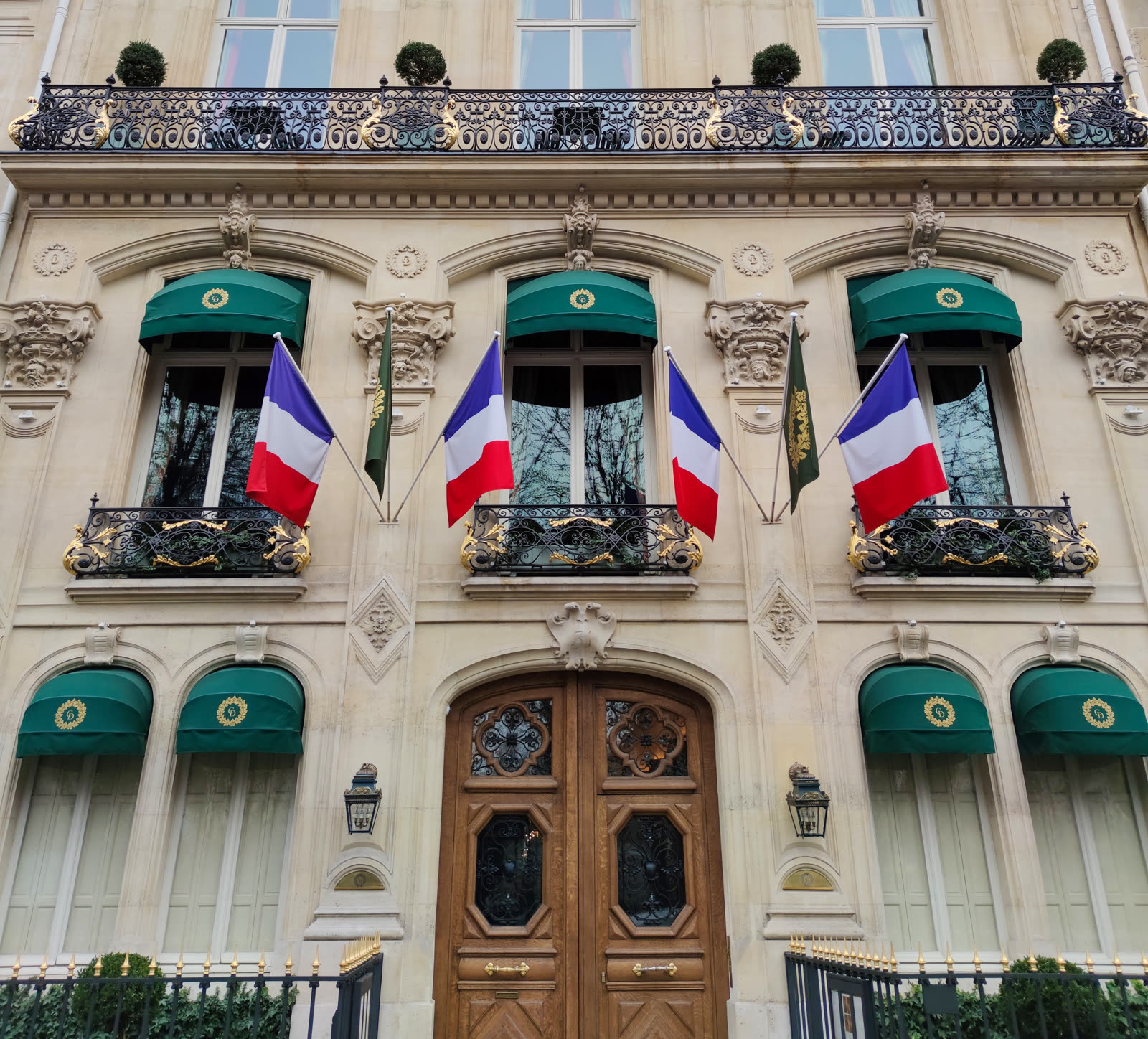
The smart order at Le Clarence in 2026 is not automatically the longest one. That is the trap. A two-star Paris mansion with wood paneling, a serious cellar, and a tasting-menu reputation naturally pushes the diner toward procession: more sequences, more wines, more proof that the occasion was worthy of the room.
The more interesting move is to use the new weekday lunch carte as a pressure valve. Le Clarence now presents a Tuesday-to-Friday lunch menu of starters, main courses, and desserts, renewed monthly and designed for business lunches or tighter agendas; the official site says a complete lunch can be paced at about one to one and a half hours depending on the guest's desired rhythm.[1] That turns the restaurant from a single ceremonial object into a set of choices.
This matters because Le Clarence is in transition without looking transitional. Andrea Capasso, who worked at the restaurant for years before becoming executive chef, is now the kitchen's public author. The restaurant says it celebrated its two Michelin stars at the 2026 ceremony under Capasso's direction, while its own menu page frames his cooking around disciplined creativity, texture, and a land-and-sea balance.[1][2][3] The ordering question is therefore practical: how much of this new Le Clarence do you want in one sitting?
Order the lunch carte when time is the luxury
Start here if the day already has a shape. A museum opening, a meeting, a train, a second dinner, or a Paris afternoon that should not be swallowed whole by lunch all point toward the carte. The restaurant's homepage is unusually explicit: the weekday lunch carte exists alongside the tasting menus, showcases seasonal products, changes monthly, and allows a complete meal inside a controlled time window.[1]
That is not a downgrade. It is a different product. The carte is the best choice when the room, service, and kitchen authorship matter, but the guest does not need the kitchen to compose the whole afternoon. It should suit a two-course business lunch, a solo diner who wants precision without four hours of ceremony, or a visitor who wants Le Clarence's atmosphere before walking back toward the Grand Palais and the Champs-Elysees axis.
What to get: one starter, one main, and either dessert or a glass from the cellar if the savory side is the point. The ordering discipline is to resist turning the carte into a private tasting menu by adding every possible flourish. If you are choosing the faster format, let it be fast. The value is not only monetary. It is the ability to leave while the room still feels like a place you entered, not a machine you had to complete.
What to skip: the carte if your real desire is to be led. Le Clarence's own restaurant page says there is "no settled menu" in the broader dining-room experience, but rather dishes based on exceptional seasonal products, assembled for guests with instinct and spontaneity.[2] If that open-ended authorship is what you came for, the carte may feel too self-directed.
Choose three sequences for a proper lunch, not a conquest
The most balanced tasting-menu move is the 150 euro lunch menu in three sequences, offered Tuesday to Friday.[2] It is the right order for someone who wants the kitchen's sequencing but does not want lunch to become an endurance sport. Think of it as the house's compact argument: enough structure to feel like Le Clarence, not enough length to turn the afternoon into a proof of stamina.
This is also the format most likely to show whether Capasso's version of Le Clarence is settling into itself. The official 2026 Michelin note describes his cooking as a sequence-driven style built around precise products, fine acidity, and clear but sometimes unexpected writing.[3] A three-sequence lunch has less room to hide. It cannot rely on course count for drama. The kitchen has to make each transition count.
What to get with it: the more modest "Clarence" wine pairing if you want the cellar involved without letting wine become the dominant expense. The restaurant lists the three-sequence lunch pairing from 110 euros, while the "Inspiration" pairing for the same menu begins at 390 euros.[2] That spread is the whole decision. If this is a lunch built for balance, the lower pairing lane reads more coherent than treating the glassware as a second trophy cabinet.
What to skip: the three-sequence menu if you are likely to regret not seeing the room at full theatrical length. Le Clarence is built for lingering. Its premises page describes a 19th-century private mansion opened as the restaurant in November 2015, with several dining rooms, a bar, and a private-house atmosphere inspired by Bordeaux estates.[4] If the building is the reason for the booking, a short tasting menu may feel like leaving before the second act.
Move to four sequences when dinner is the occasion
The four-sequence Le Clarence menu is the threshold where the restaurant becomes an evening plan. It is listed at 250 euros at lunch and 280 euros at dinner.[2] That pricing is telling. The lunch version is only slightly below dinner, so the choice is less about arbitrage and more about timing. Lunch gives daylight and a softer landing; dinner gives the room more gravity.
Order four sequences when you want enough time for the mansion to become part of the meal. The official premises page is not background decoration here. It describes the Pontac, Lestonnac, and Talleyrand dining rooms, a reception room and bar, thick carpeting, soft lighting, and views toward the Grand Palais glass roof from parts of the house.[4] A four-sequence meal is long enough for those details to stop being scenery and start acting like service.
This is also the right format for diners who care about the cellar but do not want the longest food menu. Le Clarence says its wine selection now includes more than 1,500 references from more than 500 winegrowers across France, with Domaine Clarence Dillon wines prominently featured.[2] That wine identity is not incidental. The restaurant is owned within the Domaine Clarence Dillon world, and the private mansion is part of the group's art-of-living project.[4] A four-sequence menu gives the sommelier room to work without forcing the kitchen into maximal length.
What to skip: the four-sequence menu at lunch if your schedule is secretly asking for the carte. A 250 euro lunch that must be rushed is a bad compromise. If time is tight, order the format designed for time. If the occasion is real, give the menu the space it needs.
Save six sequences for appetite and surrender
The six-sequence Inspiration menu is 380 euros at lunch and 430 euros at dinner.[2] This is the order for diners who want to stop negotiating. It should not be chosen because it is the "best" by default. It should be chosen because the guest actively wants Le Clarence to take over the meal.
That distinction is important. Long menus can become defensive buying: the diner spends more to avoid missing the supposedly complete experience. At Le Clarence, the smarter question is whether you want Capasso's kitchen in its widest register. The official restaurant page emphasizes spontaneity, seasonal products, and dishes assembled for each guest; the Michelin note describes a cuisine that seeks emotion through precise, readable construction.[2][3] Six sequences give that language the most room, but also ask the most patience from the table.
What to get with it: only the pairing level that matches your actual wine attention. The "Clarence" pairing starts at 210 euros for six sequences, while the "Inspiration" pairing starts at 510 euros.[2] If the wine program is the reason you chose Le Clarence, that upper lane may be the point. If you mostly want the kitchen, the lower lane or selective bottles may make the evening more legible.
What to skip: the six-sequence menu if you are trying to compare Paris star restaurants by value. This is the wrong yardstick. The six-sequence dinner is not the efficient way into Le Clarence. It is the surrender format, and surrender only works when you meant it.
The cleanest recommendation
For most first visits in 2026, book weekday lunch and decide honestly between two paths. If the day is tight, use the new carte and keep the order clean: starter, main, dessert or wine, out in the promised one-to-one-and-a-half-hour rhythm.[1] If the restaurant itself is the point, choose the three-sequence lunch and let the kitchen set the pace without turning the meal into an all-day commitment.[2]
Four sequences are for a real occasion. Six are for appetite, cellar attention, and surrender. The mistake is treating those longer menus as morally superior. Le Clarence's current strength is that it no longer has to be only one thing. It can be a grand private mansion with a serious tasting menu, or it can be a two-star Paris lunch that understands some guests have exactly one hour and still want the room to matter.
That is the order: do not buy the longest version of Le Clarence unless the day can hold it. Buy the version that lets the restaurant stay sharp.
Sources
- Le Clarence, official homepage - current overview of the Paris private-mansion setting, two-star status since 2017, Andrea Capasso, the 2026 Michelin-star note, the new weekday lunch carte, one-to-one-and-a-half-hour lunch pacing, opening days, address, and annual closure notes.
- Le Clarence, "The restaurant" - official menu and restaurant page covering Andrea Capasso's background, seasonal no-fixed-menu framing, three-, four-, and six-sequence menu prices, dinner prices, wine-cellar scale, and wine-pairing price bands.
- Le Clarence, "Le Clarence distingué de deux étoiles Michelin sous la direction d'Andrea Capasso" - official March 2026 news post on the Michelin recognition under Andrea Capasso, his September 2025 executive-chef role, weekday lunch carte rationale, service, and cellar context.
- Le Clarence, "The Premises" - official page on the 19th-century mansion at 31 Avenue Franklin D. Roosevelt, November 2015 opening, two-star recognition after opening, dining rooms, bar, reception room, Grand Palais view, and tableware.
- Wikimedia Commons, "Le Clarence, 31 avenue Franklin-D.-Roosevelt, Paris 2021.jpg" - real 2021 exterior photograph by CVB used as the article image.