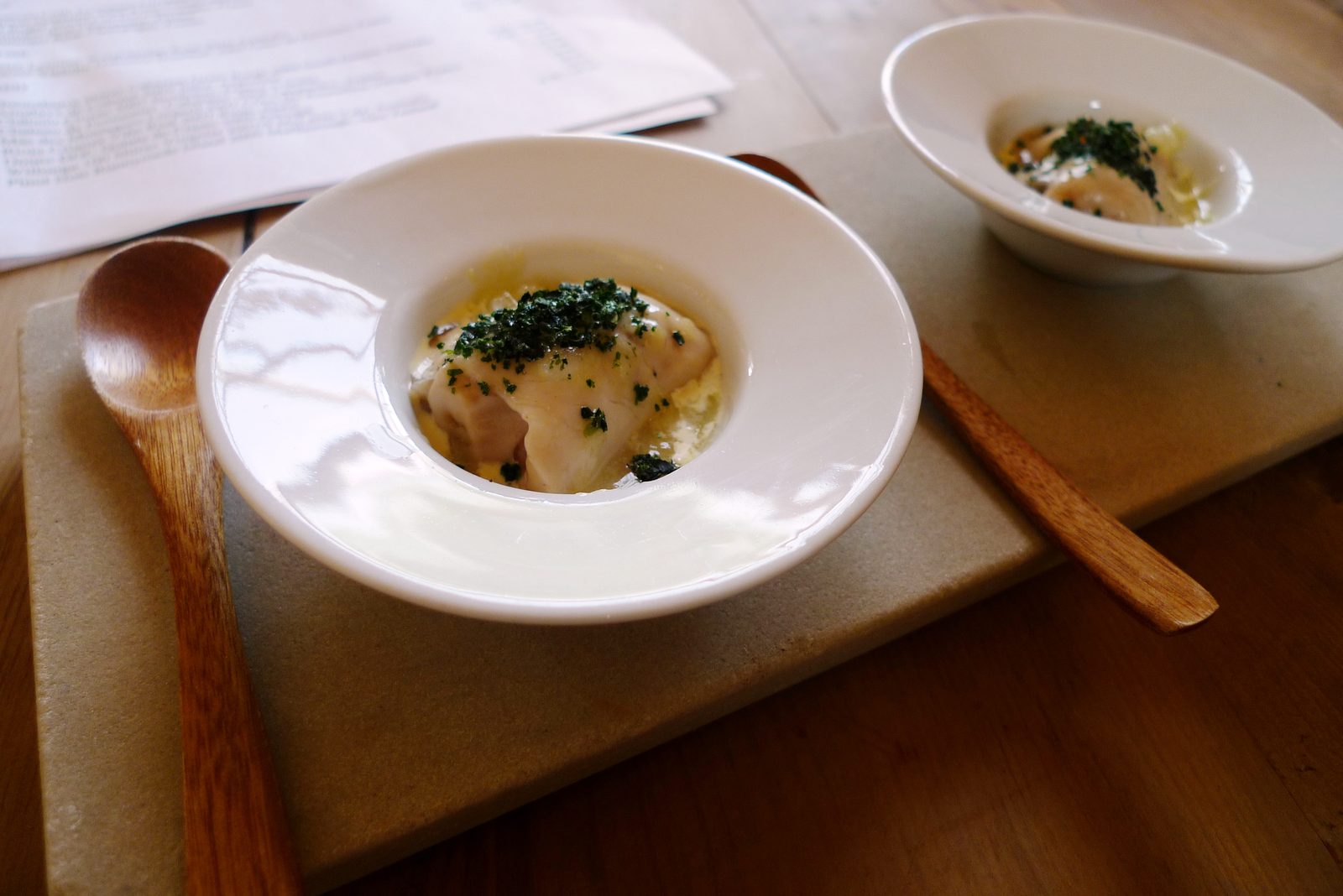
The Sportsman's most revealing dish is not revealing because it is complicated. Slip sole grilled in seaweed butter is almost aggressively bare: fish, butter, seaweed, salt, heat, plate. In a restaurant culture that often proves seriousness through accumulation, Stephen Harris made a different argument. The more exact the place, the less the plate needs to explain.
That is why the dish still matters in 2026. The current Sportsman menu continues to list slip sole grilled in seaweed butter as a fish-course option on a five-course spring menu priced at 85 pounds, alongside bread with home-churned butter and Seasalter salt, oysters, wild seabass, halibut, roast lamb, and other dishes that keep pointing back to the same coast-road pantry.[1] The restaurant's own history makes the frame explicit: Harris and the team took over the pub in November 1999, have held a Michelin star since 2008, and describe the cooking as dictated by the area around the pub, with the Thames Estuary and North Sea behind it, marshland and woods in front of it, and a kitchen garden and polytunnels close enough for produce to be picked moments before use.[2]
Slip sole is the cleanest version of that whole system because it removes the usual escape routes. There is no architectural garnish to admire if the fish is dull. No sauce construction can hide a weak butter. No luxury ingredient can make the dish feel expensive by association. The plate asks whether a small flatfish can taste more complete when it is returned to the sea through seaweed and salt.
Phaidon preserves the important origin story. In a recipe excerpt, Harris describes serving the fish alone as a "statement of intent," and the method is correspondingly severe: arrange the slip soles on an oiled griddle pan, set thin discs of seaweed butter over the fish, grill for a few minutes, baste, then let the residual heat finish the cooking before a light final seasoning.[3] The useful detail is not the exact minute count. It is the refusal to keep improving the dish once the relationship is clear. Fish takes heat. Butter carries seaweed. Salt sharpens the signal. Anything else risks turning a coastal idea into a restaurant idea.
Why the butter matters
Seaweed butter sounds like a garnish until the dish is understood as a local loop. The Guardian's 2016 profile of The Sportsman reported that the kitchen made its own butter, combined it with local seaweed, and produced salt on the premises using local seawater.[4] That matters because the butter is not just a flavored fat. It is the bridge between dairy richness and shoreline minerality.
Plain butter would make the fish feel gentle, maybe even nostalgic. Seaweed butter gives the dish a second register: iodine, green savor, and a faint sense of tide. It does not need to taste loudly of seaweed to do its work. Its job is to make the fish taste less isolated from its place. The same logic explains why the restaurant's current menu still begins with bread, home-churned butter, and Seasalter salt before moving into oysters and fish.[1] The opening grammar teaches the diner how to read the room: fat, salt, shellfish, small bowls, old pub bones, local weather.
This is not minimalism as style. Minimalism can become as mannered as excess when it asks to be admired for being empty. The Sportsman's restraint is more practical. Harris's cooking needs the dish to stay narrow because the source material is broad. The landscape already supplies fish, oysters, marsh lamb, garden vegetables, seaweed, salt, and weather. A heavy chefly signature would compete with that.
The pub is part of the dish
The temptation is to read slip sole in seaweed butter as a perfect object: one chef, one plate, one technique. But The Sportsman is more interesting when the room is left in the picture. The official site points out that an inn has stood on the site since 1642, and it connects Seasalter's food-production history to the Domesday Book and Canterbury Cathedral's kitchens.[2] That is not decorative antiquarianism. It explains why this dish lands differently here than it would in a polished city dining room.
At The Sportsman, the pub setting prevents the fish from becoming precious. The dish can be stark because the room is not. A seaside pub can serve a lone flatfish with butter and ask the guest to concentrate without making the concentration feel solemn. That informality is part of the engineering. It lets the plate be exact without becoming icy.
The 50 Best Discovery profile captures the same paradox from another angle, describing a gastropub with a large following since its 1999 launch on a site where an inn had stood since 1642, and a hyperlocal menu that draws from kitchen garden, polytunnel, North Sea fish, marshland meat and game, and even beach-reclaimed salt.[5] The point is not that every ingredient comes from a theatrically tiny radius every day. The point is that the restaurant has built its identity around knowing which nearby things are worth leaving alone.
That is harder than it sounds. A chef can overwork a modest fish because modesty feels commercially dangerous. Diners have paid for a destination meal; the plate may seem to need visible labor. Slip sole in seaweed butter answers by moving labor out of sight. The labor sits in sourcing, butter-making, salt-making, timing, restraint, and confidence. It is not absent. It is hidden in the decision not to add.
A dish that teaches the rest of the menu
The dish also works as a decoder for the larger meal. Once the slip sole has made its argument, the rest of The Sportsman reads more clearly. Oysters are not just oysters; they are part of the estuary vocabulary. Roast lamb is not just a British comfort signal; it belongs to the marshland in front of the pub. Bread and butter are not filler; they are the first lesson in dairy, salt, and house labor.[1][2][4]
This is why the dish has survived fame. "Signature dish" is often a trap: it freezes a restaurant around a single photogenic achievement. Slip sole in seaweed butter avoids that fate because it is not really a monument. It is a rule. When the rule is working, the restaurant can change the menu and still sound like itself: cook what the place gives you, intervene only when the intervention clarifies, and stop before cleverness drowns the ingredient.
The most sophisticated thing about the plate is its trust in attention. It assumes a diner can find drama in a fish shrinking slightly at the bone, in butter carrying seaweed across the flesh, in salt that belongs to the shore outside, and in a pub that has learned how to be serious without dressing up as a temple. That is a rare kind of luxury. It does not ask the diner to be impressed by how far the kitchen can travel. It asks whether the kitchen can stay put long enough for one small fish to taste like a coast.
Sources
- The Sportsman, "Tasting Menu" - May 2026 sample menu, pricing, service notes, slip sole listing, and seasonal-dish framing.
- The Sportsman, official homepage - restaurant history, Michelin-star timeline, Seasalter food-production context, local pantry description, and current practical information.
- Phaidon, "Stephen Harris shows us how to make the dish that just helped The Sportsman win best Gastro pub for the fourth time!" - recipe excerpt and context for slip sole grilled in seaweed butter.
- Jamie Doward and Martina Melli, "Seaweed, salt and soil: how 'terroir' cooking put local flavour on the plate," The Guardian, 2016 - reporting on The Sportsman's terroir logic, local produce, house butter, seaweed, and salt.
- 50 Best Discovery, "The Sportsman" - profile of the Seasalter gastropub, its 1999 launch, older inn site, hyperlocal menu, garden/polytunnel, fish, marshland sourcing, and key practical information.
- Wikimedia Commons, "File:Sportsman, Seasalter, Kent (6477075239).jpg" - Ewan Munro's 2011 photograph of baked oysters at The Sportsman, used as this article's lead image.