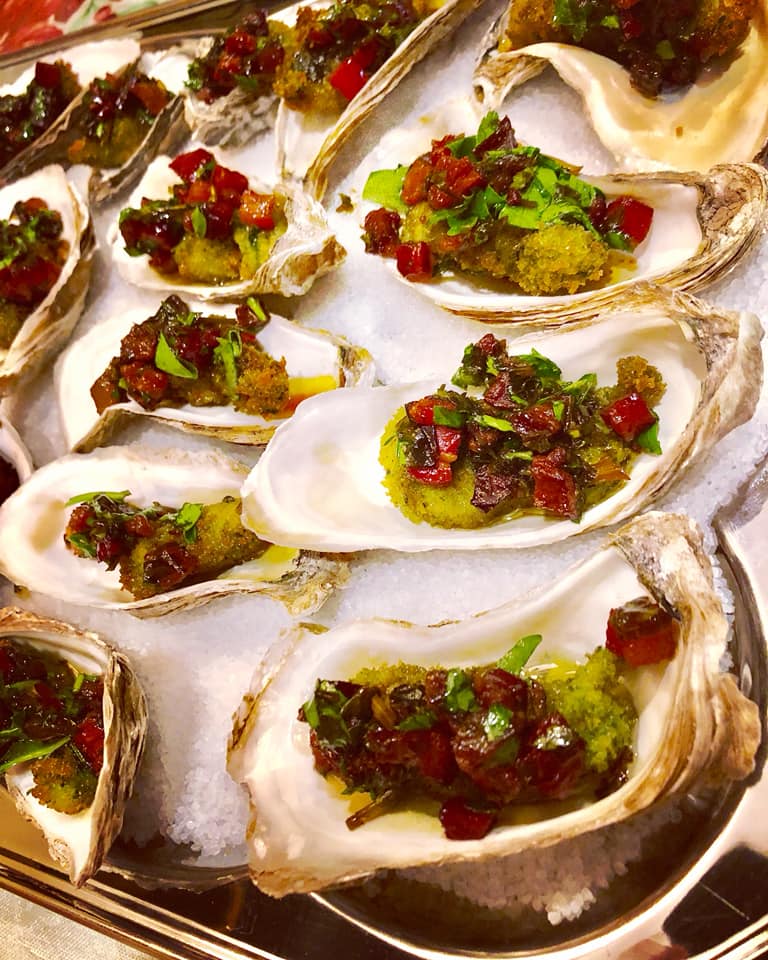
Oysters Rockefeller is a luxury dish built from a practical problem. The standard origin story begins not with a chef reaching for extravagance, but with Antoine's Restaurant in New Orleans losing easy access to French snails in 1899. Jules Alciatore, the founder's son, needed a substitute that made sense in the city around him. Oysters were local, abundant, and already part of the Gulf Coast appetite. What changed was the frame: instead of presenting them raw, he baked them under an intensely green, rich sauce and turned a replacement ingredient into a house legend.[1][2][5]
That is the enduring trick. The dish does not make oysters luxurious by hiding them under obvious expense. It makes them luxurious by surrounding them with scarcity, secrecy, heat, color, and room memory. A dozen raw oysters can feel democratic, briny, fast. Oysters Rockefeller slows the oyster down. It asks a kitchen to shuck, sauce, bake, arrange, and serve; it asks a dining room to carry the story that the original sauce is known only inside one old restaurant family.[1][5]
The result is one of American fine dining's most efficient myths. It has a date, a place, a named inventor, a famous wealth reference, and a secret recipe. It also has a useful contradiction: the central ingredient is local and perishable, while the name points to John D. Rockefeller and the richest public imagination of the late nineteenth century. A later Food Republic history summarizes the public logic neatly: the name evoked the sauce's richness and its green, money-like color.[4] Antoine's did not need to import aristocracy whole from France. It could make New Orleans shellfish behave like its own kind of grand restaurant currency.
The sauce is the story
The original Rockefeller sauce matters partly because so few people can say exactly what it is. Antoine's official history says Jules invented the dish and that the recipe remains closely guarded after many imitations.[1] A 64 Parishes history hosted by Antoine's gives the sharper restaurant lore: the French snail shortage pushed Jules toward oysters, and the sauce became a still-secret green compound associated with a large set of ingredients.[2] Roy F. Guste Jr., writing from within the Antoine's family tradition, gives the most useful boundary for modern cooks: the sauce is based on green vegetables, but not spinach.[5]
That boundary is important because many copies drift toward spinach dip in an oyster shell. The real fine-dining logic is subtler. The green should not only signal vegetable matter. It should signal concealment. If the diner can name every note immediately, the dish loses part of its spell. Butter and herbs are expected; the rest should feel like something the room knows and the guest is allowed to taste but not fully possess.
This is why the dish has survived as more than a recipe. It is a branded secret in edible form. Restaurant luxury often depends on access: a table, a room, a cellar, a reservation, a relationship with the staff. Oysters Rockefeller turns that same access logic into sauce. You can make an excellent imitation at home, but the original claim belongs to Antoine's because the restaurant kept the recipe embedded in family continuity, not just in printed instructions.[1][5]
A local oyster wearing grand clothes
Antoine's had the right stage for this maneuver. The restaurant traces its beginnings to Antoine Alciatore's 1840 New Orleans enterprise and moved to its current St. Louis Street address in 1868.[1][2] The Historic New Orleans Collection describes the Antoine's Restaurant Collection as an archive of a family business that has run for more than 180 years and situates the restaurant inside the city's long social memory.[3] That continuity matters because Oysters Rockefeller is not only a dish from a menu. It is a dish that can point to a building, a family, an archive, and a service culture.
The restaurant's expansion in the 1890s also matters. The 64 Parishes account describes Jules acquiring adjoining buildings, creating large banquet halls, and shaping a service culture that trained waiters for long periods before they handled guests directly.[2] That context changes how the oyster should be read. This was not merely a clever kitchen substitution. It was a dish born in a restaurant learning how to scale ceremony.
An oyster is physically small, but Oysters Rockefeller carries banquet energy. The shell gives each portion a built-in stage. The green sauce turns the surface theatrical. The oven adds a signal of labor and control. The name supplies the punch line before the first bite. In a room already accustomed to private dining, old-line families, Carnival rituals, and remembered waiters, a secret oyster dish could become a social token: not large, but legible.
Why secrecy improved the flavor
Secrecy can be a lazy marketing device. In Oysters Rockefeller, it does real work because the dish is otherwise easy to flatten. If it were simply "baked oysters with green herb butter," it would still be good, but it would lose the pressure created by origin, imitation, and refusal. The claim that the original has not left Antoine's makes every copy slightly argumentative. Is there spinach? Is there absinthe-like anise? Which herbs? How smooth should the puree be? How much breadcrumb? The restaurant does not have to settle the debate; the debate keeps the dish alive.[1][5]
That is a smart kind of culinary authorship. Fine dining often protects authorship through plating style or technical difficulty. Antoine's protected authorship through story control. The dish's shape is public enough to spread: oysters, green richness, heat. The exact mechanism is private enough to keep returning value to the source. This balance is why Oysters Rockefeller could become both a national restaurant appetizer and a New Orleans original at the same time.[4][5]
The sauce also made local abundance feel less vulnerable to commodity thinking. Oysters were plentiful enough to replace scarce snails, but abundance can make an ingredient seem cheap. Antoine's reversed that logic. It kept the oyster local, then added a sauce whose value came from inaccessibility. The luxury was not only in richness. It was in the gap between what everyone could see and what only the house could claim to know.
The lineage that still matters
The best reason to care about Oysters Rockefeller now is not nostalgia. It is that the dish shows how American fine dining learned to make place, myth, and operations reinforce each other. A local product solved a supply problem. A green sauce turned that solution into theater. A Rockefeller name translated richness into public language. A family restaurant guarded the recipe long enough for secrecy to become part of the flavor. An archive now preserves the broader restaurant world around the dish.[1][2][3]
That sequence is more interesting than a simple invention story. It explains why the dish remains hard to modernize without damaging it. Make it too light and it stops feeling Rockefeller. Make it too transparent and the mystery drains away. Make it too lavish and the oyster disappears. The plate needs the tension: Gulf Coast shellfish wearing a Gilded Age costume, served with the confidence of a restaurant that knows the costume has become part of the thing itself.
Oysters Rockefeller endures because it understands that fine dining is not always about rare ingredients. Sometimes it is about making a familiar ingredient pass through the right social machine. Antoine's took an oyster, gave it heat and green secrecy, named it after American wealth, and let more than a century of dining rooms repeat the story. The luxury was never just the sauce. It was the fact that the sauce made the room feel like the only place where the oyster could fully explain itself.
Sources
- Antoine's Restaurant, "About" - official restaurant history, Jules Alciatore biography, Oysters Rockefeller attribution, and guarded-recipe framing.
- Poppy Tooker, "Antoine's Restaurant," 64 Parishes, republished by Antoine's - detailed historical account of the restaurant, service culture, 1899 snail-shortage origin, and Rockefeller sauce lore.
- The Historic New Orleans Collection, "Antoine's Restaurant Collection" - archive description, founding context, family continuity, and preservation history.
- Brian Udall, "How Oysters Rockefeller Were Created In 1899 As A Replacement Dish," Food Republic, 2026 - origin summary covering the snail shortage, local oyster substitution, name, sauce color, and continuing recipe secrecy.
- Roy F. Guste Jr., "Oysters Rockefeller: The Real Recipe, Antoine's of New Orleans," FoodReference.com - family account of the 1899 origin, local oyster substitution, sauce secrecy, and spinach boundary.
- Wikimedia Commons, "File:Nathan's oysters rockefeller.jpg" - restaurant-table photograph used as this article's lead image.