Hassun is the course that proves how little room Japanese fine dining needs when its grammar is exact.
In a global tasting menu, the early courses often compete for immediate drama: smoke, caviar, hot broth poured tableside, a crisp shell designed to vanish in one bite. Hassun works differently. It does not usually announce itself as the loudest moment of the meal. It arrives as a compact seasonal arrangement, historically tied to a small square tray, and asks the diner to read before eating. The pleasure is not just in each morsel. It is in the way the tray turns scale, color, temperature, and timing into a single edible sentence.
At Kyoto Kitcho Arashiyama, the English menu explains the old measurement directly: the course takes its name from a hassun, a 24-by-24-centimeter wooden box associated with tea-ceremony meals, where delicacies of land and sea accompanied sake. The modern course remains an "assorted appetizers" moment, but the restaurant's description makes clear that the job is not random variety. Seasonal ingredients have to carry both visual impact and flavor.[1] The Ministry of Agriculture, Forestry and Fisheries' washoku publication makes the same point from a broader culinary-culture angle: hassun is designed in relation to the rest of the meal and is expected to bring the essence of the season to the table dynamically.[2]
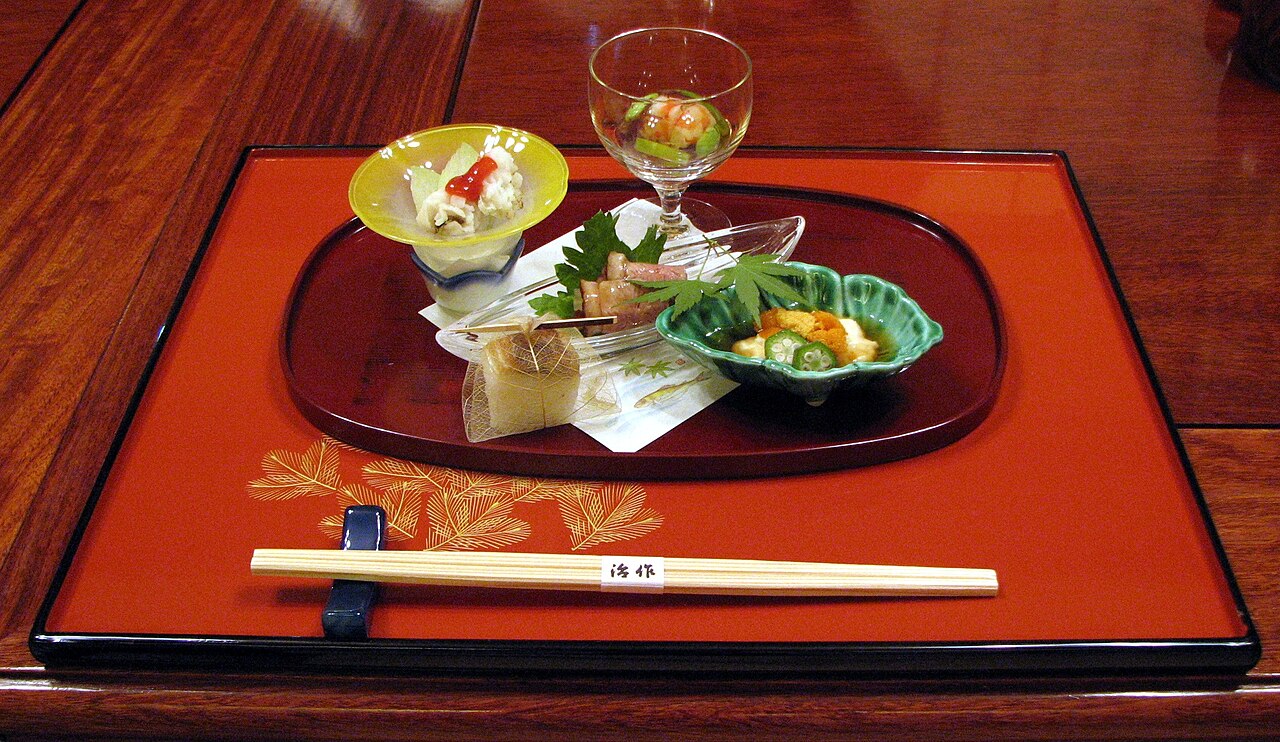
Image context: the cover is a real Wikimedia Commons photograph of kaiseki ryori at the Iwasaki mansion in Tsukiji, Tokyo. It is not presented as the exact Kyoto Kitcho tray discussed in the article; it is used because it shows the physical language this piece is about: small vessels, deliberate spacing, chopstick scale, and several preparations arranged for sequential attention rather than one large plate.[5]
The tray is a constraint, not a serving habit
The first craft decision is size. A small square tray or box changes the chef's problem. There is no room for the spread-out abundance of a Western appetizer platter, and no single object is allowed to dominate for long. Everything has to justify its footprint.
That constraint makes hassun closer to editing than to decoration. A chef needs enough contrast for the guest to feel a season opening up, but not so much contrast that the tray becomes a miniature buffet. One bite might carry the sea; another might bring mountain vegetables, preserved fruit, a grilled note, or something lightly cured. The point is not to show that the kitchen can do many things. The point is to make several small things feel as if they belong to the same weather.
This is why "assorted appetizers" undersells the course. In ordinary menu language, assortment can imply convenience: a chef gathers small items and gives the diner a little of everything. In hassun, assortment is the technique. The course has to organize difference. Land and sea, fresh and preserved, soft and crisp, pale and bright, sweet and saline all have to occupy one quiet field. If they do not relate, the course feels fussy. If they relate too obviously, it feels flat.
The best version has a kind of controlled asymmetry. One item may be visually taller, another darker, another placed in a shell, leaf, or small dish that changes how the eye moves. The guest is not meant to shovel across the tray. The course creates a reading order without printing one. The chopsticks become a pacing tool: lift, pause, reset, look again.
Seasonality has to be cooked before it is named
Fine dining often uses seasonality as a soft promise. Hassun makes the promise visible enough to test.
Kyoto Kitcho's published example describes a spring-sea motif: shells used as vessels, wild greens, abalone, shrimp, and sliced radish suggesting waves on the shore.[1] Whether a particular restaurant is that literal or more abstract, the underlying craft problem is the same. The course has to make the season feel present before the server explains it. Spring cannot be only a word in the menu copy. It has to appear through bitterness, tenderness, color, moisture, temperature, and negative space.
UNESCO's washoku entry is useful here because it frames Japanese dietary culture as a social practice built from skills, knowledge, production, preparation, and consumption, with strong attention to nature and annual events.[3] Hassun compresses that cultural frame into one service moment. It is not merely "seasonal produce." It is a small performance of knowing when something belongs: when a bud is young enough, when a fish reads as early summer rather than late spring, when a garnish is a cue rather than clutter, when a vessel makes a cold bite feel cooler.
That last point matters more than visitors often realize. In hassun, tableware is not a neutral holder. A shell can turn seafood into shoreline. Lacquer can deepen a grilled or simmered item. A pale ceramic can make greens look newly cut. A leaf can give fragrance, color, and a limit line at once. The food and the vessel share the task of saying "now."
Kichisen's public self-description places Kyoto cuisine inside tea ceremony, flower arrangement, incense ceremony, calligraphy, poetry, shrine landscape, and hospitality tradition.[4] That context helps explain why hassun can feel strange to diners trained by louder tasting-menu forms. The course is not trying to separate cuisine from the surrounding arts. It lets them leak into the plate. The chef's knife work, the florist's sense of line, the tea practitioner's awareness of occasion, and the host's duty to receive the guest all meet in a format small enough to sit between two hands.
Flavor works by intervals
Hassun can disappoint when a diner expects the first bite to be a climax. Its pleasure usually comes by interval.
Think of a tray with five or six elements. If every item is equally intense, the course becomes exhausting. If every item is equally delicate, the course becomes pretty but forgettable. The craft lies in spacing. A sweet note needs a saline neighbor. A soft bite wants crunch nearby. A fermented or cured accent needs freshness close enough to clear it. Something grilled or smoky may work best only because the next item is cool, green, or lightly acidic.
The sequence is not fixed in the way a Western multi-course progression is fixed. The diner may choose the order. That freedom gives the kitchen a harder assignment: the bites have to make sense in several possible paths. A chef can suggest movement through placement, height, color, and service explanation, but the tray still has to survive a guest who starts with the wrong-looking item.
This is where restraint becomes flavor. A small piece of fish cannot rely on volume. A mountain vegetable cannot rely on sauce weight. A preserved item cannot take over the palate too early. Each item has to be seasoned for its place in a sequence that may change slightly at the table. The seasoning is therefore relational. It asks: what will this taste like after the sweet bite? What will it do before sake? How long will the bitterness linger? Will the shellfish taste flatter if the guest eats it after the grilled item?
The link to sake is not decorative. The historical description at Kyoto Kitcho ties hassun to delicacies served to enhance guests' enjoyment of sake.[1] That changes how a chef can season the tray. Salt, cure, bitter greens, small grilled aromatics, and compact umami all have a social function: they keep conversation and drinking alive without turning the course into a heavy meal too early. Hassun is not only a prelude to more food. It is a mechanism for opening appetite at the same time that it slows the room down.
Why it still feels modern
Hassun survives in contemporary fine dining because it solves a current problem with an old tool. Modern tasting menus risk becoming either maximalist theater or a list of precious ingredients. Hassun offers another route: compression.
A chef can use the course to show sourcing without giving a speech, technique without turning the plate into a demonstration, and identity without flattening a cuisine into a slogan. A regional restaurant can make the tray local through river fish, forest plants, pickles, ceramics, or a festival reference. A Kyoto room can make it seasonal through spring shells, autumn leaves, New Year symbols, or the careful absence of anything that would break the mood. A modern chef outside Japan can learn from the format without copying it: the lesson is not "put six small bites on a square tray." The lesson is that a course can carry more meaning when its limits are strict.
That is why hassun is one of the most useful courses for understanding kaiseki as craft rather than mystique. It reveals whether the kitchen knows how to edit. It reveals whether the room understands pacing. It reveals whether the restaurant's seasonal language is alive or merely ornamental. Most of all, it makes the diner participate. You have to look, choose, taste, compare, and let the smallness do its work.
The course is quiet only if quiet means undemanding. Hassun is demanding in the way a short poem is demanding: every placement matters, every adjective has been cut or kept, and the empty space is part of the meaning. When it succeeds, the season does not arrive as information. It arrives as a tray small enough to hold in memory.
Sources
- Kyoto Kitcho Arashiyama, "Menus" - hassun description, 24-by-24-centimeter origin, land-and-sea delicacies, spring-sea example, course structure, and seasonal kaiseki context.
- Ministry of Agriculture, Forestry and Fisheries of Japan, The Washoku Way: Japan's Nuanced Approach to Food - discussion of washoku principles and hassun as a seasonal Kyoto Kitcho course designed in balance with the meal.
- UNESCO Intangible Cultural Heritage, "Washoku, traditional dietary cultures of the Japanese, notably for the celebration of New Year" - cultural framing for washoku as skills, knowledge, practice, nature, and annual-event food culture.
- Kichisen, official English site - Kyoto culinary context, hospitality tradition, and links between cooking, tea ceremony, flower arrangement, poetry, incense, and place.
- Chris 73, "Jisaku Kaiseki Ryori 01.jpg," Wikimedia Commons - real photograph of kaiseki ryori at the Iwasaki mansion in Tsukiji, Tokyo, used as the article image.