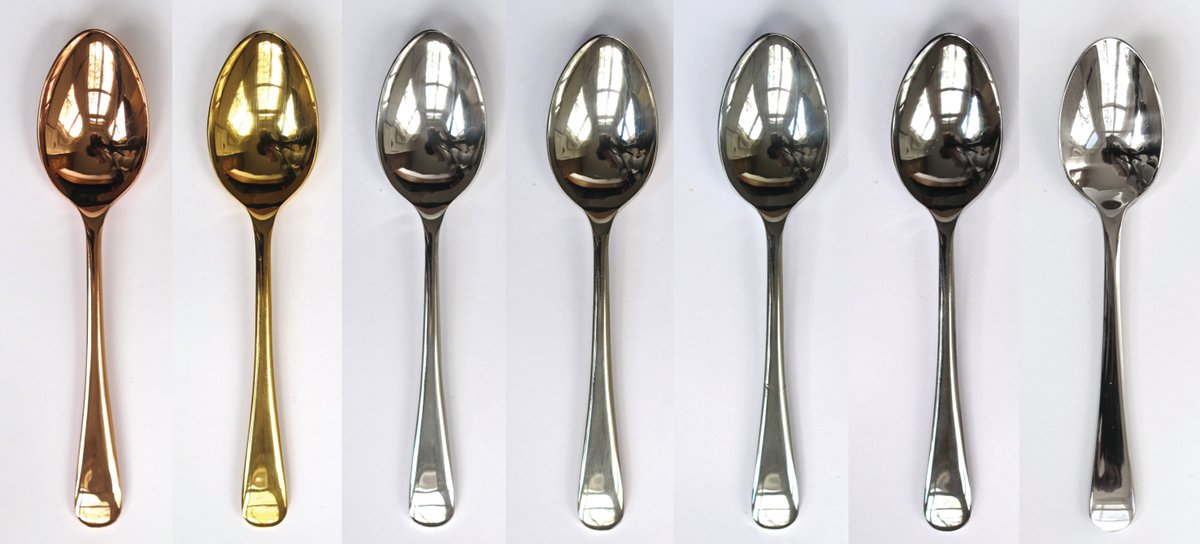


The last thing to touch a dish before the diner does is often not a garnish, a sauce or the chef's hand. It is a spoon. Its bowl edits the size of the bite. Its rim crosses the lips. Its weight arrives in the hand a moment before its contents reach the tongue. If the metal carries a taste of its own, that taste joins the food whether the menu acknowledges it or not.[4]
This makes the spoon fine dining's quietest piece of kitchen equipment: selected in the back office, laid by the dining-room team, then used by the guest to complete the course. A restaurant may spend weeks tuning the salinity of a broth and still treat the object that delivers it as visual furniture.
The two films here look unrelated at first. Science Channel's factory visit follows stainless flatware through force, dies and polishing.[1] A BBC Earth Science demonstration then puts cream on stainless-steel, zinc and gold spoons to ask what changes at the mouth.[2] Put together, they describe one continuous instrument—from sheet metal to taste—and a more interesting idea than “fancy spoons make food better.” A spoon is not a magic seasoning. It is the final interface of the recipe.
First, make a flat sheet fit a mouth
How It's Made: Flatware begins with an industrial paradox. A spoon looks inevitable only after a sequence of machines has made it so. Before it can cradle a velouté or lift the liquid center of a dessert, it is a strip of steel with no bowl, no balance and no comfortable edge.[1]
Watch the top of the utensil change. Cutting establishes the blank; rolling redistributes its thickness; pressing gives the bowl depth; grinding and polishing remove the harshness left by all that force. The familiar shape is not stamped into existence in one theatrical blow. It is approached through repeated corrections.
The film's pleasure lies in scale: ranks of blanks become ranks of finished utensils. But its fine-dining lesson is in the small differences that survive mass production. The spoon's working end has to be thin enough to feel natural at the lips, substantial enough not to flex unpleasantly, smooth enough to disappear as an edge, and deep enough to hold the intended bite. “Spoon” names a family, not a single geometry.
Mono's unusually detailed account of its own German manufactory makes that hidden specification concrete. Its spoons and forks begin in stainless sheets between 0.8 and 4 millimeters thick and take more than 30 operations. The upper part passes through a roller 16 to 30 times; Mono says the finished spoon top is brought to roughly 1.2 to 1.5 millimeters so it balances well and lies comfortably in the mouth. Later stages form the three-dimensional profile, sand the edges, polish or matte the surface, wash away compounds and inspect the result.[3]
Those figures belong to one maker, not a universal recipe for the perfect spoon. Their value is explanatory. Thickness is allocated. Curvature is pressed. The rim is finished. Balance emerges from a manufacturing sequence. When a restaurant chooses a spoon, it is choosing the accumulated consequences of those decisions even if the purchasing sheet lists only a pattern name and a price.
The same is true of a tasting-menu bite. A shallow spoon lets a composed garnish sit wide and visible but may surrender a thin sauce on the walk from pass to table. A deep bowl protects liquid yet can ask the diner to open wider or pull harder at the contents. A broad rim makes more contact with the lips. A long handle can create elegance across a large bowl and awkward leverage in a small hand. These are design inferences rather than universal sensory laws, but they are immediately testable with the actual course.
That is the first correction supplied by the factory film: flatware is not neutral merely because it is standardized. Standardization makes a set repeatable. It does not make every profile equally suited to every bite.
Then the material enters the mouth
The BBC clip turns the utensil into a tasting experiment. Materials scientist Mark Miodownik gives participants cream from stainless-steel, zinc and gold spoons, then asks them to compare the experience. The zinc announces itself with a metallic sensation; the gold prompts a different description of the same cream. Miodownik frames the contrast through material reactivity—the spoon is not merely carrying the sample but interacting at the mouth.[2]
This is a compact television demonstration, not a substitute for controlled evidence. Its value is that it makes the proposed mechanism visible and tasteable. A spoon works through more than one channel at once: its material may contribute a direct sensation; its weight and appearance can establish an expectation of quality; its size sets a familiar script—teaspoon, soup spoon, serving spoon—before the food arrives. The utensil belongs partly to materials science and partly to learned dining behavior.
The most direct evidence comes from a 2012 experiment by Betina Piqueras-Fiszman, Zoe Laughlin, Mark Miodownik and Spence. Participants tasted flavored creams from spoons plated in gold, copper or zinc, plus stainless steel. Copper and zinc introduced metallic and bitter sensations and, to varying degrees, intensified the cream's dominant taste. Yet those metallic sensations did not significantly change how pleasant participants found the samples.[4] The result is subtler than a luxury hierarchy. Gold was not crowned “best,” and an extra sensation did not automatically make the food worse.
A separate study by Vanessa Harrar and Spence varied plastic spoon size and weight, spoon color, and the utensil used for cheese. Its most useful finding is a warning against slogans. Yogurt sampled with visually identical but unexpectedly heavy plastic spoons was not simply upgraded by mass. The authors argue that the relationship between expected and experienced weight helped shape judgments; a light material behaving like a light material could fare better than one that violated its familiar script. They also caution that single-sample laboratory results do not transfer neatly to a whole restaurant meal.[5]
Real dining evidence adds another layer without resolving every variable. In a 2015 study, two groups ate the same three-course meal in a realistic dining environment. Diners given the heavier, higher-quality knife and fork with the main course rated the food more favorably on measures including liking, artistic presentation and willingness to pay.[6] That is relevant to restaurants, but “heavier, higher-quality” bundled mass with design and perceived quality. The study did not prove that adding grams to any spoon will improve any dish.
Together, the evidence makes the second correction: the utensil can influence the meal, but the effect depends on material, expectation, form, food and setting. “Heavy equals delicious” is merchandising. “This spoon changes this bite in these conditions” is a proposition a restaurant can test.
Give the course a spoon, not a prop
The practical experiment begins at the pass. Plate one bite exactly as it will be served, on the vessel it will use, at service temperature. Taste it with the candidate spoons—not only side by side in a silent prep kitchen, but after each has traveled the real route to the table. Notice what arrives first in the hand, whether the bowl collects the intended ratio, how cleanly the food releases, where the rim meets the mouth, and whether any metallic note persists after warewashing.
Then invite disagreement. A chef may value a weighty landing in the palm; a diner with reduced grip strength may experience the same mass as work. One guest may welcome a small, precise bowl; another may find it fussy. Sensory sensitivity, hand size and motor control do not disappear when a room becomes luxurious. The research's context dependence is not an inconvenience to design around. It is the reason to test with more than the person who approved the purchase.
Most courses do not need a bespoke implement. A calm, consistent stainless-steel pattern can let the food hold attention and can simplify resetting, polishing and replacement. A special spoon earns its entrance when its difference performs a clear job: delivering a precise proportion of sauce and garnish, avoiding a reactive metallic note, reaching a narrow vessel, or making an intended temperature and texture easier to perceive. If the server's explanation is more distinctive than the bite, the utensil has become costume.
The sensoaesthetic spoons in Zoe Laughlin's photograph clarify this standard.[7] Their silhouettes repeat while their surfaces change from copper through gold, silver, tin, zinc, chrome and stainless steel. They look like a collection, but they function as a question: how much of an eating experience belongs to the food, and how much enters through the material carrying it?
Fine dining should like that question because it already believes small decisions accumulate. It just tends to stop tracing them at the edge of the plate. The factory film shows that a spoon's curve and finish are made. The sensory experiment shows that the spoon is then felt, expected and sometimes tasted. The guest brings those two histories together in one motion.
The plate may have left the pass, but the course is not finished. The spoon is still cooking—not with heat, but by editing the final distance between the recipe and the body.
Sources
- Science Channel, “How It's Made: Flatware,” November 25, 2020 — the embedded factory film following the industrial shaping and finishing of stainless-steel flatware.
- BBC Earth Science, “Taste-Changing Spoon Experiment,” from Dara Ó Briain's Science Club — the embedded demonstration with materials scientist Mark Miodownik comparing cream tasted from stainless-steel, zinc and gold spoons.
- Mono, “Production process” — manufacturer's step-by-step account of sheet thickness, blanking, rolling, forming, edge sanding, polishing, cleaning and inspection for stainless-steel flatware.
- Betina Piqueras-Fiszman, Zoe Laughlin, Mark Miodownik and Charles Spence, “Tasting spoons: Assessing how the material of a spoon affects the taste of the food,” Food Quality and Preference 24, 2012 — institutional record, abstract and DOI.
- Vanessa Harrar and Charles Spence, “The taste of cutlery: how the taste of food is affected by the weight, size, shape, and colour of the cutlery used to eat it,” Flavour 2, 2013 — full experimental methods, results, limitations and conclusions.
- Charles Michel, Carlos Velasco and Charles Spence, “Cutlery matters: heavy cutlery enhances diners' enjoyment of the food served in a realistic dining environment,” Flavour 4, 2015 — open-access full article, including methods, results and limitations.
- Wikimedia Commons, “Sensoaesthetic Tasting Spoons.jpg” — Zoe Laughlin's 2012 photograph and metadata for the seven metal spoons used as the article image.