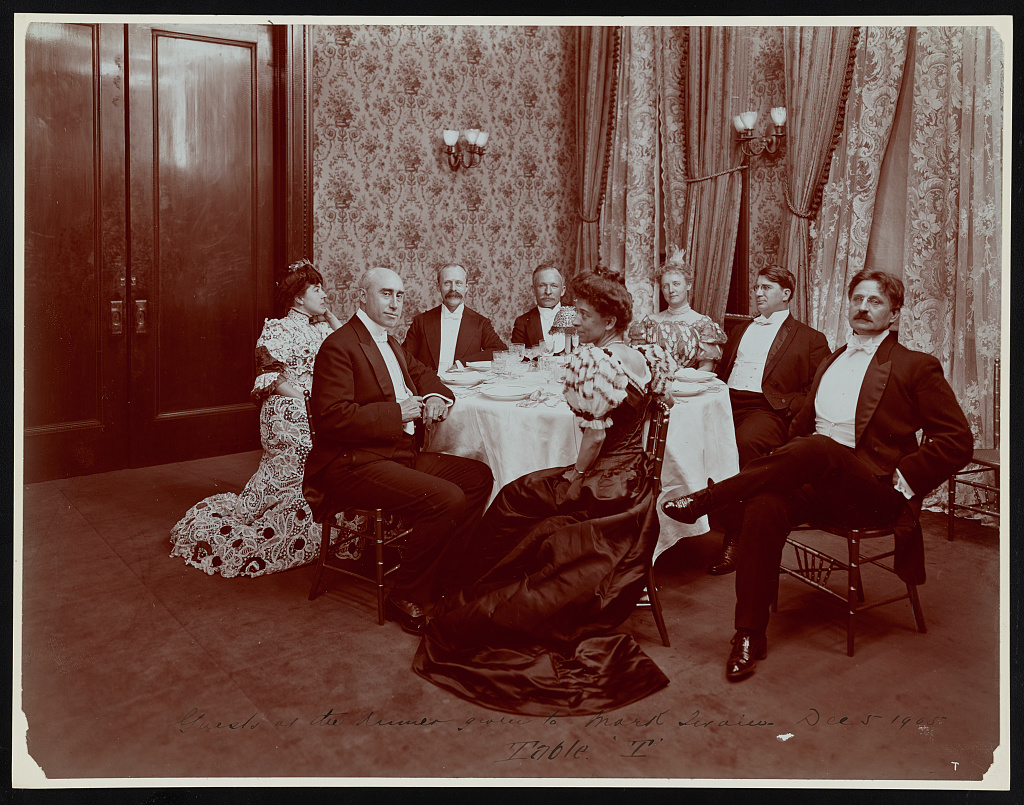
At Table T during Mark Twain's seventieth-birthday dinner at Delmonico's, eight guests sit inside a dress code that needs no sign. Five men wear full evening dress. Three women wear formal gowns. Dark jackets and pale shirtfronts repeat around the white cloth, while sleeves, bodices and collars sort the table just as decisively as the place cards.[7]
The 1905 photograph shows a social code, not necessarily a posted restaurant policy. Its clarity comes from a world that expected clothing to announce gender and class before anyone ordered. Fine dining inherited that visual grammar: jackets and ties for men; an elegant but less precisely stated standard for women.
Now some of New York's canonical dining rooms are writing a different kind of rule. Le Bernardin and Per Se recommend jackets but do not require them. Their public policies describe garments to exclude—shorts, loungewear, short sleeves, sneakers or tennis shoes, flip-flops—without assigning one outfit to men and another to women.[1][3]
This is a quiet but important movement. The serious question is no longer only whether fine dining is becoming casual. It is whether a restaurant can still shape an occasion without asking the door to decide who must dress as what.
The old code sorted the room twice
In 2008, Le Bernardin's answer was blunt. Longtime maître d' Ben Chekroun told The Amateur Gourmet that a jacket was required and a tie optional. The restaurant kept ten jackets at coat check for men who arrived without one. Asked whether the code also applied to women, he said it did, but “not exactly in the same way.”[2]
That final phrase carried most of the uncertainty. The men's obligation had an object, an inventory and a remedy: jacket, ten loaners, coat check. The women's obligation was an atmosphere. A man could know exactly what he had forgotten. A woman was expected to know whether her whole appearance belonged.
Gendered codes often worked this way. They were simultaneously over-specific and under-specific. One side received a uniform; the other received a judgment. Both rested on the idea that the room needed visibly complementary categories in order to look formal.
The current Le Bernardin page preserves a boundary but changes its construction. The code is business casual. Jackets are recommended, not required. Athletic wear, loungewear, shorts, T-shirts, short sleeves, sneakers and flip-flops are not permitted.[1] The restaurant still tells the guest what the room is not. It no longer publishes a separate costume for “him” and “her.”
That difference matters even before questions of law. A garment-based policy asks what someone is wearing. A gendered policy first asks who the restaurant thinks the wearer is.
The jacket becomes a list
Per Se has arrived at nearly the same syntax. Its current FAQ recommends rather than requires jackets, then excludes loungewear, sweatshirts, short-sleeved shirts, shorts, tennis shoes and flip-flops.[3] Again, the named items apply to guests rather than to a male or female column.
Two restaurants do not establish a global census, and the change is not complete even within New York. The useful evidence is narrower: prominent rooms that once helped make the jacket synonymous with serious dining now express formality through a shared list of garments. The visual contract remains; the binary instruction recedes.
This creates a strange new code. It is less ceremonial in the middle and more detailed at the edges. The guest no longer needs the one correct object, but must navigate a family of exclusions. A knitted polo can fail because its sleeves stop early. A pristine sneaker can fail because the category began on a tennis court. A designer set can look like tailoring to its wearer and loungewear to a host.
Those edge cases are not an argument for bringing back separate rules for men and women. They are an argument for writing better shared rules. “Gender-neutral” describes who is subject to the policy. It does not make the policy self-explanatory.
Neutral does not mean vague
Fine dining knows how to remove uncertainty when it wants to. A reservation page can specify the deposit, menu length, corkage, cancellation window and which allergies the kitchen cannot accommodate. Clothing deserves the same pre-arrival precision, especially when dinner has already been prepaid.
A useful code says more than “smart” or “elegant.” If clean fashion sneakers are acceptable but running shoes are not, it says so. If every sneaker is excluded, it does not allow price or logo to create a private exception. If sleeveless tops are welcome, that permission belongs to every guest. If shoulders must be covered, the rule is written around shoulders rather than around the restaurant's guess about the body beneath them.
This is also where the old loaner jacket offers an uncomfortable lesson. The remedy was awkward, but it proved that management had defined the missing item in advance.[2] Under a vague code, the entire outfit can be declared wrong with no equally clear repair. The apparent informality of “business casual” then gives the host more discretion, not less.
The goal is not a paragraph long enough to classify every fabric. It is a rule specific enough that two hosts on two nights reach the same answer without consulting the guest's gender presentation, perceived wealth, fame or familiarity with the room.
A code can be consistent and still ask the wrong question
In New York City, this editorial shift has a legal edge. The Commission on Human Rights says covered entities may maintain appearance standards, but may not impose requirements that differ by gender. Its enforcement guidance offers requiring men to wear ties in order to dine at a restaurant as an example of a violation and recommends gender-neutral dress codes.[4]
That is a New York City standard, not a universal rule for every jurisdiction. It nevertheless captures the design problem cleanly. A host should not need to classify a non-binary guest, a transgender guest or anyone else before deciding whether a sleeveless shirt is allowed.
New Jersey supplied a concrete case in 2024. The state's Division on Civil Rights found probable cause after Brando's Citi Cucina refused service to a non-binary patron. The restaurant barred sleeveless shirts for men but not women; staff applied the prohibition after deciding which side of the binary governed the guest. The consent order required measures including a gender-neutral dress code and anti-discrimination training.[6]
The lesson is not that sleeveless shirts must always be admitted. It is that the sleeve can be regulated without regulating identity. “No sleeveless tops” is a clothing rule. “No sleeveless tops for men” makes admission depend on a classification the restaurant does not need in order to protect atmosphere.
Hair reveals where clothing logic ends
Even a garment-neutral list can overreach if “appearance” expands to hair or religious covering. New York City's rules on race and religious hair discrimination give a specific restaurant example: refusing to seat a Black customer wearing a headscarf over an Afro because the headscarf violates the dress code. The rules reject customer preference or a perception that a hairstyle conflicts with a business's image as a defense.[5]
This boundary exposes the weakness in the phrase “the room has a look.” Every room has a look, but people are not upholstery. A restaurant can choose its chairs, uniforms, light and music with near-total control. Guests arrive with bodies, cultures, faiths and identities that are not raw material for the design department.
That does not make visual coherence impossible. It puts the work back where hospitality is strongest. The restaurant controls what it supplies and states; it welcomes what it does not need to control.
Write the rule before the door
The fairest dress code begins upstream. It appears on the same page as price and cancellation terms, before a guest commits money. Reservation confirmations repeat it in plain language. The restaurant uses photographs or concrete examples only if they widen understanding rather than present one narrow body type as the model diner.
The staff side is an operating system of its own. Hosts need one interpretation, a calm script and a manager who owns the final call. Any alternative—a loan garment in genuinely useful sizes, a nearby place to change, rebooking or a refund—should preserve dignity rather than turn the entrance into a public correction. Exceptions should answer disability, religion and law, not celebrity.[4][5]
Most of all, the rule describes clothes rather than people. It never forces a host to choose which gendered standard applies. It never turns cost into a proxy for neatness. It never becomes stricter because a guest looks unfamiliar.
These details may sound procedural beside a tasting menu's theater. They are part of the theater's credibility. A restaurant cannot promise exquisitely individualized hospitality at the table while using a blunt identity test at the door.
Formality after the binary
The Delmonico's photograph is beautiful because everybody seems to belong to one occasion.[7] It is also a record of how belonging once became visible: men in one formal language, women in another, all inside a room whose social boundaries had been established long before the shutter opened.
Modern fine dining can keep the pleasure of dressing up without recreating that sorting system. It can ask for polish, ceremony, restraint or even covered shoulders. What it does not need is a men's rule, a women's rule and a moment of judgment for everyone who makes those columns unstable.
The jacket is becoming a recommendation. The tie is disappearing from many instructions. The better change is deeper: the dress code stops telling the guest who to be and gets precise about the few garments the room actually needs to govern.
Formality does not have to vanish. It has to learn better manners.
Sources
- Le Bernardin, “Hours & Information” — current business-casual policy, jacket recommendation and shared list of excluded garments.
- Adam Roberts, “Le Bernardin Responds,” The Amateur Gourmet, June 20, 2008 — interview with maître d' Ben Chekroun on the former jacket requirement, loaner jackets and differently expressed standard for women.
- Per Se, “FAQs,” Tock — current business-casual policy, jacket recommendation and garment-based exclusions.
- New York City Commission on Human Rights, “Legal Enforcement Guidance on Discrimination on the Basis of Gender Identity or Expression” — gender-neutral dress-code standard and restaurant tie example.
- New York City Commission on Human Rights, “Title 47, Chapter 2, § 2-08” — official race and religious hair-discrimination rules and restaurant dress-code example.
- New Jersey Office of the Attorney General, “AG Platkin Announces Consent Order With Restaurant that Allegedly Discriminated on the Basis of Gender Identity,” June 28, 2024 — probable-cause finding, resolution and gender-neutral policy requirement.
- Library of Congress, “Guests at the dinner given to Mark Twain, Dec. 5, 1905. Table T,” reproduction LC-DIG-ds-13037 — catalog record and digital file for the archival cover photograph.