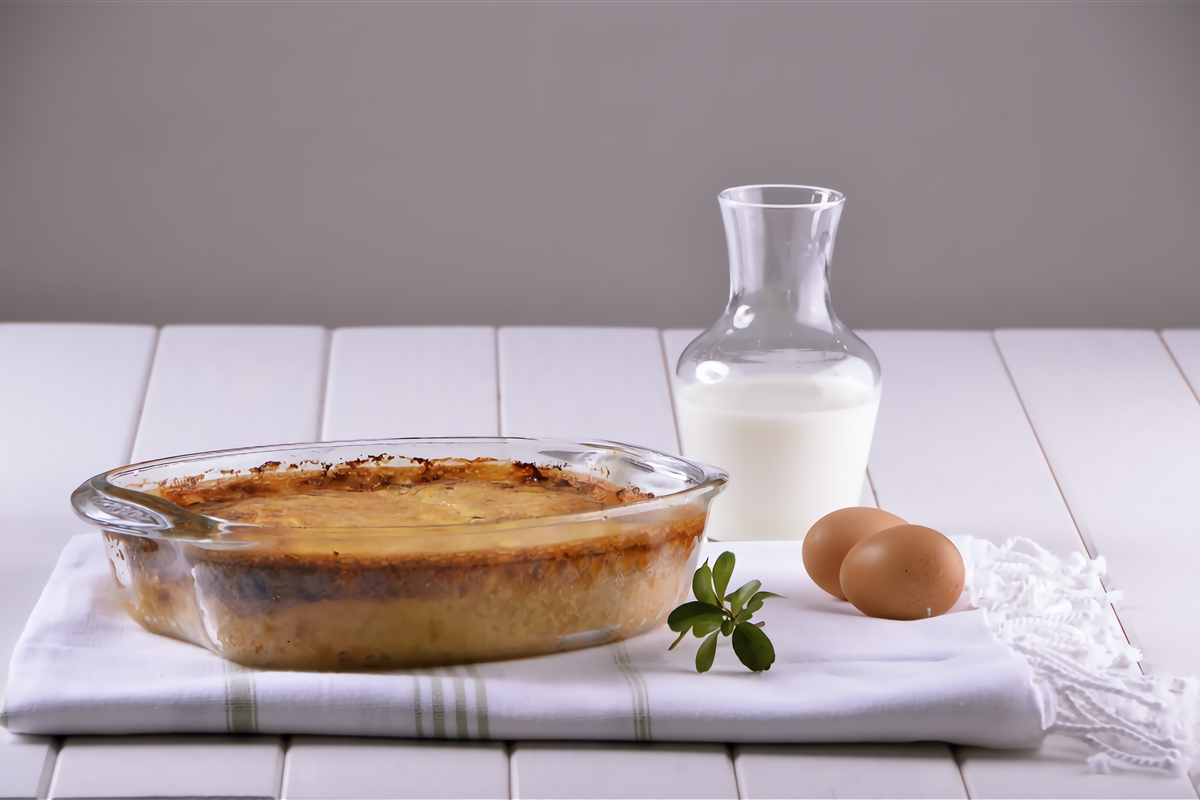
The most revealing part of sopa paraguaya is the cut face. Beneath the browned surface, the crumb holds pale pieces of cheese and traces of onion. It looks substantial enough to pick up, yet the ingredients promise something gentler than a plain hunk of bread. Paraguay's Instituto Nacional de Alimentación y Nutrición describes the dish as a savory, spongy cake and places it among the foods that accompany family occasions.[1]
Its name supplies an easy conversation starter: sopa means soup, and this one arrives in slices. The more rewarding conversation begins after that surprise. How does a mixture of corn flour, dairy, eggs and onion become a satisfying mouthful? Three published recipes reveal how much attention can be hidden inside a modest square.[2][3][4]
The onion brings its cooking liquid
In Alba Acosta's recipe for the Paraguayan newspaper ABC Color, the onion gets an unusually revealing treatment. It is sliced finely and boiled with water and salt for ten minutes, then left to cool. Later, both onion and cooking water enter the mixture. The liquid stays in the dish.[2]
That sequence changes how to imagine the slice. Onion is present as soft pieces, while the water in which it cooked becomes part of the batter. It reaches through the preparation before anyone adds a garnish. The method also makes the chopping matter: thin slices can distribute themselves through a portion in a way a few large wedges could not.
Mickey, a Paraguayan food producer selling corn flour specifically for sopa, begins by softening the onion in oil, then adds salt and water. Its recipe folds this preparation into the flour before bringing in milk and eggs.[3] The route differs, but both methods give the onion a stage of its own before the tray reaches the oven.
At the table, that is a useful detail to notice. Corn and cheese may be the obvious attractions; onion helps make their richness taste like a composed savory dish. A small serving has several ingredients to introduce, and they need to arrive together.
Cheese leaves visible interruptions
Mickey calls for 350 grams of queso Paraguay against half a kilogram of corn flour, adding the cheese in crumbled form. The same recipe offers a choice for a more airy texture: beat the eggs until foamy and fold them in at the end.[3]
Here are two different kinds of variation within one square. Crumbled cheese distributes small pockets through the mixture; the optional egg treatment changes the surrounding crumb. Neither decision requires a more elaborate presentation. The interest is already inside the slice, waiting for the fork to expose it.
Gonzalo D'Ambrosio's version for elGourmet makes a conspicuous change of pantry. He uses cubed Gouda, with 600 grams of cheese to 300 grams of corn flour, plus finely diced, lightly sautéed onion. He mixes milk, eggs and flour until smooth before adding those pieces.[4]
That is a particularly cheese-heavy interpretation, and its named cheese should remain part of the description. It would be misleading to offer it as an interchangeable specification for queso Paraguay. The two recipes show how the dish can retain its recognizable arrangement while the balance within it shifts. A menu saying only “cornbread” would tell the diner rather little about either version.
The surface cannot tell the whole story
The oven instructions also resist a single formula. Mickey specifies about thirty minutes at 200°C; Acosta's larger mixture calls for roughly an hour at the same temperature. D'Ambrosio gives thirty to forty minutes at 180°C, followed by cooling before eating.[2][3][4]
These are instructions for their respective preparations, rather than competing answers to one universal baking question. The mixtures differ, and the published methods do not supply a controlled comparison of pan dimensions. The sound conclusion is modest: a cook adapting one version should follow its full method instead of borrowing a time from another because the dish has the same name.
For the diner, the more pleasurable lesson is to pay attention to the whole cross-section. A golden lid is only the first encounter. The crumb beneath it must carry the onion and cheese, and the portion must offer enough of that interior to explain why the crust was worth breaking.
A square with room around it
Acosta suggests sopa paraguaya alongside fish or vegetable broth, as an appetizer or as a snack.[2] The broth pairing is especially appealing: spoonful and slice can alternate, letting the baked dish keep its shape while the meal offers another texture. A little cornbread need not be relegated to filling space beside a main course.
There is cultural weight behind that everyday flexibility. In 2017, Paraguay's Secretaría Nacional de Cultura included sopa paraguaya in a declaration of intangible cultural heritage. Its wording embraces traditional preparation, recipes, practical knowledge and transmission between generations.[5]
That emphasis brings attention back to the cook. A finished square can be photographed; knowing how the onion should soften, how the cheese should be broken up and how the mixture should behave takes another kind of record. The differing published recipes preserve some of those choices without making every household's tray identical.
Sopa paraguaya rewards a presentation that lets those choices remain legible. Give the slice a cut edge, enough interior to explore and a little room on the plate. The browned top has already caught the eye. Now the onion and cheese can have their turn.
Sources
- Instituto Nacional de Alimentación y Nutrición, “Conozcamos más sobre la Sopa Paraguaya,” May 18, 2021 — the dish's texture, regional presence and family context; Spanish.
- Alba Acosta, “Que en tu Semana Santa no falte una buena receta de sopa paraguaya,” ABC Color, April 12, 2025 — onion cooking water, baking method and serving suggestions; Spanish.
- Mickey, “Sopa paraguaya” — the Paraguayan producer's recipe, including crumbled queso Paraguay and optional beaten eggs; Spanish.
- Gonzalo D'Ambrosio, “Sopa paraguaya,” elGourmet, Fácil y Resultón III — the chef's Gouda version and cooling instruction; Spanish.
- Secretaría Nacional de Cultura, “Cultura declara Patrimonio Cultural Inmaterial del Paraguay la Sopa Paraguaya, el Vori-vori, el Locro y el Jopara,” August 29, 2017 — the declaration's scope; Spanish.