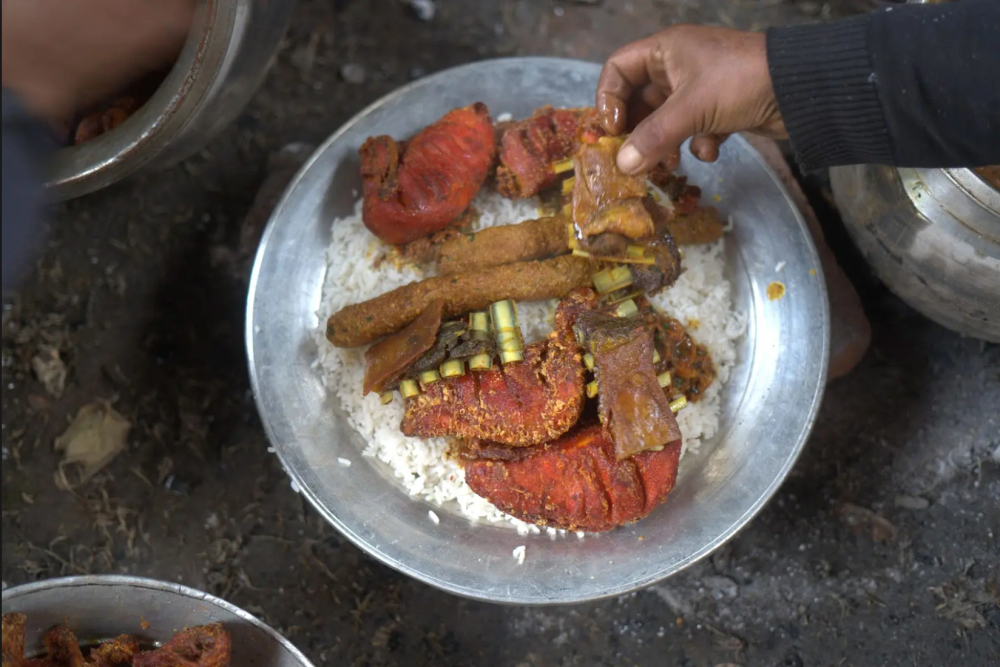
The rice arrives already dressed for a feast. Kebabs, chicken and browned ribs occupy a large copper platter, with four diners gathered around it. Yet this generous opening is only the beginning of wazwan. More dishes will come to the same platter, carried and served in succession by the cooks. The first helping has to leave room for a meal still unfolding.[1]
That platter, the trami, makes a useful place to begin understanding Kashmir's celebrated banquet. A menu can name its dishes; the service explains how they become an occasion. Wazwan brings the kitchen's work into a small circle of guests, where portions must be shared and each new arrival changes what is available to eat.
One platter, several arrivals
SBS's account of the tradition describes guests seated on the floor, washing their hands before eating together from the platter.[4] IANS reporting published by NDTV places the trami on a cloth spread before the diners. Its opening arrangement includes kebabs and tabak maaz, the fried ribs, over rice; the cook subsequently brings dishes such as rista, meatballs in red gravy, and rogan josh.[1]
The Budgam district administration's description adds a smaller detail beside this abundance: yogurt and chutney come separately in earthen pots. It also identifies the handwashing basin carried around by attendants as the tash-t-naer.[5] The meal has several vessels with different jobs, from preparing the guests' hands to keeping accompaniments within reach.
Sharing also leaves room for individual portions. Raja Muzaffar Bhat's account for Sahapedia describes one rista for each diner. At the close, a larger gushtaba is shared among four, with the eldest diner dividing it. The meal therefore moves between two kinds of generosity: everyone receives a piece, and everyone receives a share.[2]
The kitchen is assembled before the guests arrive
The serving platter depends on a much larger operation. Sahapedia describes temporary kitchens at hosts' homes, copper cooking cauldrons and teams led by a head cook. In its example, a wedding using 200–300 kilograms of meat requires three or four wazas and their assistants. The number is a reported scale of work, rather than a fixed formula for every celebration.[2]
Bashaarat Masood's 2012 reporting from Srinagar's Wazapora makes the staffing tangible. Cooks gathered in the morning, negotiated with master chefs and dispersed to different wedding venues. Preparation began the day before the reception. Meat for rista and gushtaba was worked with wooden mallets on stone, then inspected by the master cook; an unsatisfactory texture meant more pounding.[3]
There is a particular luxury in that inspection. A rounded meatball arrives with little visible evidence of the repeated blows and corrections behind its texture.
Masood also describes dishes held over gentle heat before service with hot rice.[3] Preparation has to carry through into the gathering.
The last savoury course has a job
Gushtaba, the large meatball in a yogurt-based sauce, marks the end of the savoury procession. Budgam's account describes it as the signal that the main meal is over; sweets follow.[5] The dish carries information as well as richness. Guests can recognize that the sequence is closing without needing a printed running order.
A succession of generous helpings needs an ending that feels deliberate. Here, a recognizable dish does some of the work an explanation from a server might do elsewhere.
A restaurant changes the arrangement
The labour behind that continuity deserves its own place at the table. Masood's 2012 interviewees described younger family members choosing other careers; one prospective marketing executive connected his refusal to become a cook with the poor sleeping arrangements and disrespect his father had experienced at weddings.[3] This is dated reporting, not a current workforce census. It nevertheless challenges any account that treats inherited skill as an endlessly available resource.
A restaurant can offer a different setting for the repertoire. In SBS's 2021 report, Sydney's WaazWaan adapted the experience with cutlery and à-la-carte dishes. Owner Inderpreet Singh also described overnight preparation for the banquet and the importance of arranging flavours through the meal.[4] Those observations document that restaurant at the time; they are not a claim about its present menu.
The distinction helps explain what a diner is encountering. Ordering a single dish can introduce the cooking, while a banquet also introduces the work of serving, dividing and replenishing. Around the trami, that work remains close enough to see: a cook returns with another dish, and four people make room.
Sources
- IANS, “Kashmiri Wazwan: What Makes It Such A Grand Affair,” NDTV Food, updated July 13, 2017 — platter arrangement and service sequence.
- Raja Muzaffar Bhat, “Wazwan: A Culinary Legacy,” Sahapedia — kitchen teams, portioning and Syed Muneeb Masoodi's trami photograph.
- Bashaarat Masood, “Finding The Wazas,” The Indian Express, April 1, 2012 — recruitment, preparation and cooks' working conditions.
- Afnan Malik and Paras Nagpal, “Wazwan: The story of Kashmir’s meaty, 36-course ‘feast for all’,” SBS Urdu, November 9, 2021, updated December 12, 2023 — communal dining and the Sydney restaurant adaptation.
- District Budgam administration, “Wazwan” — handwashing, serving vessels and the concluding savoury dish.