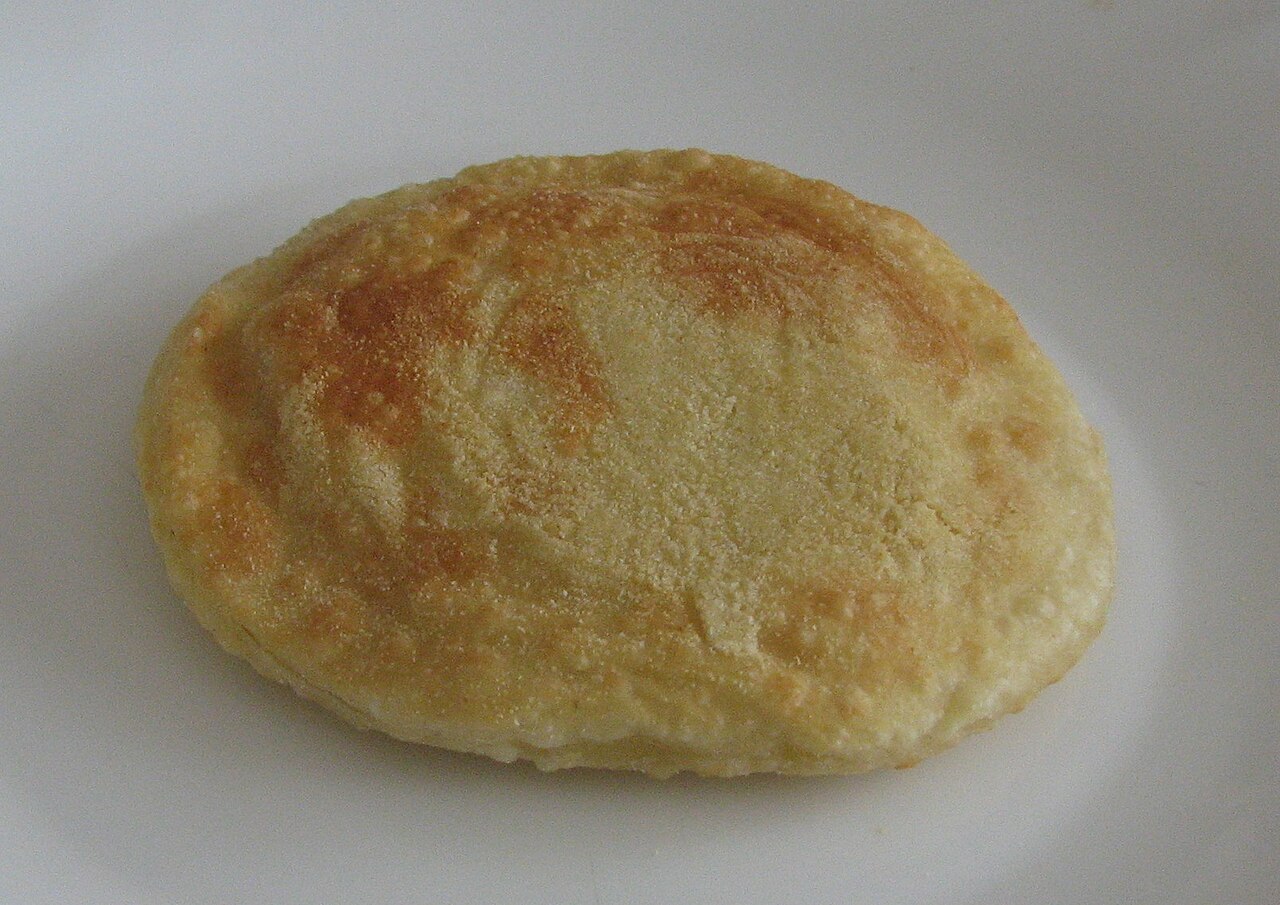
A seada arrives with a small surprise inside its fried pastry: fresh cheese, gently tangy and scented with citrus. Honey supplies a glossy finish. Alghero’s tourism office describes the Sardinian sweet through those distinct components—semolina pastry enriched with lard, sheep’s- or cow’s-milk cheese, and honey added after frying.[1] The pleasure depends on bringing them together while each still has something to say.
The work begins well before the oil heats. The cook has to turn cheese into a manageable filling, give it a thin enclosure and close the edge securely. By the time honey reaches the plate, most of the decisions that shape the first bite are already hidden beneath the crust.
The cheese can take two routes
There is room for more than one method. The Italian production specification for Sebadas di Sardegna allows the filling to be mixed cold or prepared by melting the cheese. In the cold method, cheese meets grated orange or lemon peel, with sugar optional. In the heated method, the cheese or curd melts over low heat; the thick mixture cools and is shaped into thin discs before assembly.[2]
That distinction changes where the cook does the shaping. A cold filling is portioned as a mixture. A pre-melted filling becomes a separate little component that can be handled before it enters the pastry. Both routes lead to a parcel that will still be fried. Here, “cold” describes preparation of the filling, rather than the temperature of the finished dessert.
Chef Maurizio Santin offers a particularly clear example of the second route. His recipe for Gambero Rosso uses fresh cow’s-milk caciotta, heated with water, lemon zest and a spoonful of semolina until thick. He spreads the mixture, lets it cool and cuts it into rounds.[3] The saucepan has done part of the work before the pastry arrives.
The semolina in Santin’s filling belongs to his formula; the production specification also accommodates other preparations.[2][3] Reading the methods together gives a useful way to appreciate the craft: look at how a cook makes the cheese easy to portion, as well as which cheese goes into the pan.
Leave room for the edge
The wrapper needs its own attention. Alghero’s recipe works semolina with water, salt and lard, then rests the covered dough in the refrigerator before rolling it thin. It pairs a cheese disc about 6 centimetres across with pastry rounds about 10 centimetres across.[1] That difference leaves a visible margin for joining the two sheets.
The bare border is working space. A generous filling may sound appealing, but the cook still needs two clean surfaces that can meet all the way around it. The attractive outline of the pastry begins with this practical arrangement: cheese in the middle, room to close at the edge.
Roberto Paddeu’s published method makes the handwork explicit. He presses gently around the enclosed cheese to expel air, then seals the perimeter with a pastry wheel or the tines of a fork.[4] The patterned rim records an operation that has already taken place. Its neatness is satisfying because the enclosure has been made deliberately.
Frying finishes the construction
The two chefs handle the pan differently. Santin instructs the cook to turn the seadas once during frying.[3] Paddeu fries one at a time and spoons hot oil over the exposed surface, taking the pastry out when it is puffed and golden.[4] These are specific working methods, each directing attention to how the surface cooks.
Paddeu also recommends eating the fried pastries immediately.[4] That instruction gives the service its pace: the shaping can be meticulous, but the finished seada is intended to travel promptly from pan to plate. A dessert made from such few visible elements has little room to hide a tired crust.
Honey gets the last word
Alghero names warm strawberry-tree honey, with its characteristic bitterness, as a usual finish.[1] Santin allows either bitter or sweet honey.[3] The choice gives the cook a final adjustment after the cheese and pastry are fixed.
I would judge the drizzle by what remains perceptible beneath it: citrus in the filling, the tang of the cheese and the fried edge. The honey should make a forkful feel complete. Cut through the pastry and take some of each; the careful work inside the parcel finally becomes available to the diner.
Sources
- Fondazione Alghero, “Seada,” Alghero Turismo — local description, fresh cheese choices, dough, filling proportions and honey; in Italian.
- Italian Ministry of Agriculture, production specification for “Sebadas / Seadas / Sabadas / Seattas / Savadas / Sevadas di Sardegna,” March 2022, Article 5 — cold and heated filling methods, shaping and sealing; in Italian.
- Maurizio Santin, “Seadas,” Gambero Rosso — caciotta filling with semolina, cooling, frying and honey options; in Italian.
- Roberto Paddeu, “Seadas (sebadas),” GialloZafferano — pressing out air, sealing, basting during frying and immediate service; Italian original.
- Terendo, “Seadas.JPG,” Wikimedia Commons, February 14, 2010 — original photograph of a seada before honey, released into the public domain.