The first decision at Avartana arrives before the first plate. There is no à la carte safety rail, no signature dish to add at the end, and no obvious “standard” menu.[1][5] Instead, the Chennai restaurant offers five named tasting experiences: seven-course Maya, nine-course Bela, eleven-course Jiaa, thirteen-course Anika, and the coastal, also thirteen-course Tara.[1][2] The card looks like a ladder. It is more useful to read it as an appetite test.
For a first visit, the best answer is the middle one: order Jiaa. Eleven courses give Avartana enough room to make its argument about contemporary South Indian cooking—rasam as perfume and extraction, familiar comfort compressed into a bite, regional flavor carried through modern technique—without making maximum duration feel like maximum understanding. Choose Anika because you actively want the longest performance, and Tara because seafood is the point of the night. Do not choose either merely because thirteen is a larger number.
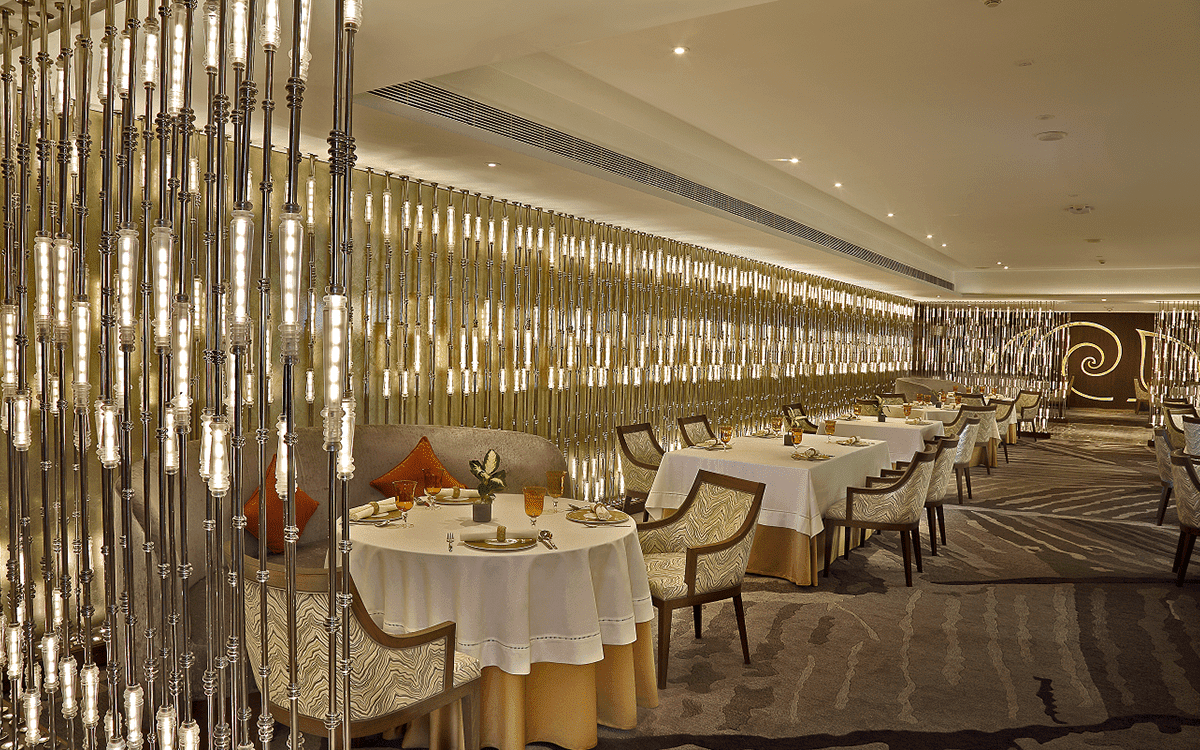
The cover photograph comes from ITC Grand Chola's own gallery and shows the actual Avartana room rather than an abstract luxury still life.[7] Its long perspective and repeated illuminated columns make the room feel measured before any food arrives. That geometry suits a menu in which what looks like candy may dissolve into a butter sauce, what resembles an egg may be panna cotta, and what arrives as clear liquid may carry the memory of rasam. The setting prepares the diner for explanation, reveal, and return.
The five menus are not five quality levels
Avartana opened in 2017 with a tasting-menu-only proposition, a striking choice in a city where South Indian food is often expected to arrive abundantly and communally rather than in a controlled procession.[5] The restaurant's answer was not to abandon those flavors but to change their scale and sequence. Current descriptions still emphasize a series of small bites: infused tomato rasam, coconut-based stew, pan-fried fish, and playful desserts, all arranged across menus of increasing length.[2]
That makes the shortest-to-longest ladder easy to misread. More courses do not necessarily mean a more authentic or more representative meal. They mean more time for variation, more technical reveals, and more chances for the kitchen to move between vegetable, seafood, meat, grain, dairy, acid, and sweetness. The proper question is not “How much Avartana can I afford?” It is “How much repetition and transformation will keep my attention sharp?”
Maya, at seven courses, is the compact introduction. It makes sense for a cautious appetite, a business dinner, or a table unsure about degustation. But if this is likely to be your only visit, it risks ending just as the restaurant's recurring grammar becomes legible. A tasting menu built around rhythm needs enough beats for return.
Bela, at nine, is the sensible lighter dinner. It buys two more transitions without demanding the full middle menu. Order it if you know that eleven small plates still feel psychologically long; palate fatigue begins in the mind as readily as in the stomach. Bela is not a lesser meal. It is the correct choice for a diner who would otherwise spend the final courses wishing the evening would accelerate.
Jiaa, at eleven, is where range and attention meet. Condé Nast Traveller's recent Chennai reporting uses Jiaa to explain Avartana at its most persuasive: the menu can move from technically playful presentations back toward the emotional directness of Uthukuli butter chicken and jasmine payasam.[3] That arc is the restaurant's real attraction. The modernist gesture lands only when a recognizable South Indian flavor survives it.
Anika, at thirteen, is the extended performance. It is right for a celebratory table that wants every reveal and has no reason to rush. A reported twelve-course Chennai tasting of new menu additions shows how quickly an extended sequence can accumulate: pumpkin dumpling, jackseed fritter, mini appam with coriander chicken, a ghee candle, and a citrus-coconut dessert all appeared in one sitting.[6] That 2021 report is not a promise of today's dishes, nor was the tasting identified as Anika. It does illustrate what the extra courses buy: not simply more food, but more changes of register.
Tara is a preference, not an upgrade. The current menu architecture gives it the same thirteen-course length as Anika, while restaurant profiles distinguish it by its coastal emphasis.[1][2] Pick it when a marine through-line sounds better than a broad survey. If one diner is merely tolerant of seafood, do not let the menu's maximal length overrule the table's actual pleasure.
Why Jiaa earns the first booking
Avartana's best-known dishes work through a small moment of disorientation followed by recognition. In a recent visit, CNA's reviewer encountered a lamb-brain fritter whose crisp shell yielded to a creamy center, then chicken and Malabar paratha with Uthukuli butter gravy and a beetroot-wrapped “toffee” designed to melt into the sauce.[4] Condé Nast Traveller describes a similar logic in spiced aubergine: a thin skin wrapped around tomato and sambar onion, then sharpened with tamarind, tempered curd, and sago.[3]
The point is not the prop. It is the recovery of flavor after the prop has done its work. Eleven courses provide enough examples to judge whether Avartana repeatedly clears that bar. Seven may show the trick; thirteen may make you start anticipating it. Jiaa leaves space for surprise, recurrence, and contrast.
Start by treating the rasam as the menu's thesis rather than as a welcome drink to hurry through. Avartana has long used clarified or infused rasam to announce that technique can alter appearance while leaving the spice-and-acid signal intact.[2][5] Notice what remains recognizable when texture changes. That question is more rewarding than trying to identify every device at the table.
Then watch how the kitchen handles starch and comfort. Parotta, idiyappam, payasam, and coconut stew carry memories that a foam or crisp alone cannot manufacture.[2][3][4][5] When one of those dishes succeeds, it is usually because the new form tightens attention around an old relationship—rice and tang, bread and gravy, coconut and heat—rather than replacing it with spectacle.
Finally, leave some appetite for sweetness. Avartana's desserts are not an unrelated victory lap; they use the same conceal-and-reveal grammar as the savory courses. The panna cotta “egg” noted by 50 Best and the jasmine payasam described by Condé Nast Traveller pull in opposite directions, one playful and one emotionally familiar.[2][3] The menu needs both. Jiaa is long enough to let that contrast feel like a conclusion.
What to skip
Skip the instinct to order thirteen courses because a rare reservation must be “maximized.” Course count is a poor proxy for value once attention begins to blur. The two longest menus are worthwhile when their specific promise—extended theater for Anika, coastal concentration for Tara—matches the diner.
Skip the hunt for one guaranteed viral plate. Published accounts across several years mention different dishes, which is evidence of a living menu, not a shopping list.[2][3][4][5] Ask what is on the current version when you reserve, especially if a particular protein, allergy, or vegetarian format will determine the evening. 50 Best presently describes vegetarian versions across the menu ladder, but dietary needs deserve direct confirmation rather than inference from a guide listing.[2]
And skip lunch if what you want is certainty about the full choice. ITC currently lists lunch only on Saturday and Sunday and dinner throughout the week.[1] That does not make lunch inferior; it makes a reservation question essential. Confirm which named menus are being served in that sitting before building the visit around Jiaa or Tara.
The clean order
For a first visit with a normal appetite, book dinner and choose Jiaa. Choose Bela if length makes you restless, Maya if the meal must stay compact, Anika if the long performance is itself the celebration, and Tara only when a seafood-led night is exactly what you want. Ask about current dishes and dietary adaptations when booking, then stop optimizing.
Avartana is trying to make rhythm out of South Indian memory. The useful middle gives that rhythm time to appear—and ends before counting replaces tasting.
Sources
- ITC Hotels, “Avartana” and the ITC Grand Chola dining listing — current menu names, course counts, service periods, and venue description.
- 50 Best Discovery, “Avartana — Chennai” — current restaurant profile, five-menu structure, vegetarian availability, representative dishes, setting, and 2024 Asia's 50 Best placement.
- Condé Nast Traveller, “Inside the technicoloured capital shaping India's melting-pot cuisine” (March 16, 2026) — recent Chennai context and a reported first visit to the eleven-course Jiaa, including Uthukuli butter chicken and jasmine payasam.
- Channel NewsAsia Luxury, “Three of India's best restaurants: Avartana, Dum Pukht, Bukhara” (December 10, 2024) — reported Chennai visit, dish construction, ingredient context, and service experience.
- The New Indian Express, “The south Indian twist” (July 15, 2017) — opening-era account of Avartana's tasting-only format, culinary intent, and early dishes.
- Indulge Express, “New menu: South Indian reimagined, Avartana at ITC Grand Chola delivers a symphony in taste” (November 18, 2021) — a reported twelve-course Chennai tasting used to illustrate the accumulation and range of an extended format, not to claim the current menu sequence.
- ITC Grand Chola, “Gallery” — official dining-room photograph used as this article's single image.