The lamb has arrived, but it must wait. With Sheki's piti, the first move is to break bread into a separate plate, then pour broth from the little clay pot over it. The meat and chickpeas stay behind. Once that first serving is finished, they emerge for a second course, mashed together and eaten with more bread and onion.[1][2]
It is a generous amount of ceremony for a stew. Azerbaijan's Tourism Board describes piti as food that began among Sheki's working people, later becoming a national favourite. Its account names chickpeas, chestnuts and saffron alongside the lamb, but singles out the earthenware cooking and serving vessel.[3] The pot brings the meal to the table; the person eating decides when to change its texture.
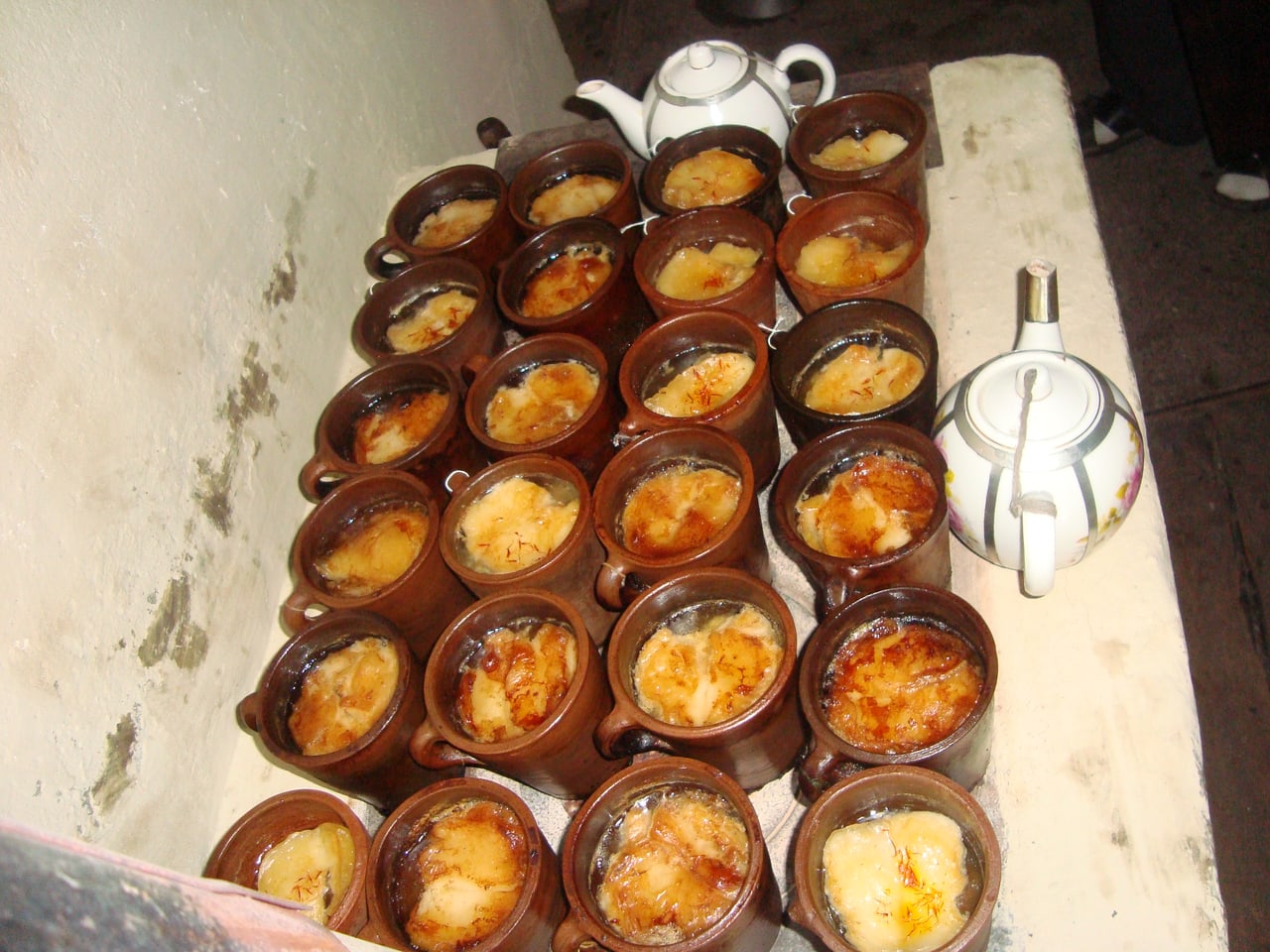
A small pot with a long working day
In Aynur Talibova's 2009 account for Region Plus, the vessel is a dopu, sized for one diner, and the lamb cooks for eight to nine hours. Gunel Manafli's 2016 report in Visions of Azerbaijan describes another rhythm: cooks begin in the evening, keep a low fire for five or six hours, and serve the piti the following morning.[1][2]
These are accounts of local practice, rather than a single cooking time to impose on every kitchen. What they share is the long wait before the pot reaches the table. The meal's apparent simplicity conceals that earlier work; there is little left to announce when a diner sits down.
The vessel itself belongs to the preparation. The Azerbaijan Center for Economic and Social Development's Culinary Directory describes conditioning a new pot with fat and hot water before cooking in it. Its Azerbaijani text specifies sheep fat. The directory also records the local preference for well-used pots.[4] That is a cook's judgement about familiar equipment, not evidence that age alone guarantees a better stew.
Ingredients leave room for variation. Against the tourism board's chestnuts and saffron, AzeriFood's home recipe offers potatoes in place of chestnuts, uses turmeric, and makes cherry plums optional. The writer explicitly distinguishes this domestic version, made in an ordinary saucepan, from the memorable clay-pot piti eaten in Sheki.[3][5] Reading the two together is more useful than turning either into a universal checklist.
Give the broth its own plate
The first serving makes the liquid worth attending to. In Talibova's description, yesterday's bread is broken up and sprinkled with sumac before the broth is poured over it.[1] Dry pieces become saturated; the plate fills with the cooking liquid while the substantial part of the meal remains out of sight.
AzeriFood's method offers a revealing detail: skim the foam from the lamb because the broth should be clear. The recipe also prepares the chickpeas separately to a partly cooked stage before adding them to the meat.[5] This is one home cook's method, but it shows the attention a seemingly modest bowl of broth can receive.
The bread changes the experience again. Instead of moving a spoon through a pot of meat and pulses, the diner encounters softened pieces carrying the broth. There is still plenty to eat in this opening course. Its relative lightness is a matter of texture and sequence, rather than an absence of substance.
Manafli notes that a little liquid remains in the pot after the first pour.[2] The separation need not be absolute. Enough broth can stay with the solids to accompany their next transformation.
The diner finishes the second course
Now the lamb and chickpeas come out. Manafli describes seasoning them and pressing them with a fork, then eating the mixture with bread and onion.[2] The meal changes from something spoonable and bread-soaked to a soft mash that can be gathered up in a bite. The onion supplies a crisp interruption alongside it.
This is the detail that makes piti so satisfying to think about as a complete dish. Its two courses have cooked together. They share a pot and a history, yet serving them separately allows each to have its moment. Emptying everything into one bowl immediately would remove that interval of anticipation.
The last bit of preparation belongs to the table. After hours of cooking, someone still has to pour, wait, tip and mash. The clay pot arrives holding dinner, but it takes a diner to finish it.
Sources
- Aynur Talibova, “Silk, Halva and a Dish Fit for a King,” Region Plus, 1 January 2009 — individual pots, cooking duration, bread, sumac and the two-stage serving sequence.
- Gunel Manafli, “Getting to Know Sheki,” Visions of Azerbaijan, Autumn 2016, especially p. 106; preserved by Azerbaijan's Presidential Library — evening preparation, low heat, retained broth and the mashed second serving.
- Azerbaijan Tourism Board, Delicious Dishes, Amazing Flavours, “Regional Specialties: Sheki” — working-class association, chestnuts, saffron, earthenware and two-course presentation.
- Azerbaijan Center for Economic and Social Development, Culinary Directory, p. 5, “Piti (Sheki)” — bilingual account of the individual clay vessel and its preparation before use.
- AzeriFood, “Piti” — a home recipe explicitly distinguished from restaurant piti in Sheki; ingredient substitutions, skimming and chickpea preparation.
- Samyi drevniy, “Shaki piti.jpg,” 2009, Wikimedia Commons — original photograph, author record and public-domain dedication.