The first surprise is how little cake you are supposed to take. In Vanessa Barone's account of Casa dos Frios, the Recife delicatessen associated with bolo de rolo, the serving advice is a slice no more than three millimetres thick.[1] That is a house ideal, not a universal regulation. It does, however, explain the invitation: look closely before asking for a larger piece.
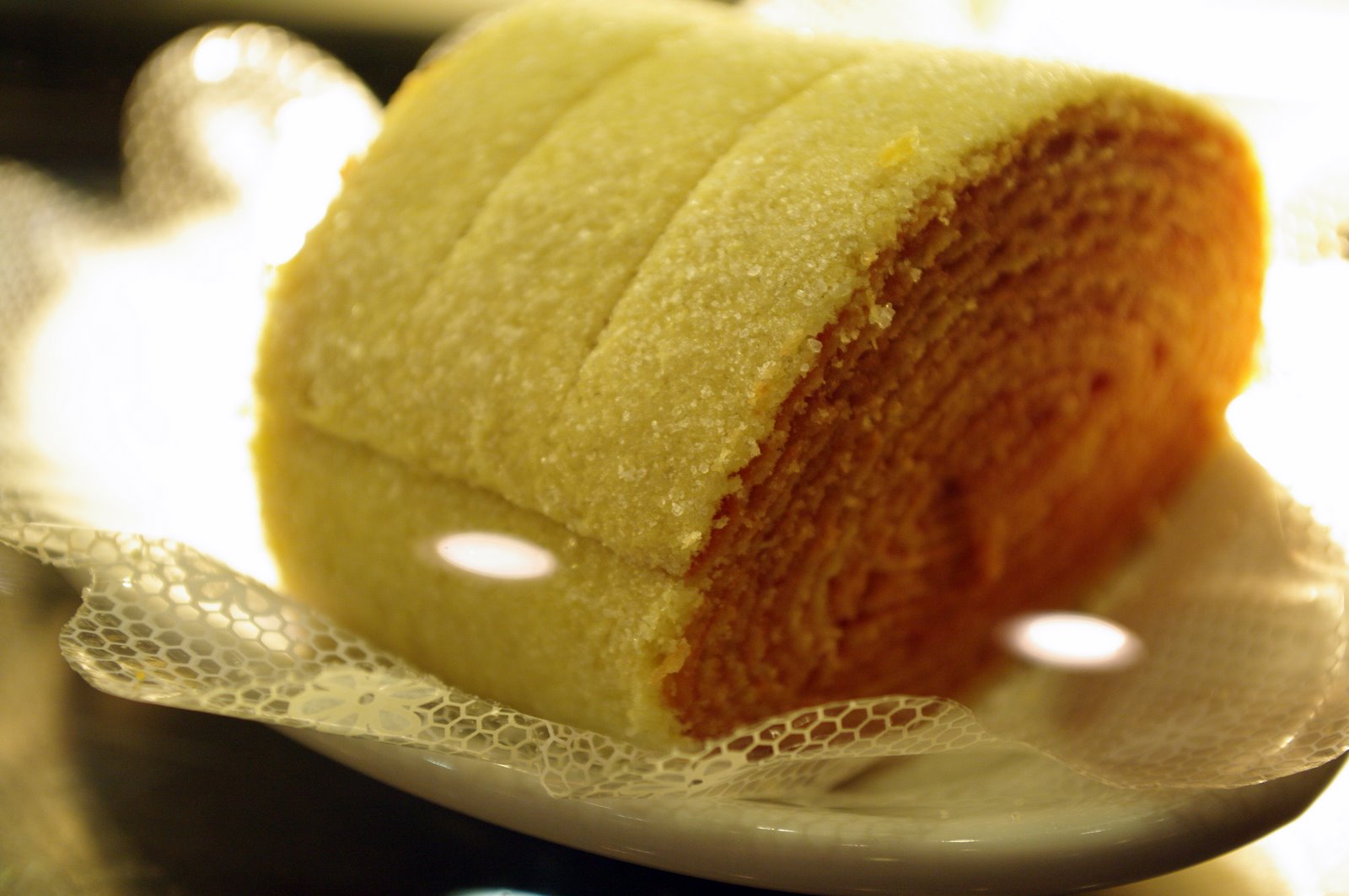
Across the cut face, pale cake and guava-red filling make a tightly wound spiral. Casa dos Frios describes its classic version as very thin layers of cake interleaved with guava filling.[2] Even a narrow slice lets the fork meet that combination repeatedly. The pleasure is built into the smallness of the layers.
This cake from Pernambuco, in northeastern Brazil, has travelled a long way through domestic kitchens, shop counters and celebration tables. Its early family tree is uncertain. Its more recent history offers something wonderfully concrete: named women, a household recipe, and the decision to put it on sale.[3][4]
A family resemblance with missing dates
The familiar ancestry leads back to Portugal's colchão de noiva. Yet a 2026 study in Revista Mangút cautions that bolo de rolo's emergence is undated and its principal influence uncertain. The authors identify colchão de noiva as the predecessor most frequently cited in the literature, while acknowledging competing accounts.[3]
That distinction leaves room to appreciate a culinary relationship without inventing a moment of arrival. A resemblance between cakes cannot tell us who first changed a filling, how quickly a method spread, or which kitchen made its layers thinner. The clean story of one imported recipe becoming one local classic is appealing; the surviving account is less complete.
The cake itself is more definite. Flour, eggs, butter and sugar form the batter; guava supplies the traditional filling.[1] Those ingredients become distinctive through proportion and handling. The spiral makes repetition visible: cake, fruit, cake, fruit, held close enough that the cut surface resembles fine marbling.
It is tempting to treat the guava as the whole explanation of the cake's identity. The later bakers' accounts suggest that the way the filling is spread deserves equal attention.
From Ana Maria's kitchen to Fernanda's counter
In a 2018 report, Mônica Santos traces Casa dos Frios's version to Ana Maria Soares, an employee who prepared the cake for Fernanda Dias's children. During the 1970s, Fernanda brought that household recipe to the delicatessen's counter.[4] This is a history of a particular recipe becoming a commercial success; it does not establish either woman as the inventor of bolo de rolo.
The movement from family table to retail counter changed the cake's audience. A sweet associated with a household could now be bought, carried away and introduced to someone who had never met its maker. The recipe acquired a public address.
By the time Santos reported on the business in 2018, demand had reached 800 kilograms a day. She described twenty confectioners making the fine sheets and rolling them by hand, with the filling spread to a similar thinness.[4] Those figures belong to that report, rather than a claim about today's factory. They capture the scale of the achievement: an intimate-looking pastry had become a substantial production operation while retaining handwork at its centre.
The practical advice remained exacting. Barone's later account stresses restrained filling, so that the cake can be rolled, and careful control of the brief baking time. It also records a little port wine in the filling.[1] These are details of the reported house method. Their interest lies in the decisions they expose: how much fruit to spread, when to lift the sheet, how much cake to place on the plate.
A heritage cake finds another occasion
Pernambuco formally recognized bolo de rolo as cultural and intangible state heritage through Law 13.436 of 24 April 2008. The short law declares its status; it does not prescribe a recipe or settle its ancestry.[5] Recognition gives the cake a public place in the state's identity while leaving the actual baking to people with trays, ovens and their own accumulated judgment.
Casa dos Frios's range includes chocolate and doce de leite alongside guava. For the latter variation, the company explicitly emphasizes continuity in the spreading and rolling technique.[2] Here, a change in flavour can coexist with a familiar construction. The fine layers give the customer something recognizable before the first bite.
Another change concerns the occasion. The Mangút study follows confectioner Dirce Cavalcante's business, Dorinha Bolo de Rolo, and its adaptations for weddings: small bem juntinhos offered in place of traditional bem-casados, and wedding cakes presented in a naked-cake format.[3] The tea-table sweet takes on the work of a favour or a centrepiece.
That journey brings the thin slice into focus again. Ana Maria's household recipe, Fernanda's retail decision and Dirce's celebration formats each put the cake before a different audience. A dessert can acquire new customers and new ceremonies while giving the eye an old point of recognition. Cut into bolo de rolo, and the spiral is still waiting.
Sources
- Vanessa Barone, “Bolo de rolo ganha variações que renovam a sua tradição,” VEJA São Paulo (25 July 2024; updated 5 June 2026) — ingredients, Ana Maria Soares, house technique, port wine and thin-slice serving advice.
- Casa dos Frios, “Bolo de Rolo” — the producer's account of its fine layers, guava filling and chocolate and doce de leite variations.
- Betânia Aragão Rodrigues, Jouberte Maria Leandro Santos, Adriana de Fatima Valente Bastos and Anna Karenina Chaves Delgado, “Inovação na confeitaria tradicional de Pernambuco: um estudo de caso voltado ao Bolo de Rolo para casamento,” Revista Mangút, vol. 6 (2026) — uncertain ancestry and Dirce Cavalcante's wedding adaptations.
- Mônica Santos, “O melhor bolo de rolo de Recife é da Casa dos Frios,” VEJA (3 September 2018) — the household-to-counter history and reported production scale and handwork in 2018.
- Assembleia Legislativa do Estado de Pernambuco, Law 13.436 of 24 April 2008 — original text declaring bolo de rolo cultural and intangible state heritage.
- Wikimedia Commons, “Bolo de Rolo, doce brasileiro, típico de Pernambuco.jpg” — Guilherme Jófili's photograph, taken 22 May 2010, with attribution and licence information.