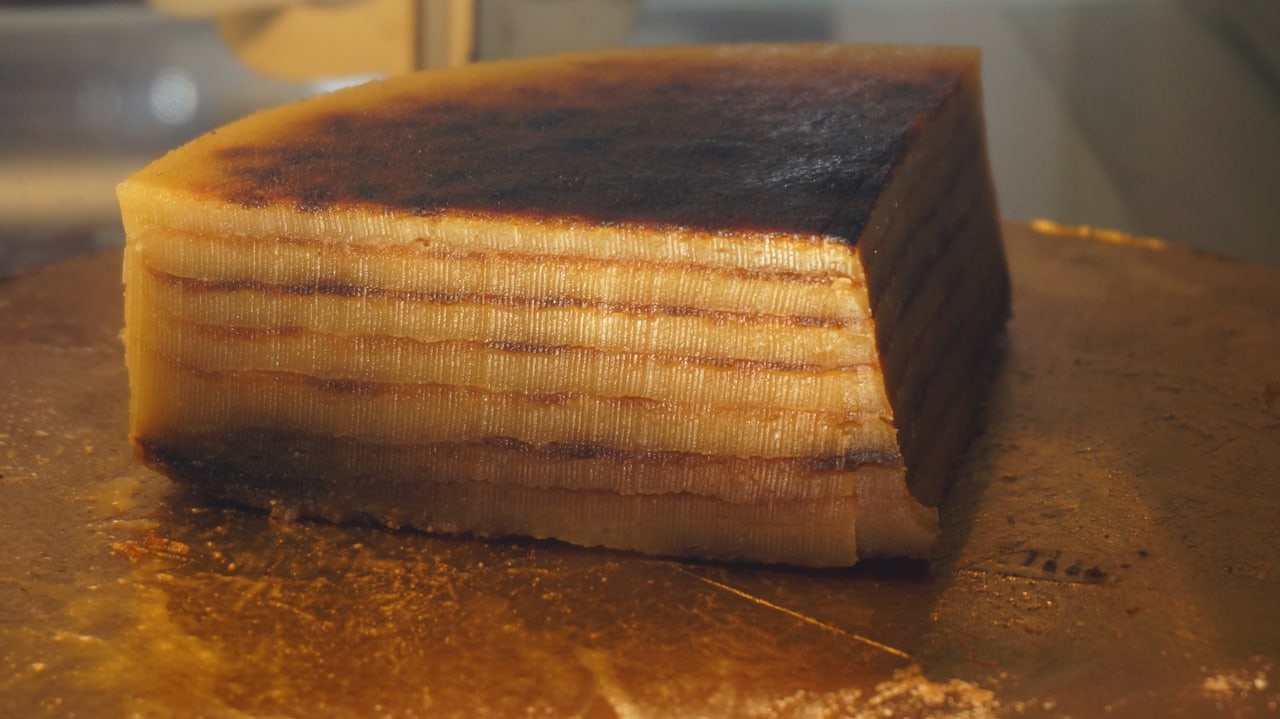
Bebinca makes a small slice look generous. Pale gold meets brown in a stack of fine horizontal bands; the cut face promises several bites' worth of texture before the fork goes in. Goa's tourism authority lists egg yolk, coconut milk, flour, sugar, nutmeg and ghee among its ingredients.[1] Nothing about that inventory quite explains the spectacle. The distinction lies in what happens between one layer and the next.
The pudding also carries a story about a nun. It is an appealing place to begin, provided the story leaves room for the people whose work can actually be traced: families tending pots, home bakers supplying chefs, and an association putting the dessert's name into an official register.
A convent story, carefully told
At the Convent of Santa Monica in Old Goa, the Museum of Christian Art and The Goan Kitchen announced a bebinca-making experience alongside a guided walk. The announcement, published by the Archdiocese of Goa and Daman, explicitly introduces the sweet's supposed birthplace as oral tradition.[2]
In that telling, Sister Bebiana found a delicious use for yolks left after egg whites had been used to starch the nuns' habits. Coconut milk and ghee helped turn the surplus into a layered pudding bearing her name. The announcement calls this a legend; it does not supply a contemporary recipe manuscript or a dated record of the invention.[2]
The proposed lesson carries its own lineage: cooks teaching the craft to new participants.
The history with an oven in it
A more firmly situated account takes us to a backyard in Betalbatim. Writing in 2016, Ashwin Rajagopalan visited Damaso and Teresa Cota, whose reputation for bebinca he traced to 1962. Damaso recalled neighbours bringing ingredients for the couple to cook, initially without payment. Orders from nearby customers and establishments came later.[3]
Rajagopalan described earthen pots with coconut husks burning on their lids. The family could spend four or five hours cooking successive layers. Their daughter, chef Sunita Lopez, explained how she used upper heat in her own oven to reproduce that arrangement.[3]
There is a compact history of changing equipment in that detail. The backyard pot and the domestic oven share a task: apply heat to the newest surface, then make room for another. The finished slice compresses an afternoon of repeated attention into something that can disappear in minutes. Its stripes are a record of the cook returning.
Food writer Christopher Tan describes the traditional method in BiblioAsia: yolk-rich coconut batter, relatively little wheat flour, and clarified butter brushed between layers cooked beneath a heated lid. The pudding then rests before slicing.[4] A restaurant can present the result very simply; much of the elaborate work has already happened out of sight.
A family tree with missing branches
Tan also gives a useful warning about bebinca's wider lineage. Similar names turn up across Asia, but they do not establish a neat route of descent. Macau's bebinca de leite is a milk custard, while bebinca de inhame is a yam cake; neither has the Goan sweet's layered construction. He notes that the direction of transmission between Goan and Timorese bebinca remains unclear.[4]
Resemblance invites investigation, but cannot identify a teacher, a pupil or a journey. A confident family tree would need more evidence; shared names and techniques alone leave several histories possible.
The names behind the slice
The makers become easier to identify in recent reporting. In Joanna Lobo's 2023 survey for Condé Nast Traveller India, chef Gracian de Souza recalled finding Nancy Fernandes' bebinca while looking for a supplier for his former Mumbai restaurant, Porto and Poie. He had been eating hers since 2018 and praised its eleven alternating layers, moisture and restrained sweetness.[5]
Another chef, Christopher Fernandes, described a recipe passing from Maurice Braganza to his niece, Livelyn Manuel. Chef Priyanka Sardessai singled out Lilia Menezes' delicate layers and soft texture.[5] These are attributed preferences, rather than a tasting verdict from this article. Together, they give the dessert a social geography: named cooks, remembered introductions, recipes passed within families and sweets carried into professional dining rooms.
A useful question at dessert, then, is who baked it.
On 1 August 2023, India's Geographical Indications Registry dated the registration certificate for Goan Bebinca. The application had been filed on 5 April 2021 by the All Goa Baker's & Confectioners Association, and the registry identifies Goa as the geographical area.[6] That record establishes a modern institutional milestone. It does not turn the convent legend into a documented invention.
The distinction suits the pudding. Its past contains a memorable story and gaps that remain open; its continuing life has identifiable makers. Look again at the cut face, at each narrow band meeting the next. Somewhere before this plate reached the table, a cook waited for one layer to be ready, then returned with another.
Sources
- Goa Tourism Development Corporation, “Goan Sweets” — bebinca's ingredients and layered form.
- Archdiocese of Goa and Daman, “Culinary Experiences with MoCA – The Legend of Bebinca” — the Museum of Christian Art and The Goan Kitchen's programme, explicitly presenting the convent origin as oral tradition.
- Ashwin Rajagopalan, “Why Bebinca is Known as the Queen of Goan Desserts,” NDTV Food, 18 May 2016 — reported visit to the Cota family and Sunita Lopez's account of upper-heat baking; historical reporting, not a current ordering guide.
- Christopher Tan, “Love Is a Many-Layered Thing,” BiblioAsia, National Library Singapore, 1 January 2021 — the “A Nonlinear Lineage” section on bebinca's method and uncertain relationships with other Asian sweets.
- Joanna Lobo, “The best bebinca in Goa, as per the state's foodies,” Condé Nast Traveller India, 19 August 2023.
- Intellectual Property India, Geographical Indications Registry, “Goan Bebinca,” application 746 — applicant, filing date, geographical area and registration certificate date.
- Frederick Noronha, “Bebinca, a delicacy and sweet from Goa.jpg,” Wikimedia Commons — photograph dated 14 March 2021, original file and attribution.