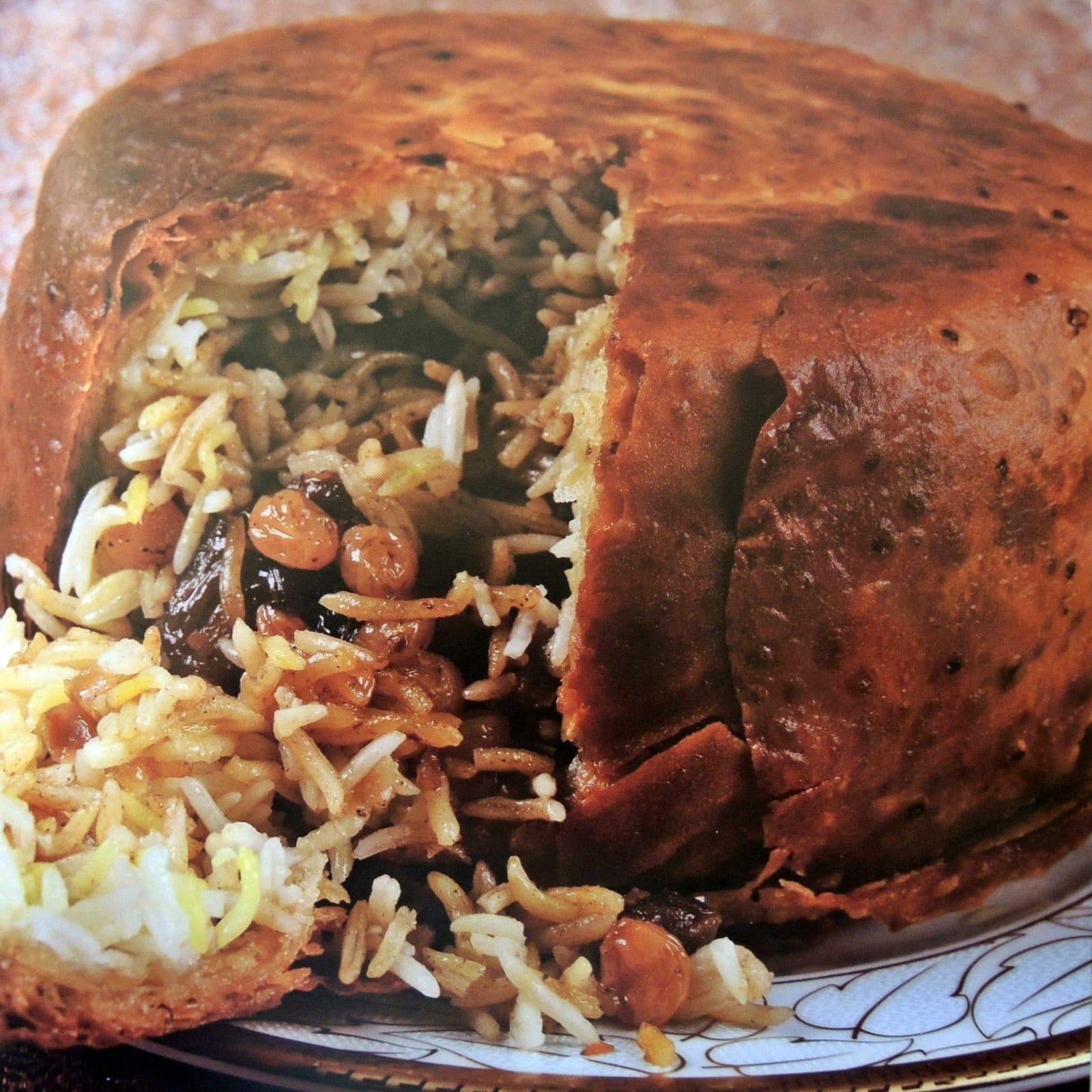
Before the knife enters, shah plov offers almost no evidence. It arrives as a burnished dome, its contents hidden behind bread. Then a wedge comes away and the dish has to prove two things at once: the shell must break cleanly, while the rice inside must still fall in separate grains around meat, chestnuts and dried fruit. A photograph can catch both conditions in the same frame—the browned casing holding its curve, the filling refusing to become a compacted rice cake.[6]
That reveal is often described as spectacle, and fairly so. The name shah plov is commonly glossed as “king's plov” or “crown's plov”; the dish is associated particularly with Ganja and is served for weddings and Novruz as well as in restaurants.[2] But the crown is not decoration added after the cooking. It is the risky part of the cooking. Crisp bread wants a relatively dry, hot environment; rice needs enough trapped vapor to finish gently; meat and fruit bring their own moisture; butter has to conduct heat without turning the base greasy. The grand entrance works only because several ordinary preparations have been stopped at exactly the right point.
This is a craft reading built from documented methods and images, not a claim to have cooked or tasted one definitive version. Azerbaijani plov is a family of preparations, and official sources describe dozens of variations rather than one authorized formula.[1][4] Shah plov is compelling precisely because its architecture makes the cook's decisions unusually visible.
The crown reorganizes plov
The easiest mistake is to treat shah plov as a fancy synonym for all Azerbaijani plov. It is one distinct construction inside a much larger repertoire. Azerbaijan's tourism board groups plov methods broadly as dashma, suzme and dosheme. In a common suzme preparation, partly cooked rice is steamed over flatbread while the meat, onions, chestnuts and dried fruit are cooked as an accompaniment and brought to the rice at service.[1] The state cultural portal likewise documents plovs in which rice, crust and a meat, herb, fruit or egg preparation retain separate identities on the plate.[4]
Shah plov changes the spatial arrangement. A vessel is lined with overlapping flatbread, filled with rice and its accompaniments, closed and baked into a complete casing. The Ganja version described by National Geographic uses steamed rice, dried apricots, plums, raisins, chestnuts and lamb or beef inside a crisp flatbread shell.[2] Instead of displaying the rice as a mound with crust and accompaniment around it, the cook hides the relationships until the first cut.
The move is theatrical, but it is also compression. Several components that can ordinarily be adjusted or served separately now share one enclosed finish. There is no chance to rescue a wet filling after the shell is sealed, or to pull fully cooked rice away from heat while the bread catches up. Assembly is therefore not the beginning of the recipe. It is the final relay.
Stop the rice while it still needs the pot
The rice reaches that relay deliberately unfinished. In the tourism board's detailed plov method, it is washed, soaked in salted water for three to four hours, boiled only until half-cooked and drained. Butter, flatbread and saffron infusion then enter before a covered, low-heat finish.[1] A direct shakh-plov recipe published by Louisiana State University likewise boils and drains the rice before it enters a buttered lavash shell for a covered, then uncovered, oven finish.[5] The timings differ, but the central logic holds: boiling hydrates the grain; the second stage completes it.
Parboiling creates room for error in the right direction. Fully cooked rice would have to survive assembly, trapped steam and baking without its exterior collapsing. Raw rice would demand so much liquid and time that the filling and shell would be forced to serve the grain. Partly cooked, well-drained rice can accept a measured amount of vapor while remaining structurally legible.
Draining is as important as boiling. Surface water carried into the mold does not stay politely with the rice; it migrates toward the bread. Too much turns the inner face of the crown pasty before the outer face has browned. Too little, and the shell may look triumphant around a dry center. “Loose rice” is therefore not a final fluff with a fork. It is a moisture budget established before the dome exists.
Saffron works within that staged process rather than as a yellow dye stirred through everything. The documented method brews a small infusion and adds it during the steaming stage.[1] That allows colored and paler grains to remain visible together. The mottling matters visually, but restraint matters more: the crown should open onto rice that still looks like rice, not a homogeneous stuffing.
The filling has to arrive with its water under control
Official recipes repeatedly separate the accompaniment's preparation from the rice. One tourism-board version cooks mutton, onions, chestnuts, dried apricots and plums together after the meat has been boiled; raisins are handled separately.[1] The LSU shakh-plov recipe poaches chicken first, then cooks it with onion and saffron water until almost all the liquid evaporates before combining it with rice and fruit.[5] Other documented Azerbaijani plovs pair rice with herb-braised mutton, pomegranate-and-walnut sauces, fruit, eggs, chicken or fish.[4] Shah plov recipes vary too. Its craft is not a sacred ingredient checklist but the control required when a chosen filling is enclosed.
That filling must be cooked enough to taste complete, yet dry enough not to sabotage the shell. Meat juices, softened onions and plumped fruit all count toward the same reservoir. Reducing them before assembly concentrates flavor and limits uncontrolled steam. The direct shakh-plov recipe makes that priority explicit by evaporating almost all of the chicken mixture's liquid before combining it with the rice.[5]
The familiar combination also has an internal logic beyond “jewelled rice.” Meat and butter supply richness; dried plums and apricots bring sweetness with acidity; chestnuts add a softer, earthy starch; saffron's aroma crosses the rice rather than competing as another solid ingredient.[1][2] The crisp casing gives that soft interior an audible edge. Remove the contrast and the dish loses more than a pretty exterior—it loses its pacing from first crack to last spoonful.
For a restaurant kitchen, this makes shah plov closer to coordinated service than to one-pot convenience. Rice, filling, saffron infusion, lavash and butter can each be prepared at its own station or moment, but all must reach assembly in compatible states. The dome records whether those handoffs were disciplined.
Lavash changes jobs inside the vessel
UNESCO documents lavash within a shared, present-day flatbread tradition rather than as the exclusive heritage of one country. Its 2016 inscription covers the making and sharing of lavash, katyrma, jupka and yufka across communities in Azerbaijan, Iran, Kazakhstan, Kyrgyzstan and Türkiye. It describes flatbread production as collaborative work, commonly divided among at least three people, and connects the breads with hospitality, weddings and communal meals.[3] Shah plov is Azerbaijani; the flatbread around it sits within a wider regional tradition.[2][3]
Inside the plov vessel, that bread changes jobs. Overlapping, buttered sheets become liner, lid, mold and edible crust. The overlaps give a thin bread enough layers to contain a heavy filling; the fat helps the sheets conform to the vessel and encourages even browning. Once closed, the pot or baking dish supports the crown until heat has made it self-supporting.[1][2][5]
The two faces of the lavash experience different kitchens. The face against the vessel meets fat and direct conducted heat, so it can brown and dry. The face against the rice meets aromatic vapor and stays more tender. A good slice contains that gradient: brittle enough outside to crack, flexible enough within not to shatter away from the filling. Calling the whole casing “crispy” misses the useful complexity.
Seams are where the architecture declares its weaknesses. Sparse overlap can open during unmolding; excessive overlap creates dense, leathery bands. A shell too pale may sag when turned out, while an aggressively dark one can taste bitter before the saffron is noticed. The even, deep-brown dome in the 2015 source photograph is persuasive because the missing wedge exposes both the thickness of the casing and the separate grains it protected.[6]
The cut is a quality check disguised as ceremony
Turning out a whole shah plov transfers the dish from cookware to platter without revealing its center. The LSU method calls for inverting the pot, letting the crown stand, then cutting and serving it.[5] That delay creates suspense, but it also prevents selective plating. A chef cannot choose the best-looking spoonful in the kitchen and hide the rest. The revealed slice shows whether the crown released, whether its base colored evenly and whether the filling settles loosely when the first portion is removed.
This is honest culinary theater. The action does not decorate a finished result with smoke, cloches or a last-minute flourish. It opens the cooking system and makes its success audible and visible. The knife cracks the crust; the wedge shows its layers; steam and saffron aroma escape; rice and fruit spill into the space created by the cut. Every dramatic effect is evidence of something that happened earlier.
Timing still matters. Cut immediately, and a rush of steam can soften newly exposed crust and make the rice seem wetter than it is. Leave the dome too long, and carryover heat plus condensation can erase the contrast from inside. The LSU recipe specifies a ten-minute stand, which makes sense as a settling interval rather than a universal law: vessel material, dome size, filling and bread thickness all change the useful pause.[5] The cook has to read the object, not merely obey a timer.
The fine-dining lesson is not miniaturization
Shah plov does not need to become a tiny individual dome, a deconstructed smear or a last-minute trick to qualify as sophisticated craft. Its scale and shared opening are part of its meaning. The wedding and Novruz associations documented for the Ganja preparation, and the broader communal culture around flatbread, place abundance and division at the center of the experience.[2][3]
A tasting-menu kitchen can still learn from it. First, drama earns its place when it reveals technique rather than distracts from it. Second, texture can be designed across a boundary: one side of a sheet browns while the other manages steam. Third, apparently seamless service may depend on components cooked separately and united late. Those are portable lessons. The dish's name and cultural context are not.
The best crown therefore does not ask the diner to admire an untouched dome for long. Its purpose is to be broken. Once cut, shah plov becomes generous and slightly disorderly: crust fractures, grains loosen, fruit rolls away from the slice. The architecture has succeeded when it can surrender without collapsing—when the king arrives whole, and the meal begins only after the crown comes apart.
Sources
- Azerbaijan Tourism Board, “Azerbaijani Plov” (accessed August 22, 2026)—plov families, rice soaking and parboiling, flatbread layering, saffron infusion, steaming method and separately cooked accompaniment.
- National Geographic, “Azerbaijan: the seven dishes that define a nation” (paid content for Experience Azerbaijan, accessed August 22, 2026)—Ganja association, shah plov composition, crisp flatbread casing and wedding/Novruz context.
- UNESCO Intangible Cultural Heritage, “Flatbread making and sharing culture: Lavash, Katyrma, Jupka, Yufka” (inscribed 2016)—multinational scope, collaborative production and the breads' social role.
- Azerbaijan.az, “Plov” (accessed August 22, 2026)—official recipe collection documenting varied rice, crust, meat, herb, fruit, egg and fish arrangements across Azerbaijani plovs.
- Louisiana State University Global Engagement, International Cook Book, “Shakh Plov,” p. 4 (accessed August 22, 2026)—direct Azerbaijan-origin method for drained rice, reduced chicken filling, overlapping buttered lavash, covered and uncovered baking, inversion and resting.
- Tubus, “Shah-plow azerbaijani.JPG” (April 24, 2015), Wikimedia Commons—source record for the real dish photograph, dimensions and CC BY-SA 4.0 license.