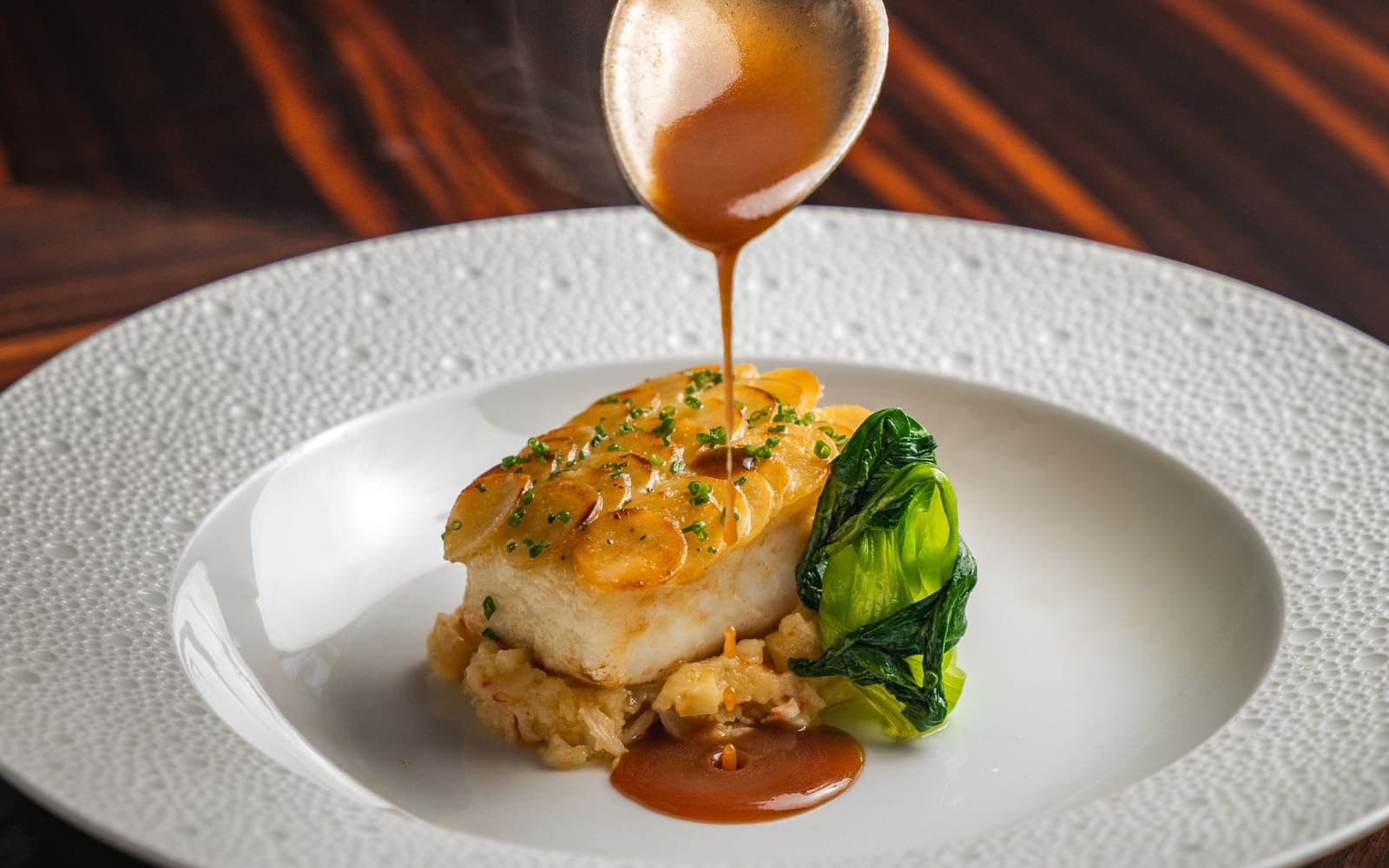
At 1919, Puerto Rican forms and staples arrive in formalwear. Malanga becomes gnocchi under black winter truffles; tostones carry caviar; fish pastelón sits beneath halibut and a rum-and-plantain emulsion. The room requires formal attire, and its standard five-course menu costs $175 before tax and gratuity. An early-dining offer adds two complimentary glasses of wine and a chef's-choice canapé, but only with a dinner reservation and one entrée per person.[1][2]
At Vianda, that culinary vocabulary moves more freely. The current August menu runs from $10 trunkfish with coconut arepa to a $19 bowl of mofongo in pork broth, then out toward rabbit tagliatelle, fried chicken with nuoc cham and breadfruit crème brûlée. It is not a tasting-menu procession. It is a compact à la carte menu that lets a table choose its own rhythm.[3][4]
These rooms should not be collapsed into a ranking. Taken on two nights, they make a better travel story: San Juan's ambitious cooking is not moving in one straight line toward greater ceremony. It is testing what happens when the same agricultural constraints, Puerto Rican staples and globally trained technique pass through radically different machines.
This is a document-led itinerary, not a claim to have eaten either current menu. It is built from restaurant pages current on August 22, Vianda's August menu, 1919's currently linked January menu, a recent local-chef guide, official agricultural context and independent reviews. Dishes change; execution can only be judged in the room. What the documents reveal unusually well is the choice each restaurant makes before service begins: how much structure to put around Puerto Rican culinary vocabulary.
First night: let 1919 make the rules visible
Begin in Condado, inside the Condado Vanderbilt hotel. The restaurant takes its name from the year the hotel first opened, and its current rules are refreshingly explicit: dinner runs Tuesday through Saturday, 5:30 p.m. to 10 p.m.; formal attire is required; shoes are mandatory; dressy shorts and beach sandals are out.[1] In a coastal district where resort ease can become the default language, 1919 asks the diner to cross a visible threshold.
That threshold is useful. Fine dining often hides its operating system beneath words such as effortless and timeless. Here, the dress code, dim room, wine program and course structure announce that the restaurant is selling concentration. The official photographs show pale cloth, upholstered chairs, deep blue-grey walls and enough space between tables for each one to feel like its own stage.[1] An independent Condé Nast Traveler review describes service as warm rather than overbearing, which is the important counterweight: formality only works if precision does not harden into distance.[8]
Chef Ciarán Elliott is new to leading this room. After working at restaurants including Patrick Guilbaud, Arzak, Akelarre, Frantzén, Hertog Jan, Chapter One and Per Se, he moved to Puerto Rico in 2020 and co-founded the intimate Pio Pio in Old San Juan. The Condado Vanderbilt announced him as 1919's executive chef in 2025; the current restaurant page calls this a new beginning and frames his menu around European tradition, global producers and Puerto Rico's harvest.[1]
That biography could easily produce generic international luxury. The current menu is more interesting because the island keeps interrupting the grammar.
Read the Puerto Rican forms where the technique bends
The clearest dishes at 1919 are not those that merely place one Puerto Rican reference beside an imported prestige product. They are the ones in which a Puerto Rican form changes the whole construction. A halibut entrée uses fish pastelón and rum-and-plantain emulsion; grilled branzino meets carrucho, saffron aioli and bouillabaisse sauce; roasted duck takes on acerola mostarda. Sorullitos, ordinarily compact cornmeal batons, are broken and paired with whipped ricotta and caviar. Tostones become the vehicle for a 30-gram caviar service.[2]
The pleasure on paper comes from friction. Pastelón does not disappear merely because the fish above it is confit. Carrucho does not become bouillabaisse; it pulls a French seafood frame toward Caribbean chew and salinity. Acerola does the work that a European sour cherry might do, but with the sharp brightness of a fruit cultivated in the region. The restaurant's argument is not that European technique validates Puerto Rican culinary forms. It is that those forms can deform a familiar fine-dining sentence until it belongs to this room.
There is a real boundary here. Three kinds of caviar appear across four dishes or services on a compact menu, and black truffle, lardo Ibérico and prime beef make the global luxury network highly visible.[2] “Local harvest” therefore cannot mean local exclusivity. The restaurant itself says its work is complemented by producers beyond the island.[1] Judge the menu by authorship, not purity: do imported ingredients sharpen an island-specific idea, or do they pull the plate back toward a luxury language available anywhere?
For a first visit, the five-course tasting menu is the cleanest way to test that question. À la carte remains possible, but the tasting lets the kitchen control sequence and contrast. Think carefully before adding a pairing. The current menu lists a five-course private-collection pairing at $145 and a sommelier collection at $199, both before tax and gratuity.[2] Either can make wine as expensive as the food. That may be exactly the evening desired; it should be a conscious second purchase, not an automatic extension of the room's formality.
Second night: give the table its verbs back
The second night changes neighborhood as well as format: leave the Condado hotel for Vianda at 1413 Avenida Ponce de León in Santurce. Its current schedule already signals a different machine: dinner starts at 5 p.m.; last seating is 9 p.m. Wednesday, Thursday and Sunday, and 9:30 p.m. Friday and Saturday.[3] In 2017, founders Amelia Dill and Francis Guzmán returned to Guzmán's hometown to build the restaurant, following work in San Francisco and New York restaurants including Blue Hill and The Modern.[3]
The formal recognition is substantial. The James Beard Foundation named Vianda a 2026 semifinalist for Outstanding Restaurant, after earlier recognition for both the restaurant and Guzmán.[3][6] Yet the current menu resists behaving like an awards submission. There is no compulsory arc and no escalating parade of luxury products. A table can begin with chorizo croquettes and candied papaya, add alcapurrias with chayote escabeche, share mofongo, then stop—or keep moving toward the catch of the day, pork belly or strip loin.[4]
That freedom changes the diner's job. At 1919, attention follows the kitchen's sequence. At Vianda, the table edits: crisp against soft, fried against raw, roots against fruit, one more plate against enough. The most revealing order is not the one that imitates a tasting menu by buying everything. Choose across forms. An alcapurria shows what the kitchen does with a familiar fried shell; the $45 catch of the day brings butter beans, sofrito butter, peppers and yellow sweet potato into one main plate; the $14 breadfruit crème brûlée brings breadfruit into the classic custard format without announcing itself as a lecture.[4]
Vianda's menu is just as globally porous as 1919's, but less ceremonially organized. Tuna crudo gets passion-fruit ponzu; local avocado meets an al-pastor treatment and chilli crisp; fried chicken takes habanero, mango, papaya and nuoc cham; pork belly comes with coconut rice, peanut sauce and Thai basil.[4] Guzmán told the James Beard Foundation that San Juan's cooking draws on global influence while keeping a local component at the center.[5] The menu supports that reading. Puerto Rican identity here behaves like an anchor, not a fence.
An independent review in Condé Nast Traveler makes the same point from the dining room: it emphasizes the restaurant's local roots, Guzmán's high-end training and a style of service that is polished without becoming stiff.[9] That last distinction matters. Vianda does not reject fine-dining discipline. It removes the long compulsory format and lets discipline appear in the handling of a small menu.
“Local” is a harder promise on an import-dependent island
Both restaurants talk about Puerto Rico's harvest. That phrase carries more weight here than the soft-focus “farm to table” language found on menus everywhere. The statement of motives for Puerto Rico's Act 67 of 2025 says the archipelago produces roughly 15 percent of its food.[7] The USDA's 2022 agricultural census counted 7,602 farms across 494,481 cuerdas; its farmer snapshot put the average age at 60.3, while the number of farms had fallen 7.6 percent since 2018.[10]
Those figures do not prove that any specific tomato, malanga or avocado on tonight's plate is local; only a restaurant or producer can trace that chain. They establish the constraint. A San Juan kitchen foregrounding the island's harvest is working inside an economy where imports are not an occasional supplement but the dominant condition. Seasonality can mean genuine variation, price pressure, supply gaps and the need to change a menu rather than simply swapping garnishes.
Vianda's official account makes seasonality part of its identity: its cooking is rooted in Puerto Rico's agriculture and guided by seasonality and creativity.[3] Its dated August 2026 menu offers a present-tense snapshot rather than a timeless sample card.[4] At 1919, the language is more deliberately hybrid—Puerto Rico's harvest alongside producers from beyond the island—and the menu openly mixes regional staples with imported caviar, truffle and European wine culture.[1][2]
Neither model is automatically more honest. The better question is whether the boundary stays visible. Vianda should not turn “seasonal” into a blank permission slip for any change. 1919 should not let one Puerto Rican root vegetable launder an otherwise placeless luxury plate. Menus earn trust when the island's culinary vocabulary changes the dish's structure and when the restaurant is clear about what comes from elsewhere.
The two-night route
Book 1919 first and Vianda second. This order is not a ranking; it makes the contrast easier to read. At 1919, accept the restaurant's choreography. Wear what the room asks, let the tasting menu set the pace, and notice every moment when malanga, plantain, carrucho, sorullito or acerola changes a European technique rather than merely decorating it.[1][2]
At Vianda on the following night, resist rebuilding the ceremony you just left. Order three or four plates across scales, ask what is especially good from the current market, and let the table decide when the meal is complete.[3][4] If the menu has changed since August, that is not a failure of this itinerary. Change is part of the proposition; the live question is whether the replacement keeps the relationship among Puerto Rican staples, global technique and appetite legible.
The calendar needs a little care. Both rooms operate Wednesday through Saturday, so those are the easiest nights to place together; 1919 is closed Sunday and Monday, while Vianda is closed Monday and Tuesday.[1][3] As of August 22, 1919 also announces a seasonal break from September 6 through September 28, reopening September 29, so this two-night route cannot be placed inside that window.[1] Reserve rather than improvise, confirm dietary needs directly, and verify prices when booking. The 1919 menu explicitly warns that dishes can change; treat Vianda's August page as a dated snapshot and verify its live offerings.[2][4]
After two dinners, San Juan should look less like a city waiting for one flagship restaurant to define it. 1919 turns Puerto Rican forms and staples into a formal composition and asks whether luxury can remain geographically specific. Vianda loosens the frame and asks whether ambition can survive choice, movement and a smaller bill. The useful discovery is not which room wins. It is that Puerto Rican culinary vocabulary remains articulate in both—provided the restaurant lets it do more than state an address.
Sources
- Condado Vanderbilt, “1919 Restaurant” (accessed August 22, 2026) — current chef biography, operating hours and seasonal closure, dress code, local-and-global sourcing language, reservation details and source page for the official plated-course photograph.
- 1919 Restaurant, Dinner Menu (January 27, 2026; accessed August 22, 2026) — five-course price, pairing tiers, current à la carte dishes, tax-and-gratuity boundary and change notice.
- Vianda, “Our Story” (accessed August 22, 2026) — founders, training path, 2017 return to San Juan, agricultural premise, current address, hours and recognition history.
- Vianda, “August 2026 Menu” (accessed August 22, 2026) — live dish descriptions, prices, service hours and the current menu's local/global vocabulary.
- Layla Khoury-Hanold, “Where To Eat in San Juan, According to James Beard Semifinalist Francis Guzmán,” James Beard Foundation (February 2, 2026) — Guzmán on San Juan's globally influenced, locally anchored restaurant culture.
- James Beard Foundation, “The 2026 James Beard Award Semifinalists” (January 21, 2026) — Vianda's listing in the Outstanding Restaurant category.
- Government of Puerto Rico, Act 67-2025 (approved July 18, 2025) — statement of motives on the archipelago's food-production estimate and agricultural policy context.
- Condé Nast Traveler, “1919 Restaurant” (accessed August 22, 2026) — independent review of Ciarán Elliott's current menu, service and special-occasion positioning.
- Condé Nast Traveler, “Vianda” (accessed August 22, 2026) — independent review of the restaurant's local-rooted cooking, room and polished but relaxed service.
- USDA National Agricultural Statistics Service, Puerto Rico Agriculture: Highlights from the 2022 Puerto Rico Census of Agriculture (July 2024) — farm count, land in farms, change since 2018 and farmer demographics.