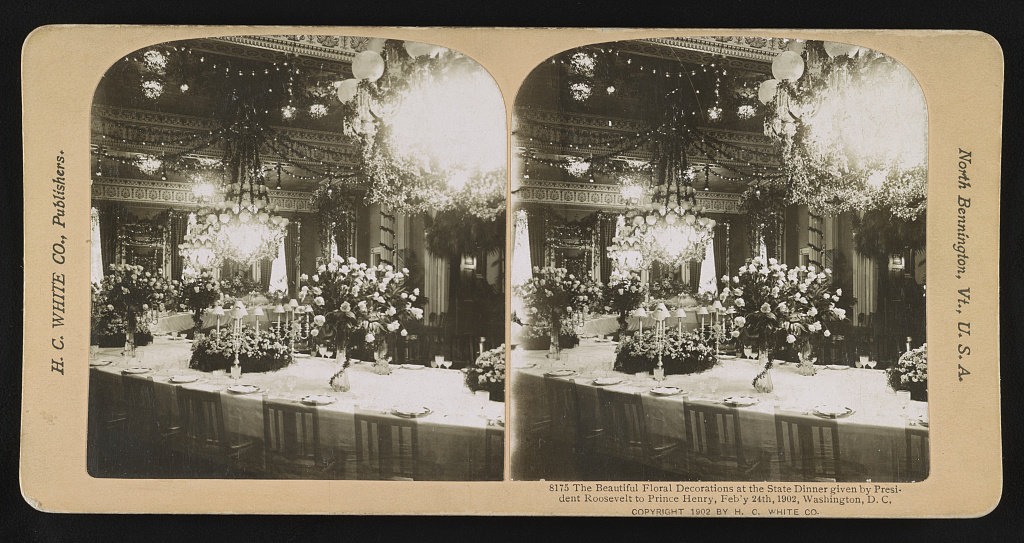
In a 1902 stereograph of the White House East Room, a crescent table waits under chandeliers. Roses and greenery rise in banks along its inner curve. Candlesticks, folded napkins and ranks of glasses occupy the cloth, but no roast, tureen or fish platter interrupts the floral field. The Library of Congress describes the room as awaiting guests for President Theodore Roosevelt's dinner for Prince Henry; it does not record how the meal was served.[8]
That distinction matters. The photograph cannot prove a service method. It can, however, introduce the kind of ceremonial surface that period accounts associate with moving hot food off the dining table.[2][5]
During the nineteenth century, fashionable European dining moved gradually from service à la française toward service à la russe. The change is often compressed into a neat before-and-after: everything on the table at once, then courses one by one. The real history is more interesting. French service already had courses and order. Russian service changed where the food waited, who controlled it and when a diner could eat it. By moving dishes to the sideboard and bringing them through the room in sequence, it gave dinner a clock.[2][3][5]
The modern tasting menu did not descend intact from a Russian ambassador's table. Kitchen plating, restaurant labor and twentieth-century cooking changed the form again. But its most familiar promises—that the room advances through the same course or stage together, that a hot dish arrives in its intended condition, that wine can be matched to a precise moment, and that the menu is a sequence rather than an inventory—echo a course-by-course service grammar this nineteenth-century transition helped establish.
The old table was a composition
Service à la française was not a disorderly buffet, nor did it necessarily place an entire meal on the table in one colossal wave. The components of a service were arranged together, often symmetrically, and servants reset the table before the next service. The Metropolitan Museum of Art's account of an eighteenth-century Sèvres tureen explains the visual logic: diners helped themselves from nearby vessels while the grand tureen anchored an ornamental pattern of dishes. For court dinners, table diagrams could prescribe the geometry.[3]
The Musée national Adrien Dubouché describes four or five services in a classical arrangement. Soups and entrées might occupy the first; sauced meat and fish the second; roasts, salads and entremets followed, sometimes with a further service of pies, vegetables and hot entremets; cheese, fruit, preserves and ices closed the meal. Repeated dishes could be stationed at different points so more guests had access. Choice was broad, but reach and seat position mattered. The host still carried the burden of carving and distribution.[5]
This was luxury as visible abundance. Silver, porcelain, pastry, steam and animal scale were all on display. A whole salmon looked generous before anyone discovered who could reach it or whether it was still warm. The table showed the kitchen's wealth all at once, even when the diner experienced only the fraction within arm's length.
That is the first boundary around the lineage. Service à la russe did not invent the idea that soup should precede roast or that dessert should come last. It inherited an existing culinary order. Its practical shift was to make the successive stages more linear and synchronized across the room: less simultaneous display, more coordinated arrival.[1][2]
The revolution happened at the sideboard
The origin story usually names Prince Alexander Kurakin, Russia's ambassador to France, and a Paris dinner around 1810. The attribution is traditional rather than a cleanly documented moment of invention. Graham Harding's history calls Kurakin the figure generally credited, then traces scattered references, an 1829 novelty and decades of gradual adoption. Hybrid forms persisted; households adjusted the fashionable model to their staff, money and habits.[2] The Institut de France likewise presents the Russian style as a nineteenth-century development, not a switch thrown across Paris in a single night.[6]
What changed was concrete. Major dishes waited on a sideboard rather than in front of the guests. A servant carved or portioned them, then presented food around the table. Hosts no longer had to interrupt conversation to dismantle a joint. Diners had less freedom to compose meals from the available dishes. The room began moving through a common program.[2][5]
The two-volume La Cuisine classique of 1856 made that program explicit in its title: Urbain Dubois and Émile Bernard described the French culinary school as applied to service à la russe.[1] This was adaptation, not national replacement. French cooks kept the sequence, sauces and categories of haute cuisine while reorganizing their delivery.
The sideboard therefore became more than furniture. It was a buffer between production and appetite. Carving moved out of the host's hands; portion control became easier; dishes or portions could be presented in an intended order. The meal acquired a backstage.
Heat became an appointment
Russian-style service won its strongest argument in temperature. Under the older display system, hot dishes could spend their best minutes waiting to be admired, reached and carved. Warming dishes and covers slowed the loss but did not erase it. Sequential presentation narrowed the distance between readiness and eating.[5][6]
This sounds obvious only because the restaurant now treats it as ordinary. A consommé should arrive before its surface clouds with cooling fat. Fried crust should still crack. A sauce mounted with butter should not wait beside flowers while another end of the table negotiates a roast. Moving food through the room in stages made those qualities schedulable.
It also changed the meaning of kitchen readiness. A cook was no longer trying to complete a whole ornamental landscape before the doors opened. Each dish needed to meet a service window. The dining room, sideboard and kitchen had to agree on pace. That agreement is an early analogue for the modern pass: not the same equipment or plate presentation, but the same insistence that quality is partly a question of when.
There was an economic edge as well. Harding notes contemporary claims that a household could portion for the actual guest count instead of displaying an entire salmon and surrendering the remainder to waste or staff. Commentators also liked removing “smoking joints and steaming preparations” from the room. Russian service promised a cooler table, cleaner conversation and tighter control of quantity.[2]
The empty cloth filled with flowers, glass and instructions
Food left the table; status did not. The cleared surface quickly became another theater.
Harding charts a move from great displays of plate toward centerpieces, fountains, flowers and greenery. Table decoration became a test of aesthetic judgment, and businesses rented the furniture, crockery, glassware, fruit and waiting staff needed to stage it. One could spend less on redundant food and more on the visible apparatus of taste.[2]
The 1902 White House stereograph catches the mature spectacle: the crescent of cloth is almost a garden, punctuated by glasses and candelabra.[8] It would be wrong to call that restraint. Sequential service did not make elite dinner modest; it shifted abundance from edible mass to choreography and décor.
Glass multiplied for a practical reason and a social one. When wine followed courses, different pours could be assigned different vessels and moments. The Adrien Dubouché museum dossier describes water, white-wine, red-wine and Champagne glasses contributing to the setting, while Harding connects the spread of specialized glassware with increasingly directive food-and-wine matching.[2][5]
The decorated menu card performed a similar double duty. It was beautiful, but it was also operational. Once diners could no longer inspect every hot dish on the table, the card told them what was coming. Harding cites a contemporary description of it as a diner's “plan of campaign.” Appetite could now be budgeted across a sequence.[2]
That is very close to the psychological contract of a tasting menu. The printed list may reveal every course, conceal several of them or reduce each to a few ingredients. In every case it asks the diner to surrender some control to an arc designed elsewhere.
Synchronization had a labor bill
The new clock did not run by itself. Russian-style service transferred work from hosts and diners to cooks, butlers and waiting staff. It needed people who could carve cleanly, remember the sequence, approach from the correct side, change plates, manage several glasses and keep a room moving without making its machinery too loud.[2][5]
Harding's Victorian sources suggested roughly one servant for every four guests, with a highly skilled server perhaps managing six. Households without a permanent staff hired workers for the night. When the labor was insufficient or untrained, elegance turned into gaps between dishes, cold plates and confusion.[2]
The cost was not only financial. The synchronized meal reduced a diner's freedom to choose, return or take a second helping. It also moved authority away from the person eating. The menu constrained the route; the hostess planned it; servants enforced its pace. A guest became, in one historian's formulation discussed by Harding, an audience for a preconceived meal rather than a participant composing one from the table.[2]
Modern fine dining inherits that tension. Course-by-course attention can make an ingredient more vivid than any crowded spread. It can also turn hospitality into compliance if the room treats pace as more important than the guest. The history explains why a well-timed pause, a declined course or an allergy substitution is not a small disruption. It presses against a service form built to synchronize difference.
Restaurants inherited the sequence, not the exact ritual
By the late nineteenth century, the service revolution was unfolding beside the rise of the modern restaurant. Musée d'Orsay places the two changes in the same landscape: diners increasingly ate the same course at the same time, while restaurants normalized the menu, bill, individual table and continuous service.[4] Harding follows elite sociability out of private dining rooms and into restaurants, where specialist labor and an inclusive charge could replace the expense and anxiety of mounting a grand dinner at home.[2]
The restaurant then modified Russian service. Much nineteenth-century service à la russe still presented a platter from which a servant portioned food. Most contemporary tasting-menu dishes use service à l'assiette: the kitchen composes individual plates and a server sets them down. The inheritance is therefore not an unbroken gesture but a shared commitment to sequence.[2][5]
A comparable ordered structure appears in UNESCO's description of the gastronomic meal of the French: successive courses, a deliberate order from apéritif through dessert and liqueurs, food-and-wine pairing, and differentiated tableware.[7] A modern tasting menu may abandon that classical course vocabulary, replace wine with ferments or tea, and serve twelve small plates where an older dinner offered several choices within a service. What persists is the belief that a meal can make meaning through controlled succession.
The White House photograph is not a portrait of the tasting menu's birth, and service à la russe is not its sole parent. It offers something subtler: dinner after hot food stopped needing to prove abundance by waiting in public.[8] Once dishes could remain backstage until their moment, menus could guide appetite, wine could follow a course and the dining room could coordinate the table.
That inheritance is double-edged. Course-by-course attention can make an ingredient more vivid; it can also make hospitality feel like obedience. Whenever a room decides that this plate belongs now—not five minutes earlier, not beside six competing platters—it is still working with the nineteenth century's most durable service idea: sequence as a form of control.
Sources
- Urbain Dubois and Émile Bernard, La Cuisine classique: études pratiques, raisonnées et démonstratives de l'école française appliquée au service à la Russe (1856), Bibliothèque nationale de France scan — primary-source title, preface and menu architecture.
- Graham Harding, “Dinner Is the Great Trial: Sociability and Service à la Russe in the Long Nineteenth Century,” European Journal of Food, Drink, and Society 1, no. 1 (2021) — peer-reviewed history of adoption, sideboard service, menu control, labor, table decoration, glassware, wine matching and the move toward restaurant entertaining.
- The Metropolitan Museum of Art, “Stand,” Sèvres Manufactory, ca. 1777–85 — curatorial account of service à la française, table diagrams, self-service and the ornamental role of the tureen.
- Musée d'Orsay, “The Art of Eating in the 19th Century” — museum overview placing the gradual shift toward synchronized courses beside the menu, bill, individual table and continuous service of the modern restaurant.
- Musée national Adrien Dubouché, À table educational dossier — museum synthesis of French, Russian and mixed service; menu cards, sideboard carving, hot food, specialized glasses, linear meal structure and later plate service.
- Institut de France, Jean Vitaux, “Du service à la française au service à la russe” (2012) — historical audio note on the nineteenth-century development, table arrangement and changing presentation of dishes.
- UNESCO Intangible Cultural Heritage, “Gastronomic meal of the French” — current description of successive courses, food-and-wine pairing, table setting and the written transmission of the meal's structure.
- Library of Congress, H. C. White Co., “The beautiful floral decorations at the state dinner given by President Roosevelt to Prince Henry,” 1902 — catalog record and source of the archival stereograph used as the article image.