Plenty of region-minded restaurants can describe a large geography in beautiful language. Far fewer can turn that geography into a room with edges. Seroja matters because it does exactly that. Kevin Wong's restaurant does not treat the Malay Archipelago as an atmospheric label pasted onto a modern tasting menu. The official story page frames the project as a personal and cultural return: the name comes from the Malay word for lotus flower and also from Jalan Seroja, the street in Klang where Wong's family still lives, while the menu centers the familiar herbs, spices, and flavors of the archipelago.[1] Once that idea enters the dining room, the restaurant gets much sharper. The question is no longer whether Southeast Asian food belongs in fine dining. The question becomes how much diversity a restaurant can hold before the idea dissolves into vagueness.
Seroja's answer is scale. Asia's 50 Best describes it as a 24-seat restaurant with counter seats and tables, while the restaurant's own story page adds that the open kitchen remains visible throughout a 2,700-square-foot space inside Duo Galleria.[1][7] That is the right size for Wong's cuisine. It is large enough to stage a serious multi-course progression and small enough to keep the idea from drifting into spectacle. By 2026, that discipline has become legible in public recognition as well: Michelin describes Seroja as a one-star, contemporary Malaysian restaurant built around seafood, local produce, and carefully balanced flavors, and Asia's 50 Best now places it at No. 20 in the region after its fast rise since opening in 2022.[5][7]
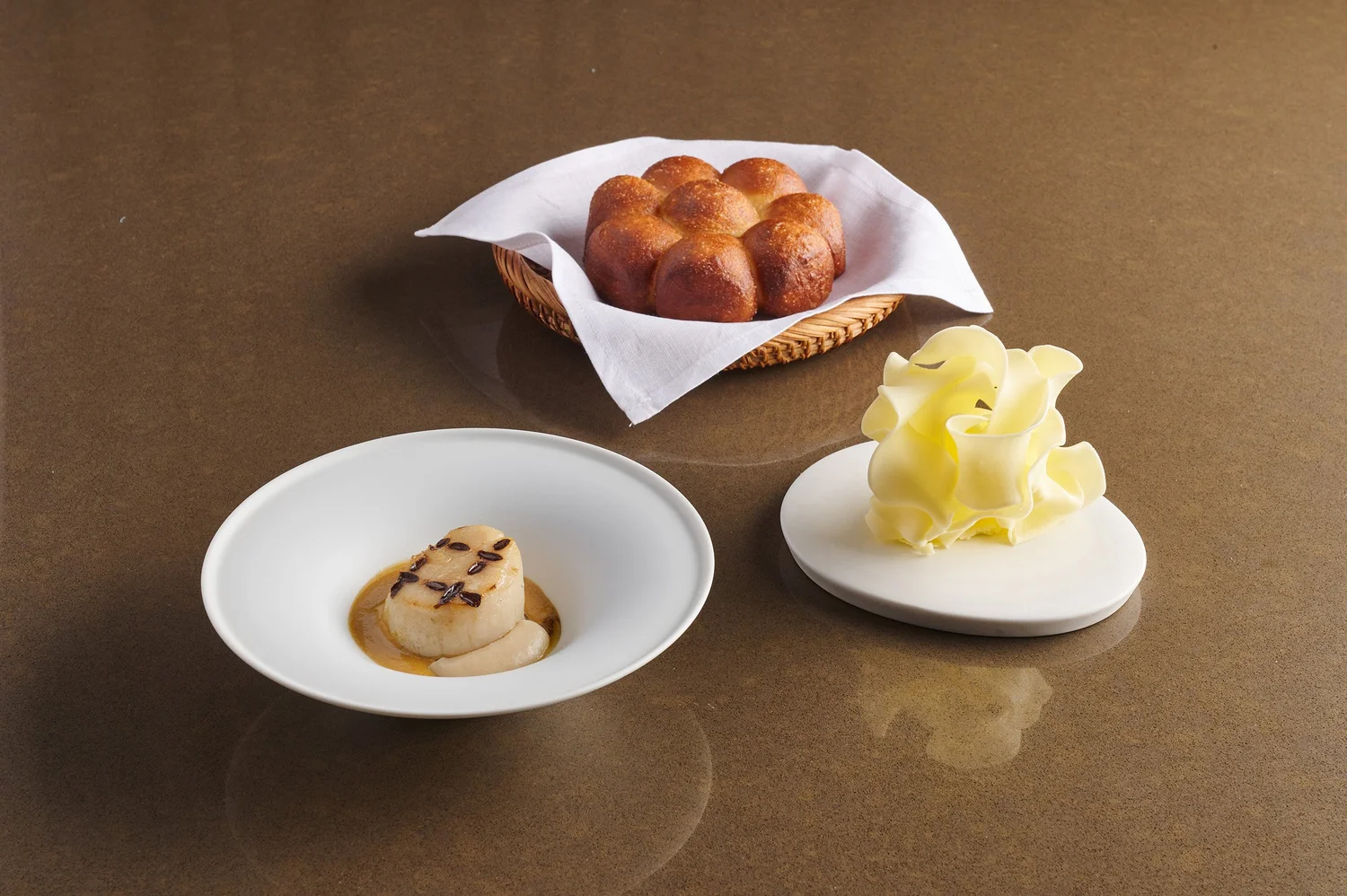
Image context: the lead image uses Seroja's official menu photography because the scallop, roti paung, and Johorean milk butter capture the restaurant's strongest habit in miniature. A marine product from the region arrives with bread, fat, and sauce, then gets tightened into a composed Singapore tabletop rather than being left as rustic memory.[2]
1. The restaurant's subject is a region, but its unit of measure is one room
The official story page is useful because it shows how Seroja avoids treating "the Malay Archipelago" as a grand but slippery abstraction.[1] Wong writes about commonality inside diversity, about growing up with these flavors, and about building a restaurant that celebrates the region through ingredients, beverages, and collaborations.[1] The People page extends that logic into actual roles: Wong leads the kitchen, Andrew Ou runs as head chef, and Long Tran anchors the front of house, all as long-term collaborators rather than a prestige cast assembled for a launch cycle.[3]
That continuity matters because the restaurant's dining room is designed to keep the concept under pressure. Asia's 50 Best notes that the counter lets guests watch the kitchen work directly, and Seroja's own story page says there are 13 counter seats alongside tables for small groups.[1][7] This is not a massive luxury floor built to flatten differences into generic comfort. It is a compact room where every course has to justify the trip from idea to plate in front of the guest. In practice, that makes Seroja easier to trust than many "pan-regional" restaurants. The room is small enough that the concept cannot hide behind theatrical scale.
2. Seafood is the spine, and the pantry gives it accent and memory
Michelin's restaurant profile gets the core point right: Wong's menus are seafood-focused, and they pay tribute to Malaysian culinary traditions through local produce, spice work, and technique.[5] The menu page makes that claim concrete. Lunch and dinner both move through marinated spot prawn with asam pedas sauce, braised beef tripe and cheeks with rice ball in village chicken broth, roti paung with Johorean milk butter, and a mangrove wood-charred shellfish course with laksa leaf sauce. Then the structure widens into silver pomfret and jade abalone with roasted fish bone sauce, followed by a percik course, dessert, and pairings.[2]
Those details show why Seroja reads as a restaurant profile rather than a dish file. The menu is not trying to reduce the region to one icon or one grandmotherly comfort reference. It keeps translating pantry logic across multiple textures and temperatures: acid from asam pedas, char on seafood, fish-bone depth, herb brightness, coconut and spice memory, and then sweet courses that remain regionally specific through bandung, sesame muah chee, or Cameron Highlands sweetcorn.[2] Asia's 50 Best highlights the same pattern when it describes native spices and herbs, a signature mangrove wood-charred scallop with laksa leaf sauce, and buns that encourage the diner to finish the sauce rather than merely admire the plate.[7]
That is where Seroja feels more exact than many contemporary Southeast Asian tasting menus. It does not present archipelago cuisine as an endless shelf of references. It narrows the field to a few recurring controls: seafood, aromatic depth, bread and sauce interaction, and a sequence that keeps one course explaining the next.[2][5][7]
3. The producer network is not background texture; it is the restaurant's real engine room
Wong's Michelin Young Chef profile is especially revealing on this point. He says the menu is collaborative with farmers and fishermen, and he treats Michelin visibility less as personal coronation than as a wider platform for the people supplying the restaurant.[6] The official People and Artisan pages give those collaborators names and locations: growers in Singapore, craftspeople in Kuala Lumpur and Bali, tropical-herb vendors in Geylang Serai and Tekka Market, rice from the Lun Bawang community in Sarawak, poultry from Toh Thye San, and fishermen connected to the Straits of Malacca, Japan, and Europe.[3][4]
That list could have been decorative branding. At Seroja it functions more like a sourcing argument. Wong is trying to show that a restaurant about the Malay Archipelago should not speak only through recipes. It should also speak through who grows, harvests, shapes, and carries the materials of the meal.[1][3][4][6] Even the table objects participate in that logic. The official pages emphasize craftsmen and artisans alongside growers and fishers, which helps explain why the room does not feel like a neutral modern container. It feels authored all the way down.[1][3][4]
This is one reason Seroja's rise has been so fast. Michelin's inspectors praise the food for balance and meticulous plating, but the restaurant's deeper persuasive power comes from coherence.[5] The food, the room, the ceramics, the herbs, the seafood, and the supplier language are all pushing in one direction. The restaurant knows what it wants to platform.
4. Pairings and sustainability are part of the profile, not side programs
The Michelin restaurant page includes one of the clearest statements of Seroja's working philosophy: seasonal vegetables, sustainably sourced seafood, and trimmings reused in non-alcoholic beverages or even art.[5] The menu page then shows that the non-alcoholic pairing is not a token accommodation. It is a full track alongside wine, priced and presented as part of the meal's structure.[2] That matters because Seroja is not a restaurant where sustainability sits in a separate PDF while the dining room behaves conventionally.
The story and Young Chef pages push the same point from the operational side.[1][6] Wong talks about sustainability training, building systems such as rainwater and waste management, and a sixth-floor farm supplying some herbs and vegetables.[6] The restaurant story page describes a building with Green Mark certification, sun-shading facade logic, water management, and organic waste returned to nearby soil.[1] None of this makes the meal virtuous by declaration alone. What it does is narrow the distance between what the restaurant says about regional abundance and how it chooses to run the room.
For a fine-dining profile, that is significant. Plenty of restaurants can tell you that they honor place. Seroja keeps trying to make place legible in the mechanics of service, sourcing, pairing, and waste. The result feels less like branding and more like an operating discipline.[1][2][5][6]
5. Why Seroja feels timely in 2026
Seroja's public rise is easy to list: opened in 2022, Michelin star, Singapore's first Michelin Green Star in 2023, Young Chef recognition for Wong, and a climb to No. 20 on Asia's 50 Best Restaurants 2026.[1][5][6][7] The better question is why those signals keep sticking. The answer is that the restaurant has found a scale at which regional ambition stays readable.
In larger rooms, archipelago thinking can turn into broad rhetoric about diversity and spice. In smaller, sharper rooms, it can become cuisine. Seroja belongs to the second category. Its strongest move is not maximalism. It is editing. A 24-seat room, a seafood-led sequence, a close view into the kitchen, and a collaborator network spread across markets, farms, craft studios, and fishing lanes keep the concept dense without letting it become foggy.[1][2][3][4][7]
That makes Seroja one of the more persuasive restaurant stories in Asia right now. It does not flatten Southeast Asia into a tasting-menu souvenir. It brings the region down to working scale. In that room, the Malay Archipelago stops being a map and starts behaving like a grammar.[1][2][5][7]
Sources
- Seroja, "Press Room / Story" - official statement on the restaurant's concept, the Jalan Seroja name, the Duo Galleria space, open-kitchen layout, sustainability systems, and awards history.
- Seroja, "The Seroja Experience" - official menu page and image gallery covering the current Kuntum and Nusantara menus, representative dishes, and wine/non-alcoholic pairing structure.
- Seroja, "The People of Seroja" - official team page covering Kevin Wong, Andrew Ou, Long Tran, and the restaurant's collaborator list.
- Seroja, "Artisan" - official collaborator page covering farmers, fishers, herb vendors, ceramic makers, and other production partners across the region.
- MICHELIN Guide, "Seroja - Singapore" - restaurant profile covering the Michelin star, seafood-led tasting menus, local produce, sustainability quote, and service facts.
- MICHELIN Guide, "Meet Seroja's Kevin Wong, Winner of Singapore's MICHELIN Guide Young Chef Award 2023" - profile covering Wong's background, collaborator emphasis, sustainability initiatives, and signature dish framing.
- Asia's 50 Best Restaurants 2026, "Seroja" - ranking profile covering the No. 20 placement, 24-seat room, counter format, menu character, and the restaurant's rise since 2022.