The easiest way to flatten KOL is to describe it as Mexican food made with British ingredients, then stop there.
That description is true, but it sounds too defensive, as though the restaurant's main achievement were learning how to survive without importing a Mexican pantry whole. The stronger reading is structural. The MICHELIN Guide's current London best-of note says Santiago Lastra's cooking is defined by a commitment to using only British ingredients, to the point that something as central as citrus gets rerouted through substitutes like sea buckthorn.[3] That is not a minor workaround. It is the design pressure that gives the food its shape.
As of April 25, 2026, KOL's own home page is still introducing the restaurant with four linked ideas: "Mexican Soul, British Ingredients," wild food, seasonality, and "Memories of Mexico, shaped by British produce." The same page frames the restaurant around a GBP145 seven-course menu.[1] The current public spring PDF then turns that philosophy into a sequence: Short rib Quesadilla, Caviar and Ceviche, Langoustine Taco, an optional Wagyu Huarache, Mushroom Pozole, Duck Mole, Paleta, Pastel, and optional Buñuelos, with Soft, Classic, Mezcal, and Icons pairings priced at 65, 95, 105, and 170 pounds respectively.[2] That is not a generic tasting ladder. It is a carefully ordered argument about which parts of Mexican cooking stay load-bearing when the produce changes country.
50 Best Discovery captures the visible result neatly enough: KOL keeps its Mexican spirit while always using British seasonal produce, so dishes like langoustine taco and mackerel and rhubarb chalupa can feel coherent rather than gimmicky.[4] The deeper reason is that the restaurant keeps returning to durable forms such as quesadilla, ceviche, taco, pozole, mole, and paleta. British seasonality does the hard work inside those forms; it does not replace them.
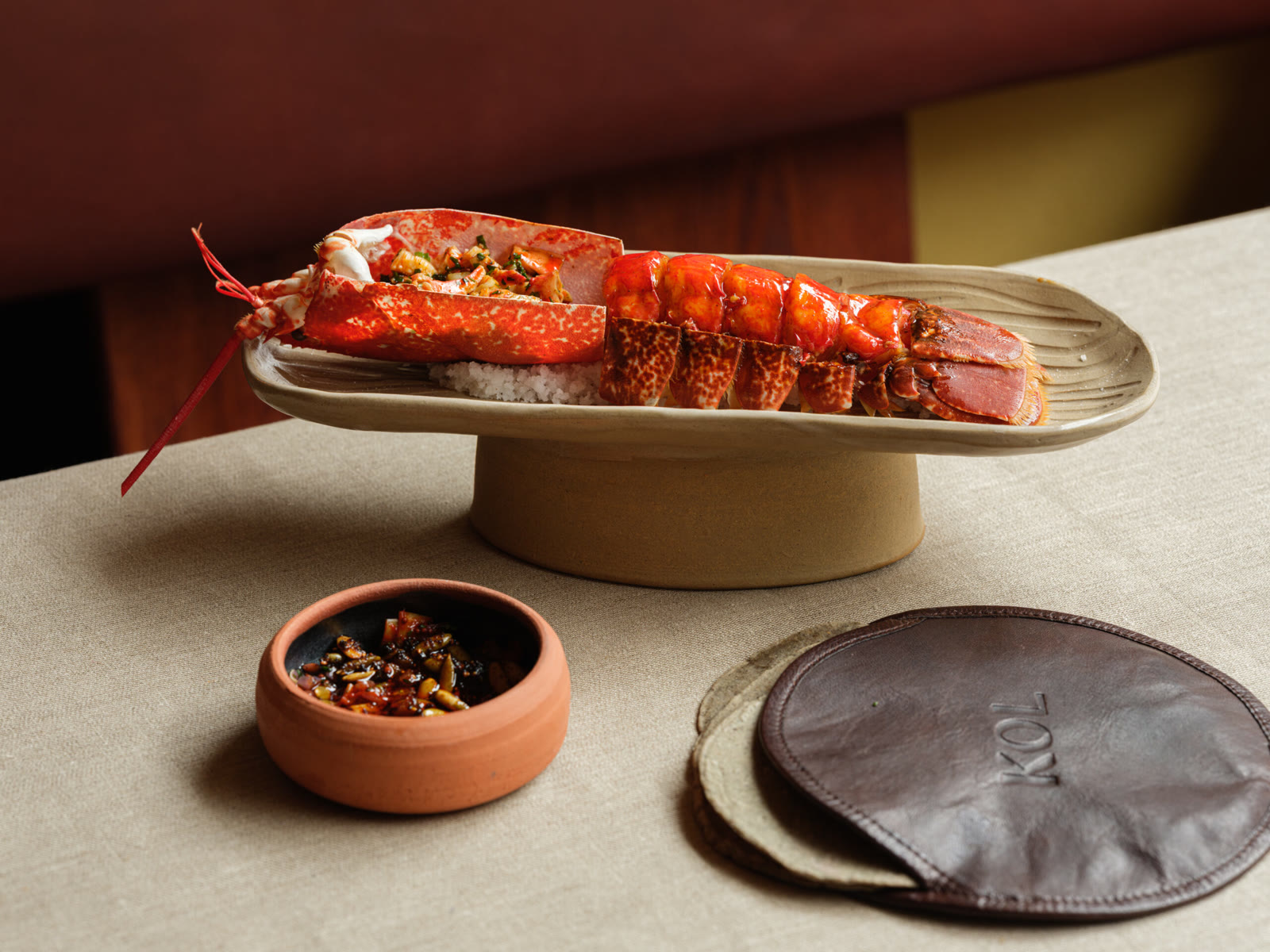
Image context: the cover uses KOL's official lobster photograph because this walkthrough is really about form carrying flavor. The image shows the restaurant's larger method clearly: local shellfish, restrained plating, and a service object that feels recognizably contemporary London, all held inside a grammar that still points back toward Mexican coastal memory.[1]
The first two courses teach the rule
The opening pair is where the method becomes legible.
Short rib Quesadilla is a clever place to begin because it starts the meal with starch, fold, and animal depth rather than with luxury display.[2] The question is not whether short rib is "traditional" enough. The question is whether the quesadilla still behaves like a quesadilla: toasted exterior, contained richness, and a format built for compression rather than for spread-out decoration. KOL answers yes, then immediately sharpens the frame with Caviar and Ceviche.[2]
That second move matters because ceviche is one of the clearest tests of the restaurant's identity. The MICHELIN Guide's London note makes explicit that KOL cannot rely on imported citrus in the usual way, which means brightness has to be rebuilt through British ingredients and local acidity.[3] Even when the current menu lists the course in broad terms rather than spelling out every supporting detail, the structure is enough. The meal moves from toasted masa and meat to cold marine sharpness, and in doing so it tells you that KOL is not trying to imitate Mexican abundance ingredient for ingredient. It is trying to preserve Mexican directional logic under British conditions.[2][3]
Taco and huarache show that masa is the load-bearing wall
The Langoustine Taco is the hinge of the spring menu.[2]
50 Best Discovery already treats langoustine taco as one of the dishes that best explains KOL's house style, and that makes sense.[4] A taco is a small format, but it is also a strict one. It asks the kitchen to make marine sweetness, chilli, fat, and bite all arrive at once without becoming elaborate for the sake of elaboration. At KOL, British shellfish enters the meal most convincingly when it is asked to obey that structure rather than when it is asked to stand alone as expensive produce.[2][4]
The optional Wagyu Huarache makes the same point in a heavier register.[2] A huarache carries more heft than a taco and invites a broader surface, more chew, and more topping pressure. By placing it as a supplement rather than as the meal's compulsory center, KOL reveals its priorities. Luxury beef is available, but it is not the only story. The menu's real continuity comes from masa formats that keep the meal recognizably Mexican even as British seasonality keeps changing the fillings.[2][4]
The middle goes darker so the menu can stop looking like adaptation
The strongest claim of the menu sits in the move from Mushroom Pozole to Duck Mole.[2]
KOL's own home page says the restaurant honors old and new through familiar foundations of mole, corn masa and ceviche, reimagined in presentation.[1] In the spring menu, that line stops sounding like copy and starts reading like structure. Mushroom Pozole is the point where the meal ceases to feel like a string of refined small plates and starts behaving like a deeper broth-and-hominy argument.[2] Then Duck Mole arrives and fixes the emotional temperature of the dinner.[2]
This is important because British produce can easily make globally minded fine dining drift toward polished localism: beautiful meat, excellent vegetables, clean sauces, not much memory. Mole blocks that drift. It brings archive, smoke, bitterness, spice layering, and duration. The duck may be local, but mole decides how the course is remembered. Instead of reading as a seasonal British main with Mexican references attached, the dish reads as a Mexican form powerful enough to absorb a British bird and still keep the center of gravity southward.[1][2]
That is why KOL feels more disciplined than many "ingredient substitution" restaurants. The substitutions are not the point. The point is that Mexican formats survive the substitution process with enough force to keep directing the meal.
The ending stays light without leaving the cuisine behind
The dessert sequence is short, but it clarifies the whole meal.
Paleta and Pastel look almost too simple when listed on the PDF after duck mole.[2] In practice, the simplicity is the intelligence. KOL does not pivot into an anonymous French pastry register just because the savory section is done. It stays inside recognizably Latin dessert shapes: frozen relief first, then a softer cake-like landing, with optional Buñuelos available if the table wants one more crunch-and-sugar accent.[2]
This matters because it keeps the menu from ending as a concept meal. The spring sequence begins with recognizable Mexican forms and ends with them too. British produce is allowed to alter texture, aroma, acidity, and season, but not the meal's underlying orientation. That is the difference between a restaurant performing influence and a restaurant building a house style.
What you are really booking in 2026
KOL's current home page says the restaurant is open for Tuesday dinner and for Wednesday-to-Saturday lunch and dinner, with the kitchen closing earlier than the room itself.[1] 50 Best Discovery still places it inside the global top 50 and treats it as one of London's go-to tasting destinations.[4] Those signals are useful, but the stronger reason to book is that the meal is unusually legible.
You are not booking a compromise restaurant that happens to be clever about sourcing. You are booking a room that treats British produce as pressure strong enough to clarify Mexican structure. That is why the current spring menu holds together. Quesadilla, ceviche, langoustine taco, pozole, duck mole, paleta, and pastel do not read like substitutions. They read like one cuisine thinking out loud in another climate.[1][2][3][4]
Sources
- KOL official homepage, including the house line "Mexican Soul, British Ingredients," seasonality framing, the "Memories of Mexico, shaped by British produce" restaurant summary, current seven-course GBP145 menu framing, opening hours, and the official lobster photograph used for the cover image.
- KOL, "KOL New Menu" spring 2026 PDF, listing the current seven-course menu, vegetarian, vegan, and pescatarian variants, pairings, and supplements.
- The MICHELIN Guide, "The Best Mexican Restaurants in London" (updated February 13, 2026), on KOL as the UK's only MICHELIN-starred Mexican restaurant and its use of British ingredients such as sea buckthorn in place of citrus.
- 50 Best Discovery, "Kol - London - Restaurant," on KOL's 2025 ranking, British-seasonal-produce rule, langoustine taco, mackerel-and-rhubarb chalupa, and Mezcaleria context.