
The easiest way to flatten Saint Pierre is to quote its own tagline, call it contemporary French cuisine "with an Asian accent," and stop there.[2][3] That phrase is useful, but it is still too broad for what the restaurant actually seems to optimize. The official site talks instead about balance, precision and flavour, while the MICHELIN Guide adds a sharper operational clue: the single tasting menu revolves around premium seafood, especially from Japan, and is delivered in a room defined as much by Marina Bay views and discreet service as by classical luxury codes.[2][5] Those details matter because they shift the restaurant away from generic fusion and toward something stricter. Saint Pierre is trying to make refinement feel lucid rather than dense.
That is why the short official video is more revealing than its length suggests.[1] It is a silent montage, not a chef lecture, but silence helps here. Without explanatory voice-over, the house has to declare itself through sequence alone: first the room, then the kitchen, then fish and plating, then wine, then the finished dish and chefly signature.[1] Watched beside the official pages, the clip reads like a statement of method. Saint Pierre does not present luxury as heavy upholstery, silver-domed theater, or old-world solemnity. It presents luxury as controlled flow: bay light moving through glass, marine product moving through the kitchen, and service moving the guest between concentration and ease.[1][2][5]
The written sources reinforce that reading from different angles.[2][3][4][5] The homepage insists on warm hospitality, elegant interiors, and a floor-to-ceiling panorama over the waterfront.[2] The about page frames Emmanuel Stroobant's cuisine as the result of long movement between Belgium and Asia, then links the current menu to the Zen Circle and the freeing of the mind rather than to static French orthodoxy.[3] The wine page makes pairing part of the restaurant's identity rather than a sidecar revenue lane, and the MICHELIN entry confirms that the food is judged not only by product quality but by mindful preparation and restraint.[4][5] Put together, the stronger claim is that Saint Pierre's real house style is engineered calm. It wants the meal to feel smooth, but only because a lot of precision is holding that smoothness in place.
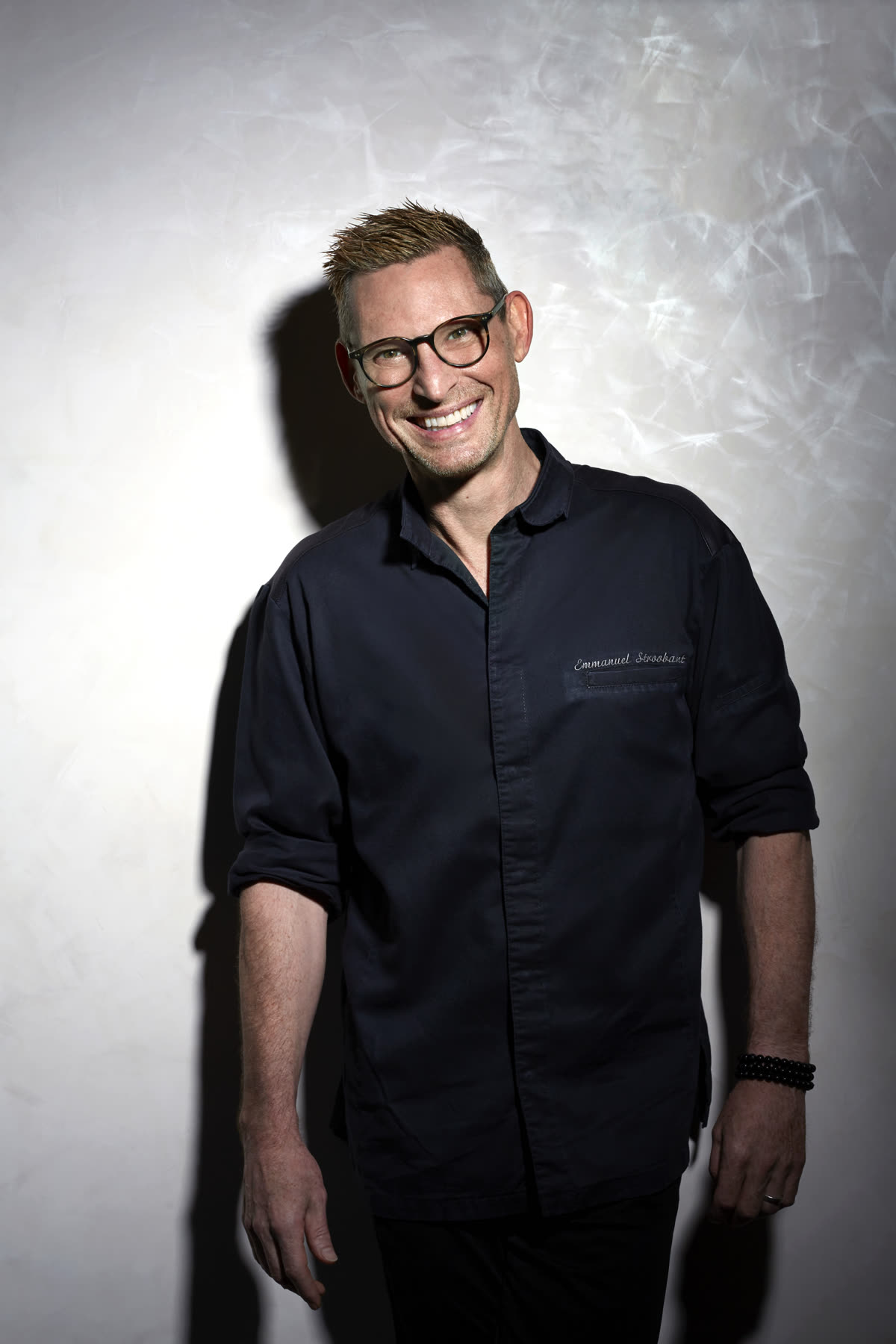
Image context: the cover uses Saint Pierre's official portrait of Emmanuel Stroobant rather than a generic dining-room still. That choice fits the article's argument because the restaurant's quiet surface is not accidental. The cross-cultural line, the bayfront setting, the seafood emphasis, and the pairing logic all point back to an authored discipline that the official biography makes explicit.[3]
Around 0:15 to 0:30, the room announces that Saint Pierre wants openness before grandeur
The first really useful stretch comes once the montage settles into the dining room.[1] What the camera gives you is not baroque French luxury but a bright, glass-heavy room with palms and water outside, enough daylight to keep the tables from feeling ceremonial, and a layout that lets the view remain part of the meal.[1] That matches the homepage language almost exactly: Saint Pierre advertises not just cuisine but a panoramic Marina Bay setting, elegant interiors, and a sensory experience in which place matters as much as plate.[2]
This is more than scenic packaging. A lot of expensive dining rooms ask the guest to accept seriousness first and pleasure second. Saint Pierre appears to reverse the order. The room is airy, visually legible, and socially unthreatening, which matters because the food itself is pitched at a very high level.[1][2][5] My inference from the clip plus the written sources is that the waterfront light is doing real hospitality work. It stops two-star formality from hardening into stiffness, and it prepares the guest to read precision as calm rather than intimidation.[2][5]
That choice also helps explain why the restaurant's East-West language feels less dated than the phrase "Asian accent" might suggest.[2][3] If the room were darker, denser, and more self-consciously French, the cross-cultural claim could risk reading like surface garnish. In this brighter setting, the restaurant instead feels tuned to Singapore itself: high-end, international, marine, and fast-moving, but not eager to cosplay Paris.[2][3]
Around 0:30 to 0:48, the kitchen and fish shots reveal that product clarity is the restaurant's real luxury code
The middle of the video gets more exact. After the room comes the kitchen view, then fish handling, then close work on ingredients.[1] That sequence matters because it gives Saint Pierre a better center of gravity than broad words like refinement or innovation. MICHELIN says the single tasting menu showcases premium seafood from around the world, especially Japan.[5] The video makes that believable not by listing origins, but by showing marine product as the restaurant's working texture: flesh, skin, knife contact, and hands that treat fish not as garnish for luxury but as luxury's core material.[1]
This is where Saint Pierre starts to look different from French fine dining rooms that still signal prestige through accumulation: richer proteins, darker sauces, heavier table rhetoric, more explicit opulence. The clip points in another direction.[1] The product emphasis is expensive, but the visual language is clean. Fish arrives as surface, translucency, and precision. That fits the homepage's promise of balance and the MICHELIN language about natural flavours being accentuated through mindful preparation.[2][5] The luxury offer, in other words, is not maximalism. It is marine concentration.
That also makes the "Asian" part of Saint Pierre easier to understand.[2][3][5] The about page presents Stroobant's cooking as the result of classic French training reshaped by years in Asia, while MICHELIN notes that the team knows the Asian F&B market inside out.[3][5] In practice, the seafood focus seems to be where those lines meet. Seafood lets the kitchen keep French technique while chasing a lighter, more tensile finish than a heavier continental grammar might produce. Saint Pierre does not look like it wants to erase richness altogether. It looks like it wants to keep richness moving.
Around 0:48 to 1:10, plating and wine service show that balance here is a systems concept, not just a tasting note
The next beat is the one that most clearly justifies the word balance.[1] The camera moves from tweezers and plate composition to a wine pour by the windows, then back toward the completed dish.[1] On the page, Saint Pierre makes exactly the same argument in written form. The wine program is described as integral to the dining experience, not ornamental, and the restaurant says it maintains hundreds of labels while the about page notes that Ying Hsien oversees more than 2,300 bottles as wine consultant.[3][4] That is not small talk. It means the house thinks harmony has to be built across glass, room, and plate at the same time.
This is where Saint Pierre's calm starts to look engineered rather than merely tasteful. The plating shots are delicate, but they are not dainty in the weak sense.[1] They suggest editing, spacing, and measured contrast. The wine shot performs the same logic from another angle: a service gesture that is visually soft, but structurally important.[1][4] The article's strongest inference is that Saint Pierre treats pairing as a control mechanism. Wine is there to tune pressure, not just to decorate prestige. A restaurant that advertises balance and precision needs a serious liquid program, because otherwise the meal risks collapsing into disconnected beautiful plates.[2][4]
That systems reading also makes sense of the chef biography. The about page says the current menu is inspired by the Zen Circle and the freeing of the mind, which could sound abstract on its own.[3] Beside the video, it becomes more concrete. Calm is not emptiness. Calm is what happens when enough technical decisions have already been made well that the guest no longer has to feel the strain.
Around 1:10 to the end, the plated finish and chef reveal the restaurant's final move: authorship without noise
By the end of the clip, Saint Pierre has shown the finished dish and then returned, implicitly or directly, to the chefly figure behind the house.[1] That closing matters because it confirms the video's structure. This is not a documentary about sourcing alone, nor a lifestyle reel about the bay view. It is a compact authorship statement. The restaurant begins with atmosphere, moves through product and service, and ends by reminding the viewer that all of that apparent ease is being held together by a singular point of view.[1][3]
That is why Saint Pierre is more interesting than the generic category of "French fine dining in Singapore."[2][3][5] The category is crowded; the restaurant's distinguishing move is narrower. It uses the Marina Bay frontage to lighten the social mood, uses premium seafood to keep the cuisine exact rather than weighty, and uses wine and service discipline to stop elegance from becoming inert.[1][2][4][5] The official video is silent, but its message is clear enough: Saint Pierre wants luxury to feel poised, marine, and breathable.
In that sense, the restaurant's real achievement is not fusion language, nor waterfront glamour by itself. It is the conversion of many potentially flashy assets into one continuous emotional register.[1][2][3][4][5] View, product, plate, and pour all move in the same direction. Saint Pierre's calm is engineered because every part of the house seems tasked with the same job: keep refinement alive, but never let it turn static.
Sources
- Emmanuel Stroobant Group, "Saint Pierre Restaurant," YouTube video, published December 16, 2014.
- Saint Pierre, homepage - official overview describing the restaurant's contemporary French cuisine with an Asian accent, balance/precision/flavour approach, and Marina Bay waterfront setting.
- Saint Pierre, "About" - official page covering Emmanuel Stroobant's culinary background, Saint Pierre's two-MICHELIN-star history, Zen Circle inspiration, and core team.
- Saint Pierre, "Wine" - official page covering the pairing philosophy, wine-program scope, and the role of Master of Wine Tan Ying Hsien.
- MICHELIN Guide, "Saint Pierre - Singapore" - two-star restaurant entry highlighting Marina Bay views, discreet service, mindful preparation, and the tasting menu's premium seafood focus.