Septime's useful trick is that it makes a hard reservation feel like a relaxed room. That sounds contradictory until the operating model comes into focus. The restaurant publishes only two menu lengths, opens reservations every morning at a fixed clock time for a short forward window, closes on weekends, and lets the surrounding Charonne-side family of places absorb some of the demand that the main room cannot hold.[1][2][3]
That is the more interesting story than hype. Septime is not only a famous neo-bistro with a high ranking. It is a small system for keeping looseness from turning into drift. Bertrand Grebaut's food can be seasonal and low-pretension because the frame around it is unusually tight: 5 steps at lunch, 7 at dinner, a published wine-pairing option, weekday-only services, and reservations released daily at 10 a.m. for the next three weeks.[1]
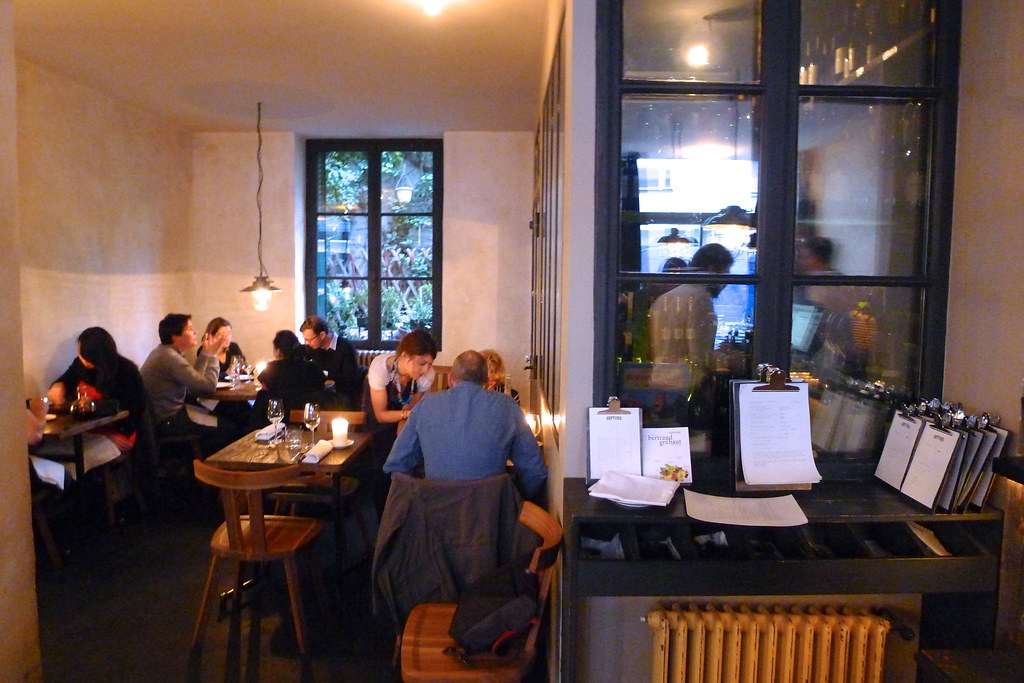
Image context: the cover uses a real interior photograph of Restaurant Septime taken in April 2013 and published on Flickr by HPRG Les Hotels Paris Rive Gauche. It fits this service-operations article better than a plated-course close-up because Septime's enduring lesson is partly architectural and social: the room feels like a neighborhood bistro while the booking mechanics behave like a global-demand filter.[1][2][7]
The Booking Clock Is Part Of The Product
Septime's current website is blunt where many destination restaurants are ornamental. Lunch is a "tasting menu in 5 steps" at 85 euros, with a 60-euro wine pairing. Dinner is a "tasting menu in 7 steps" at 135 euros, with a 75-euro wine pairing. Reservations open every day at 10 a.m. for the next three weeks. The restaurant serves Monday to Friday from 12:15 p.m. to 2 p.m. and 7:30 p.m. to 11 p.m., and closes Saturday and Sunday.[1]
Those numbers do more than help a diner plan. They define the restaurant's emotional contract. Septime is not asking the guest to choose among long menus, supplements, rooms, private counters, prestige pairings, and alternate formats. It creates a narrow gateway, then lets the meal feel lighter once the guest is through it.
The World's 50 Best Restaurants 2025 profile makes the demand side explicit: Septime was ranked No. 40, has a limited number of oversubscribed seats, and accepts reservations three weeks in advance online only.[2] The Discovery profile adds the room-side interpretation, describing Septime as a stripped-back bistro that helped set the standard for contemporary eating in Paris's 11th arrondissement.[3] Read together, the public evidence shows a restaurant that keeps scarcity outside the dining room as much as possible. The stress belongs to the booking clock. The table gets to remain informal.
That separation is a service design achievement. Many popular restaurants let the fight for access leak into dinner itself. The guest arrives expecting status confirmation, and the staff has to perform significance all night. Septime's better move is to keep the room closer to bistro manners: no grand palace ritual, no luxury costume, no menu encyclopedia. The restaurant's reputation is heavy; the service grammar tries to stay light.[2][3][6]
Two Menu Lengths Keep The Room In Tune
The 5-step lunch and 7-step dinner look simple, but simple is not the same as loose.[1] A fixed course count lets the kitchen and floor run a compact rhythm. Lunch can stay concentrated. Dinner can stretch without becoming an epic. Wine pairing has a published price, but the bottle culture is broader and more personal than a standard sommelier-led upsell.[1][4]
Phaidon, drawing from Grebaut and Pourriat's book on the Septime family, describes one of the house's most revealing departures from conventional luxury: the locations were intentionally conceived without traditional sommeliers, even though some trained wine people are on staff, and everyone is expected to learn on the job.[4] The point is not anti-expertise. It is anti-theater. Wine knowledge is meant to circulate through the team instead of sitting behind a ceremonial badge.
That fits the official site's current "Les Vignerons" section, a long list of producers that reads more like a living address book than a polished luxury category tree.[1] It also explains why Septime's wine service matters operationally. A room with a short menu and an oversubscribed book can easily become rigid. Natural-wine culture, shared staff learning, and a less hierarchical service model give the restaurant a way to stay conversational without surrendering control.[1][4]
The risk is obvious: a casual service style can be misread as less precise, especially by diners who equate fine dining with visible hierarchy. Septime's model asks for a different read. Precision sits in the constraints: the booking window, the course count, the service days, the producer network, and the staff's ability to explain ingredient and wine choices without turning the exchange into a lecture.[1][4][5]
The Ecosystem Solves Excess Demand
Septime also works because it is not alone on its block. The 2025 50 Best profile points diners toward the wider family: Clamato, the seafood-focused nearby restaurant; Septime La Cave, the natural wine bar; Tapisserie, the pastry shop; and D'Une Ile, the countryside hotel project outside Paris.[2] Phaidon frames the same constellation through wine, noting that La Cave emerged after the main restaurant was already running at full capacity and needed more space around its wine life.[4]
That matters because excess demand is one of the hardest service problems in modern fine dining. If every disappointed guest has only one doorway, frustration gathers around that doorway. Septime's ecosystem creates softer fallback paths. A diner who cannot get the main reservation can still drink nearby, eat seafood nearby, buy pastry nearby, or understand the group as a set of related expressions rather than a single trophy table.[2][4][6]
Bon Appetit's practical note captures the guest-side version of this. It tells readers to reserve as soon as the three-week window opens, or take their chances and wait around the neighboring Septime Cave or Clamato.[6] That is not just travel advice. It describes a demand-management system with neighborhood texture. The restaurant's scarcity becomes less brittle because the surrounding addresses keep the evening from becoming binary success or failure.
In a more formal restaurant group, this could feel like brand extension. Around Rue de Charonne, it reads more like pressure relief. Septime can remain small because the group has built other ways for people to enter the world around it.[2][4][6]
Sustainability Becomes A Service Burden
The sustainability story is older but still useful because it shows how Septime's informality is backed by operational decisions rather than vibe alone. When Septime won the World's 50 Best Sustainable Restaurant Award in 2017, the cited practices included 99 percent French-grown produce with narrow exceptions, an 80 percent vegetable share of the menu, buying whole animals when meat was used, avoiding beef, working with small-boat fishermen, paying seafood suppliers above market in some cases, natural wine, filtered water instead of plastic bottles, and front-of-house staff explaining dish contents and ingredient origins.[5]
Some of those details belong to the 2017 reporting moment, not to a guarantee that every number is identical today. The durable lesson is structural. Sustainability at Septime was not presented only as procurement. It became service work. If the kitchen buys from small producers, avoids certain luxury defaults, uses less fashionable fish, and places vegetables at the center, the dining room has to make those choices legible without sounding moralistic.[5]
That is where the neo-bistro frame helps. A grand room can make restraint feel punitive: the guest pays for ceremony and then notices what is absent. Septime's stripped-back style changes the expectation. Seasonal vegetables, leaner seafood choices, natural wine, and filtered water can feel like the restaurant's native language rather than a denial of luxury.[3][5]
Why The Casualness Holds
Septime's casualness holds because it is not accidental. The restaurant limits choices before service begins, then gives the guest enough warmth to forget the limits for a while. It is difficult to book, but easy to understand once seated. It is globally ranked, but its official mechanics remain almost stubbornly plain. It is associated with natural wine and sustainability, but the service lesson is less about slogans than about making constraints feel hospitable.[1][2][3][4][5]
That is why Septime still matters as a service-operations model in 2026. Many restaurants can copy the stripped room, the mismatched chair, the seasonal menu, or the natural-wine tone. Fewer can make the whole system cohere: daily 10 a.m. reservation release, three-week horizon, two course counts, weekday rhythm, producer-driven wine culture, sustainability translated through staff, and neighboring formats that absorb the demand the main room cannot satisfy.[1][2][4][5][6]
The result is not anti-luxury. It is luxury with the pressure moved around. The guest fights for the table online; the restaurant fights to make the table feel unforced. Septime's best operational idea is that scarcity does not have to announce itself at dinner. If the system is disciplined enough, scarcity can arrive wearing a bistro facade.
Sources
- Septime official website - current spring menu prices, wine-pairing prices, 10 a.m. three-week reservation window, address, opening times, and producer list.
- The World's 50 Best Restaurants 2025, "Septime" - current No. 40 profile, Bertrand Grebaut and Theo Pourriat roles, 5-course lunch and 7-course dinner framing, three-week online booking note, and related Septime-family addresses.
- The World's 50 Best Discovery, "Septime - Paris" - venue profile covering the stripped-back interior, 11th-arrondissement setting, micro-seasonal cooking, current accolade notes, tasting-menu entry point, and weekday lunch/dinner service.
- Phaidon, "How Septime swapped the sommelier for better wine" - excerpted book context on Grebaut and Pourriat's wine philosophy, nontraditional sommelier model, La Cave origin, and natural-wine approach.
- The World's 50 Best Restaurants, "14 reasons why Septime is the most sustainable of The World's 50 Best Restaurants 2017" - sustainability award context, sourcing, vegetable focus, seafood practices, water, staff explanation, and labor notes.
- Bon Appetit, "Septime" - restaurant guide entry on the room, relaxed sophistication, three-week reservation advice, neighboring Septime Cave and Clamato fallback, and weekday service context.
- Flickr, HPRG Les Hotels Paris Rive Gauche, "Restaurant Septime, Paris" - real 2013 interior photograph used as the article image.