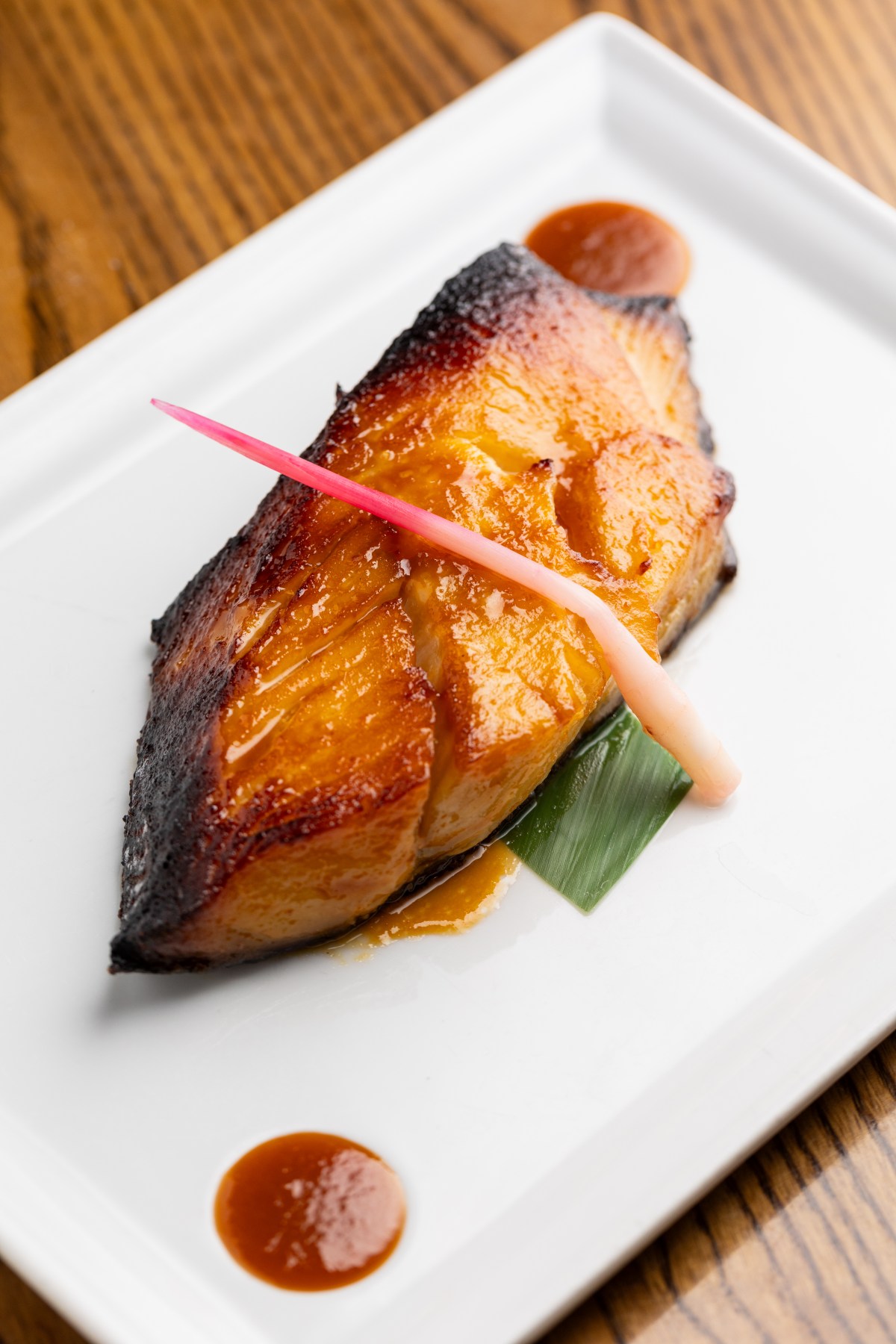

Nobu's black cod with miso is one of those restaurant dishes that looks almost too simple to explain its reach. A golden piece of fish sits on a white plate, usually with a sharp little accent of pickled ginger and a disciplined amount of sauce. It does not arrive as a tasting-menu puzzle. It does not need smoke, foam, tweezers, or a server's long speech. The point is stranger: the luxury has already happened before the plate reaches the table.[1][2]
The official Nobu Restaurants video is useful because it treats the dish as both memory and mechanism. Nobu Matsuhisa frames black cod as an ingredient he knew from Alaska, then explains why the fish became a vehicle for a miso marinade that could travel far beyond one Beverly Hills dining room.[1] Eater LA's reconstruction of Nobu's Japanese-lounge vocabulary makes the same point from the dining-culture side: black cod with miso did not invent miso-marinated fish, but the Nobu version made the preparation canonical for a whole genre of expensive, energetic, globally legible Japanese fine dining.[2]
That is why this is an annotated viewing rather than a recipe note. The video is not valuable only because it tells a cook what to do. It shows how a dish becomes durable: choose a fatty fish that can take a cure, build sweetness and umami into the surface, use high heat to turn marinade into lacquer, then serve it with enough restraint that the diner reads the result as effortless. Fine dining often sells complexity by showing it. Nobu's black cod sells complexity by hiding most of it in time.[1][3][4]
Image context: the cover uses a real photograph of Nobu's black cod from Eater LA, not a generic cod fillet or recipe-process shot. That matters because the article is about the finished restaurant code: pale plate, dark glaze, small garnish, and the confidence to make one carefully marinated fish carry the whole argument.[2]
The Dish Starts Before The Fire
The first thing to watch is how little of the dish depends on last-second virtuosity.[1] Many restaurant videos train the eye on speed: knife work, pans, flames, plating gestures. This one is more revealing when it slows your attention down. The core technique is marination. Hikari Miso's published version of the Nobu recipe describes sake, mirin, white miso, and sugar as the base, with black cod held in the cooled miso mixture for four days before cooking.[3] Cathay's dining feature gives the restaurant-facing version of the same logic: sablefish, or black cod, is held in a miso-and-sugar mixture for roughly 72 hours before it is served sparely and classically.[4]
Those details change the way the video should be read. The dish is not "fish plus sauce." It is fish whose surface and interior have been reorganized before service begins. The marinade seasons, dries, sweetens, and prepares the exterior for browning. The cook at the broiler is finishing a decision that began days earlier. In a restaurant setting, that makes the dish a time-management object as much as a flavor object.[1][3][4]
This is one reason the plate feels luxurious without looking overloaded. It gives the diner the sensation of immediate tenderness while the kitchen has absorbed the waiting. The guest does not experience four days of preparation; the guest experiences a few minutes of flake, gloss, sweetness, salt, and heat. That compression is a fine-dining move. The work is hidden, but not absent.
Sweetness Is The Adaptation, Not A Shortcut
Around the video's central explanation, Matsuhisa talks about black cod's rise as something that happened through a specific encounter between ingredient, audience, and restaurant style.[1] Eater LA is especially helpful here because it places the dish beside yellowtail jalapeno, rock shrimp tempura, and spicy tuna crispy rice: dishes that became attached to Nobu and to the broader Japanese-lounge category because they lowered the barrier to pleasure without abandoning discipline.[2]
The black cod does that through sweetness. In a weaker dish, sugar would flatten the fish into candy. Here, sweetness is the bridge that lets miso's salt and fermentation meet sablefish's fat. Hikari's recipe explains the technical side clearly: sake and mirin are boiled down, miso and sugar are cooked into a glossy marinade, the fish is held long enough for the cure to season and dry the flesh, and high broiler heat later caramelizes the surface.[3] Cathay's restaurant-facing account reinforces the same handling logic from the diner side: a roughly 72-hour miso-and-sugar marinade, followed by a golden, crisped fillet that reads as polished rather than busy.[4]
That distinction matters. The Nobu move is not simply making Japanese flavors sweeter for a Western palate. It is making the sweetness perform a job. Cathay's account is blunt about the adaptation: Matsuhisa added sweet mirin and sugar, then crisped the fillet to a golden brown.[4] That protects the dish from austerity, helps build a lacquered crust, and gives the fish a memorable first impression. The dish became widely copied because that first impression is easy to remember: soft white fish, dark caramelized edge, miso depth, clean plate.[2][3][4]
The Plate Is Sparse Because The Brand Is Loud
The video also helps explain Nobu's visual restraint.[1] A global restaurant group can easily over-mark its signatures. It can add height, garnish, color, and drama until the dish looks like advertising. Black cod with miso goes the other way. The plate is spare enough that the fish has to carry the identity by texture and glaze rather than by decoration.
That restraint is not accidental minimalism. Nobu Portman Square's current restaurant page describes the menu as shaped by Nobu Matsuhisa's Japanese and South American influences and names Black Cod Miso, Rock Shrimp Tempura, and Yellowtail Sashimi as signature dishes.[5] In other words, the dish now operates as part of a recognizable house vocabulary. Guests arrive already expecting it to mean "Nobu." The plate can stay quiet because the brand memory is loud.[2][5]
This is the dish's most interesting fine-dining lesson in 2026. Many restaurants try to create signatures by making them visually unignorable. Nobu's black cod became unignorable by becoming repeatable. It can appear in London, Malibu, New York, and other Nobu rooms without needing to be reinvented each time. The core promise is that the fish will have the same deep sweetness, same burnished surface, same soft interior, and same feeling of polished ease.[2][5]
What To Notice When Watching
Watch the video for the confidence of proportion rather than for novelty.[1] The important choices are narrow: a fatty fish, a miso-sake-mirin-sugar cure, patient refrigeration, careful removal of excess marinade, and aggressive browning without letting the fish dry out.[3][4] None of those steps is exotic by itself. The dish's power comes from the way they stack.
The second thing to notice is the economic story hiding inside the technique. Matsuhisa's video account of knowing black cod before it became a famous luxury ingredient turns the dish into a supply-story as well as a recipe.[1] Eater LA notes that the fish is technically sablefish and that Matsuhisa's version helped turn it into a staple of high-end Japanese-lounge dining.[2] Once a dish becomes a global signature, it changes how diners value the ingredient. Fine dining does not merely respond to markets; sometimes it teaches diners what to desire.
Finally, notice how short the final plate's message is. It says: wait, wipe, burnish, serve. That is the whole theater. The dish works because it turns delayed preparation into immediate pleasure, and because it lets a globally famous restaurant group express itself through a small piece of fish rather than through spectacle. Nobu's black cod remains influential because it solved a hard problem elegantly: how to make a dish travel worldwide without making it feel mass-produced.
Sources
- Nobu Restaurants, "How Nobu's Black Cod With Miso Revolutionized Cuisine" - YouTube video featuring Nobu Matsuhisa on black cod as a Nobu signature.
- Matthew Kang, "For the Love of Cod." Eater LA, 2024 - essay on Nobu's defining Japanese-lounge dishes, black cod's place in the Nobu vocabulary, and the dish photograph used as the article image.
- Hikari Miso, "Miso Black Cod Recipe By Chef Nobu" - recipe notes on the sake, mirin, white miso, sugar, four-day marinade, and broiler caramelization.
- Cathay Pacific, "World's best dishes: black cod" - dining feature on miso black cod as Nobu's defining dish, the 72-hour marinade, sweet mirin-and-sugar adaptation, and global replicability.
- Nobu Hotel London Portman Square, "Nobu Portman Square Restaurant" - official page naming Black Cod Miso among signature dishes and describing the Japanese and South American flavor frame.