As of June 7, 2026, Quay is no longer a restaurant you can book. Its final service was announced for February 14, 2026, after a run that began as Bilson's in 1988 and became Quay in 1999.[1][2] That changes the way the room should be written about. The point is not whether a diner should choose the six-course or eight-course menu, or whether a sunset table is worth the effort. Those questions belonged to a living reservation book. The better question now is why one harbourside dining room became such a durable reference point for Australian fine dining, even in a city full of water views.
The obvious answer is visible before the first glass is poured. Quay occupied the upper level of the Overseas Passenger Terminal at The Rocks, facing the Sydney Opera House and the Harbour Bridge.[3] Many restaurants would have treated that geography as the product: expensive windows, polished service, a menu competent enough not to interrupt the panorama. Quay's more interesting achievement was that it resisted becoming only a view. Its history is the story of a room that had every excuse to be theatrical and kept trying, at its best, to become precise.
That precision came through Peter Gilmore, but it also came through the unusual pressure of the site. Destination NSW's closure notice credits Gilmore, who joined Quay in 2001, with shaping the restaurant around nature-inspired cuisine, meticulous technique, and relationships with Australian growers and producers.[1] The language can sound ceremonial now that the restaurant has closed, yet it explains something practical about Quay's authority. A dining room with this much scenery needs plates that can hold their place against distraction. Gilmore's cooking often did that through texture: shells, curds, granitas, jellies, pristine seafood, vegetable forms that looked delicate but landed with structure.
That was the restaurant's real lineage. Quay did not merely inherit French luxury and put it beside Sydney Harbour. It helped translate high-end Australian cooking into a grammar of landscape, produce, and controlled spectacle. The Rocks listing, still useful as a snapshot of how the restaurant presented itself late in life, described Quay's menu around rare ingredients, harmony of texture and flavour, and tasting-menu formats set against the harbour room.[3] Read after closure, that sounds less like sales copy than a compact explanation of the restaurant's balancing act: make the setting unmistakable, then make the plate detailed enough that the diner returns attention to the table.
The Snow Egg became the public shorthand for that balance. Broadsheet's 2018 account of the dessert's retirement notes that it had lived on the menu for a decade, moved through more than 20 flavour changes, and become a national talking point after appearing on MasterChef in 2010.[4] Its fame can obscure how strange it was as a restaurant symbol. It was playful but exacting, photogenic but fragile, recognisable but seasonal in variation. It made fine dining feel shareable before every restaurant had to behave like a content studio, yet it was still a kitchen object: meringue, ice cream, tuile, heat, fruit, cold.
Quay's smartest move was eventually letting that dish go. In 2018, after a major renovation and menu overhaul, the restaurant reopened without the Snow Egg. The Guardian reported that the refurbishment cost $4 million, reduced the nightly scale of the room, introduced new tasting menus, and pushed Gilmore toward a fuller rethinking of experience rather than a simple refresh.[5] For a restaurant whose best-known dessert had become part of Australian popular culture, removal was not an act of modest housekeeping. It was a statement that a flagship cannot survive on monuments, even monuments it built itself.
The 2018 reset is important because it shows Quay's second act was not nostalgia. Many established fine-dining rooms soften into museum pieces: the famous dish returns, the lighting flatters memories, the menu reassures regulars that money can buy continuity. Quay instead tried to make the room smaller, more intimate, and more deliberate.[5] The harbour stayed the same; the restaurant changed the distance between guest, plate, and service. That is a useful lesson for any dining room with a great address. Architecture can attract attention, but operations decide whether attention stays alive.
There was also a labor lineage behind the glamour. Fink's announcement, carried by Destination NSW, framed Quay as a home for generations of chefs, sommeliers, and hospitality professionals whose influence continued beyond the restaurant.[1] That matters because famous restaurants often survive in public memory as a collage of signatures: the chef, the dish, the view, the awards. Inside an industry, their afterlife is more distributed. A commis learns how a room paces. A sommelier learns how to make ceremony feel natural. A pastry cook learns that a dessert can be famous and still need replacement. Those lessons leave the building with the staff.
This is why Quay's closure feels larger than one lease turning over. The official farewell on Quay's own site is brief and restrained, thanking guests and directing them toward sibling restaurants after the final chapter closed.[2] The Destination NSW notice is more expansive, saying Australian Venue Co. would take over the restaurant space within the Overseas Passenger Terminal and that the site would continue into another era.[1] The physical address remains valuable. The room will almost certainly keep seducing diners. But the specific Quay equation - Fink stewardship, Gilmore's nature-led precision, a harbour view disciplined by tasting-menu craft - is now historical.
That history is easy to sentimentalize, so it is worth stating the counterweight. Quay was not important simply because it lasted, won awards, or made a dessert famous. Longevity can become inertia. Awards can reward consensus. A signature can flatten a kitchen into one edible logo. Quay mattered because it repeatedly faced the central problem of luxury dining in a spectacle-heavy location: how do you prevent the guest from paying for atmosphere and merely receiving food as decoration?
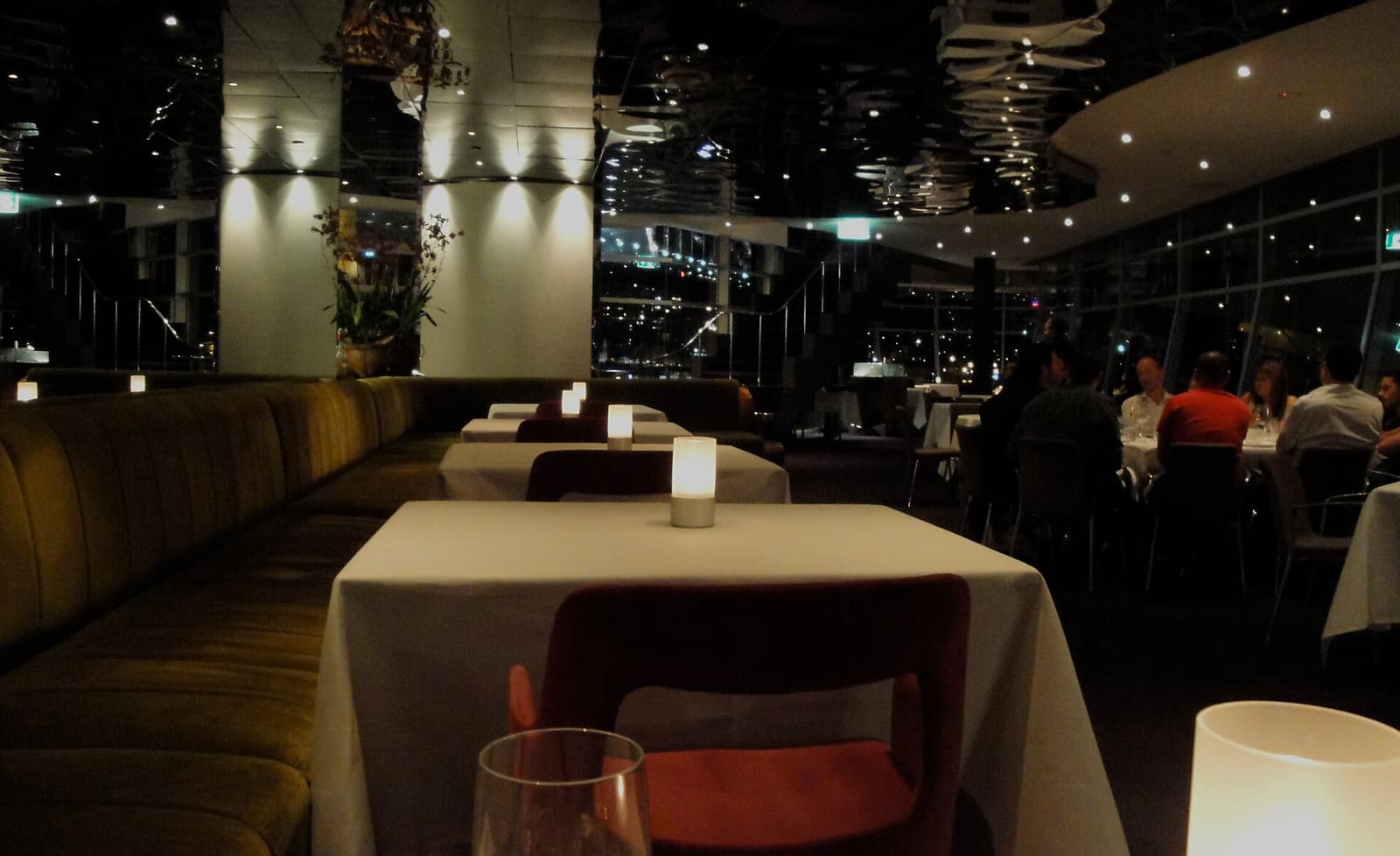
Its best answer was to make intimacy out of scale. The room looked outward, but the meal worked inward: from harbour to table, from skyline to ceramic, from public landmark to private occasion. That is why the 2011 dining-room photograph still feels useful rather than merely archival. The tables are dressed for ceremony, the windows announce Sydney, and yet the real drama is not the view alone. It is the attempt to slow the room down enough that glass, linen, service, and plate can compete with the city outside.[6]
Quay's final lesson, then, is not a recipe for the next Sydney flagship. It is a warning and an invitation. A spectacular room can make a restaurant famous before the first course arrives. It cannot, by itself, make the meal memorable. Quay's legacy is that, for a long stretch of Australian dining history, it made the most obvious view in Sydney feel like only the beginning.
Sources
- Destination NSW, "Fink announces closure of Quay restaurant" (17 December 2025) - closure date, history, Gilmore tenure, awards, and site transition.
- Quay Restaurant Sydney, "A Farewell from Quay" - official closing note from Leon Fink, Peter Gilmore, and the Quay team.
- The Rocks, "Quay Restaurant" - location, late-era dining-room positioning, menu format, and harbour-view description.
- Sarah Norris, "Vale Quay's Snow Egg." Broadsheet, updated 23 September 2020 - Snow Egg history and 2018 retirement context.
- Steph Harmon, "Peter Gilmore's Quay named Australia's best restaurant." The Guardian, 23 August 2018 - refurbishment, menu reset, and post-Snow Egg context.
- Jude Adamson, "Quay restaurant interior.jpg." Wikimedia Commons - real photograph of Quay's dining room, taken 7 March 2011.