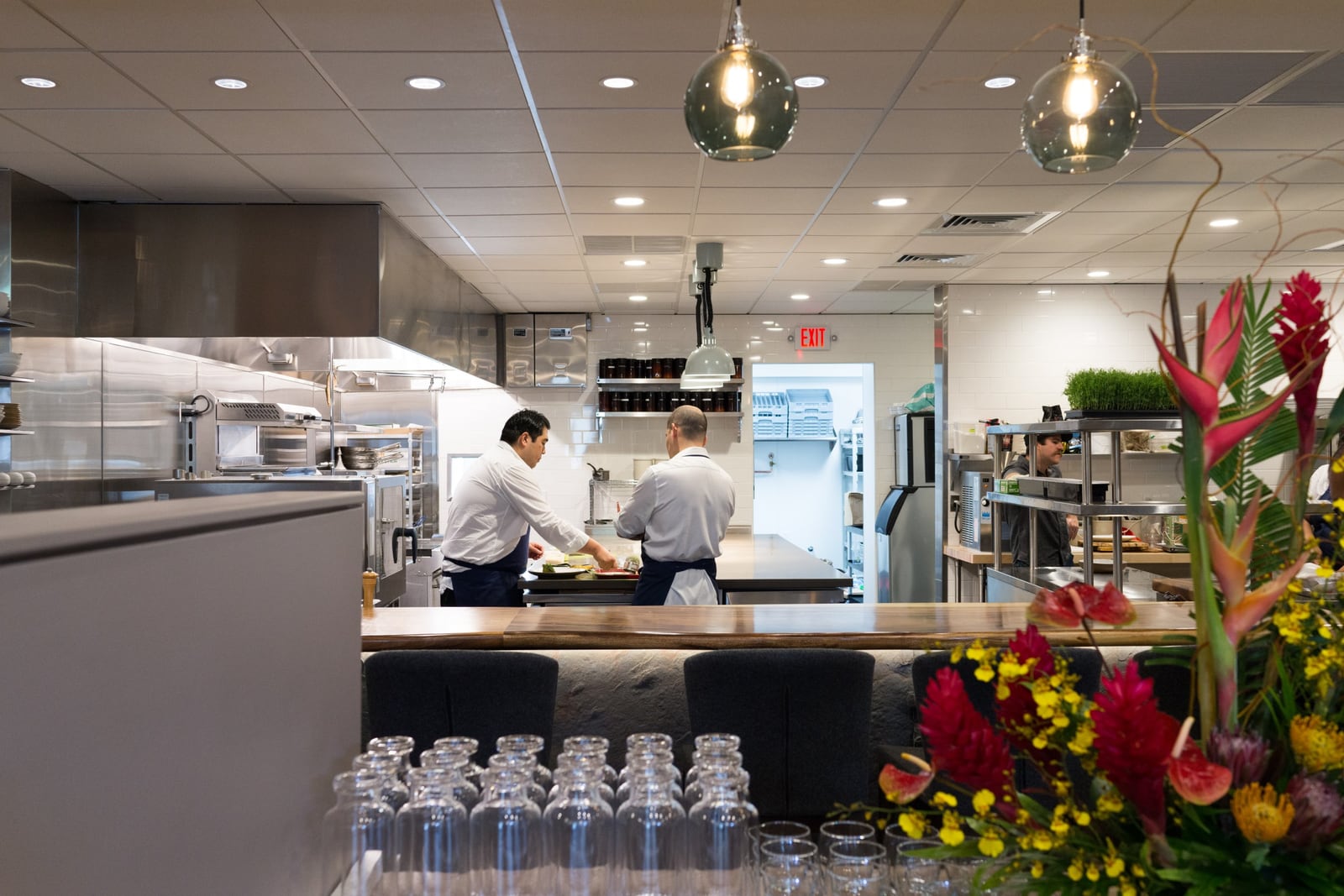
The photograph catches a restaurant rehearsing two identities before either has served dinner. Behind a long monkeypod counter, two chefs in white jackets bend over the same plate. Stainless steel and white tile make the open kitchen look almost clinical; red heliconia, yellow pincushions and rows of water glasses keep the dining-room side lush. There is a boundary, but no wall.[4]
That was Senia in late 2016, still waiting to open in Honolulu's Chinatown. The founding team was trying to place an exacting chef's counter inside a restaurant that neighbors could use more casually. Almost a decade later, the asymmetry remains unusually clear. The à la carte dining room operates Monday through Saturday. The tasting menu appears only on Friday and Saturday, at one 6:30 p.m. seating for eight guests.[1][2]
The small counter is not merely a premium version of the big room. It is a different grammar of dinner: fixed rather than chosen, synchronized rather than shared at the table's own pace, and close enough for guests to speak directly with the cooks. Senia's more interesting question is whether that concentrated experience can sharpen the whole house without becoming its throne.
What follows is a reported Q&A synthesis, not a newly conducted interview. The answers are written in the third person from Anthony Rush's published interview, Senia's current materials, contemporary opening coverage and independent reviews. No first-person reply has been invented, and this is an analysis of the documented format rather than a review based on a visit.
Why make the tasting menu the exception?
Because Rush's most revealing decision was not to reject fine dining. It was to stop letting fine dining dictate the only way into the room.
His résumé could easily have produced a tasting-menu-only restaurant: The French Laundry, The Fat Duck and Per Se all appear in the career history published before Senia opened. Yet Rush described the main concept to The Caterer as casual regional American dining built around shareable small plates, large cuts of meat and whole fish. The more refined 12-course menu was assigned to a seven-seat counter and a tiny chef's table.[3]
The distinction was deliberate. Opening coverage called Senia a neighborhood restaurant seen through a fine-dining lens, not a fine-dining restaurant with a cheaper annex. The room reinforced the claim. A 50-seat dining area faced an equally visible kitchen; the counter, cabinetry and suspended glass sculpture were made by Hawaiʻi craftspeople rather than imported as anonymous luxury fixtures.[4]
Today the counter has eight seats, while the main room owns six service nights and the full evening window from 5:30 to 9:30. The counter owns two seatings per week.[1][2] That schedule makes the editorial hierarchy legible. Most of Senia's working life is still à la carte.
“Neighborhood” should not be confused with inexpensive. OpenTable places the current restaurant in its “$50 and over” band, and the tasting menu is explicitly sold as an exclusive experience.[2] Nor can a website prove that regulars actually return. The defensible claim is narrower: Senia preserves choice as part of hospitality. A guest can share a few plates, build a large dinner, reserve a private room or submit to the counter's complete sequence. Fine-dining discipline is available without becoming a compulsory admission ritual.
Can one kitchen speak two service languages?
Only if it treats them as different forms, not different levels of seriousness.
Senia describes its à la carte menu as broad, collaborative and family-style. The tasting page changes the verbs: seasonal ingredients are composed into one considered progression, presented at close range by the culinary team.[1] In the main room, the kitchen must tolerate variation—one table lingering over snacks while another waits for a large-format dish. At the counter, eight guests move together. Every course creates the next deadline.
The physical room makes that tension visible. The counter looks straight into the kitchen, while the dining room shares the same open volume.[4] On Friday and Saturday, cooks are therefore serving a synchronized miniature restaurant inside a larger unsynchronized one. The counter rewards concentrated explanation and last-second finishing. The main room demands parallel timing, choice and enough slack for conversation.
That arrangement can fail in a very specific way: the tasting menu becomes the performance, and everyone else becomes its background audience. An early Honolulu Magazine review recognized the ambition of Senia's multi-format model while also reporting inconsistent execution and front-of-house kinks as a young team learned an ever-changing menu.[6] Eater's later review described the business problem behind the split: an extravagant counter alone might not draw a sufficiently consistent local clientele, so the team paired it with a bustling à la carte room.[5]
Neither account settles today's execution. They identify the enduring test. On counter nights, a plate chosen from the main menu must not feel like the kitchen's interruption. A family-style dish can be less intricate than course nine without receiving less attention. If the counter's precision depends on making the rest of the room wait, the two-format idea has become a hierarchy after all.
Where does Hawaiʻi enter a regional American restaurant?
Through ingredients, makers and dining habits—but not through a claim to represent every cuisine of the islands.
Senia's current language is careful. It calls the food regional American and describes an intersection of Hawaiʻi's ingredients, diverse cultures and the team's multiple kinds of training.[1] At opening, the menu joined Maui venison, North Shore sea asparagus and Hawaiian sweet bread to techniques and seasonings gathered elsewhere. The space carried monkeypod wood and work by University of Hawaiʻi artists.[3][4] Place was distributed across supply, material and room rather than reduced to a pineapple garnish.
That does not make Senia a primer on Native Hawaiian or local food. Eater critic Bill Addison argued that a visitor would understand the restaurant better after eating poi, squid lūʻau, poke, plate lunch and the cooking of Hawaiʻi Regional Cuisine's earlier generation. His point was contextual, not a prescribed itinerary: Senia's combinations become more legible when the diner already knows some of the foods and histories being refracted.[5]
Rush's own position adds another layer. He arrived from Britain after working in celebrated kitchens in England, California and New York. Before opening, he spoke about learning from Kajioka's local relationships and about the strength of Hawaiʻi's community and produce.[3] Current official materials now identify Rush as founding chef-owner and describe the menu as the work of his kitchen team, not as a solitary importer's vision.[1] A later Hawaiʻi Magazine Q&A locates his personal everyday tastes in Oʻahu—from neighborhood poke to British comfort food—without pretending those appetites collapse into one “island cuisine.”[7]
The useful standard is therefore specificity, not purity. Name the venison, fish, farm or craftsperson when the relationship is real. Let a Japanese, British, Filipino, Hawaiian or continental American reference remain identifiable when it matters. A melting pot becomes lazy when it erases the vessels that poured into it.
What survives when a founding partnership changes shape?
The restaurant can either rewrite itself around one auteur or preserve collaboration as a method.
The cover photograph belongs to Senia's opening chapter. Chris Kajioka and Anthony Rush are in the kitchen; Katherine Nomura helped create and run the house; the three shared a Per Se history.[3][4] Current public materials use a different frame. Senia's website names Rush as its founding chef-owner and leader of the kitchen team, while OpenTable identifies Rush as executive chef and describes Nomura as his wife and co-owner.[1][2]
Those records should not be blurred into a timeless founding myth. They also should not be used to erase the collaborative origin visible in the photograph. A restaurant outlives a partnership by deciding which parts were personal chemistry and which became house knowledge.
Senia's own answer is embedded in the language of both menus. The à la carte page says development draws on Rush's experience and the skills of the kitchen as a whole. The tasting page likewise assigns sourcing, technique and composition to Rush and his team.[1] That wording matters because a tiny counter naturally magnifies the person standing behind it. Eight guests can watch one chef approve a plate and leave believing they witnessed sole authorship, even when farmers, prep cooks, pastry cooks, dishwashers, servers and the opening team made the moment possible.
Collaboration is credible only when it changes opportunity as well as copy. Public pages cannot show who proposes a dish, receives credit, advances through stations or stays long enough to teach the next cook. Still, naming the team establishes the right burden of proof. The restaurant's present should not depend on freezing its founders in 2016; its future should not pretend one pair of hands built the room.
Does the counter protect the neighborhood room—or betray it?
The answer is observable in service, not in branding.
The strongest case for the counter is that it gives experimentation a small, controlled stage. Eight portions let the kitchen test a fragile composition, explain an unfamiliar ingredient and receive immediate reactions without forcing every guest through the same sequence. The main room can remain generous and plural: a place where the table chooses its appetite rather than renting the chef's.[1][2]
It would be tempting to go further and say the tasting menu financially supports the à la carte restaurant. Senia does not publish the operating numbers needed to prove that. Eight premium seats may carry strong margins, or the labor and product intensity may consume them. The honest argument is editorial, not accounting: the counter concentrates one kind of attention while the larger room protects several other ways of eating.
That bargain creates practical tests. Does the main menu still offer complete pleasures rather than simplified counter leftovers? Can a server explain a local ingredient without delivering a lecture? On Friday night, do à la carte courses retain their pace while the eight-seat sequence moves? Does the team speak about both formats with equal pride? And can a first-time guest understand that the most exclusive reservation is not automatically the most faithful expression of the restaurant?
Senia's present schedule keeps those questions alive. Six nights of chosen dishes surround two small, fixed processions.[1] The tasting menu is rare enough to feel special, but the neighborhood room is not merely its waiting area.
Return to the archival photograph. The counter runs horizontally across the frame, a beautiful seam of dark wood between flowers and steel. It could be read as a barrier: guests on one side, expertise on the other. The open kitchen makes a better reading possible. The counter is an edge where two kinds of dinner meet.
Senia works as an idea when that edge stays permeable—when concentration at eight seats improves the craft without concentrating all the dignity there. The tasting menu may be the hardest reservation. The neighborhood room is the harder promise.
Sources
- Senia, “Hospitality & Friendship” — current official account of Anthony Rush's leadership, regional American framing, collaborative kitchen, linked à la carte and tasting-menu formats, hours and hospitality philosophy.
- OpenTable, “Senia” — current restaurant listing for the eight-seat counter, Friday–Saturday tasting schedule, six-night à la carte service, dining areas, ownership and executive-chef details.
- Janet Harmer, “Brits abroad: Anthony Rush, Senia restaurant, Honolulu,” The Caterer (May 18, 2016) — Rush's pre-opening interview on training, partnership, local sourcing, community and the planned split between a casual main room and refined counter.
- Kathy YL Chan, “Why Senia Marks a New Chapter in Honolulu Dining,” Eater (December 6, 2016) — opening report on the room, founding team, two-format concept, local makers and source of the archival kitchen photograph.
- Bill Addison, “Senia Is Hawaiʻi's Most Thrilling New Restaurant,” Eater (October 25, 2017) — multi-visit review placing the dining-room/counter split within Honolulu's local and Hawaiʻi Regional Cuisine context.
- Martha Cheng, “Is Restaurant Senia Worth the Hype?” Honolulu Magazine (January 2017) — early two-visit assessment of the restaurant's multi-format ambition, changing menu, inconsistent execution and service learning curve.
- “The Chef's Guide to Hawaiʻi Grinds,” Hawaiʻi Magazine (January 7, 2022) — Q&A identifying Rush as Senia's co-founding chef-owner and locating his everyday Oʻahu tastes outside the tasting-menu frame.