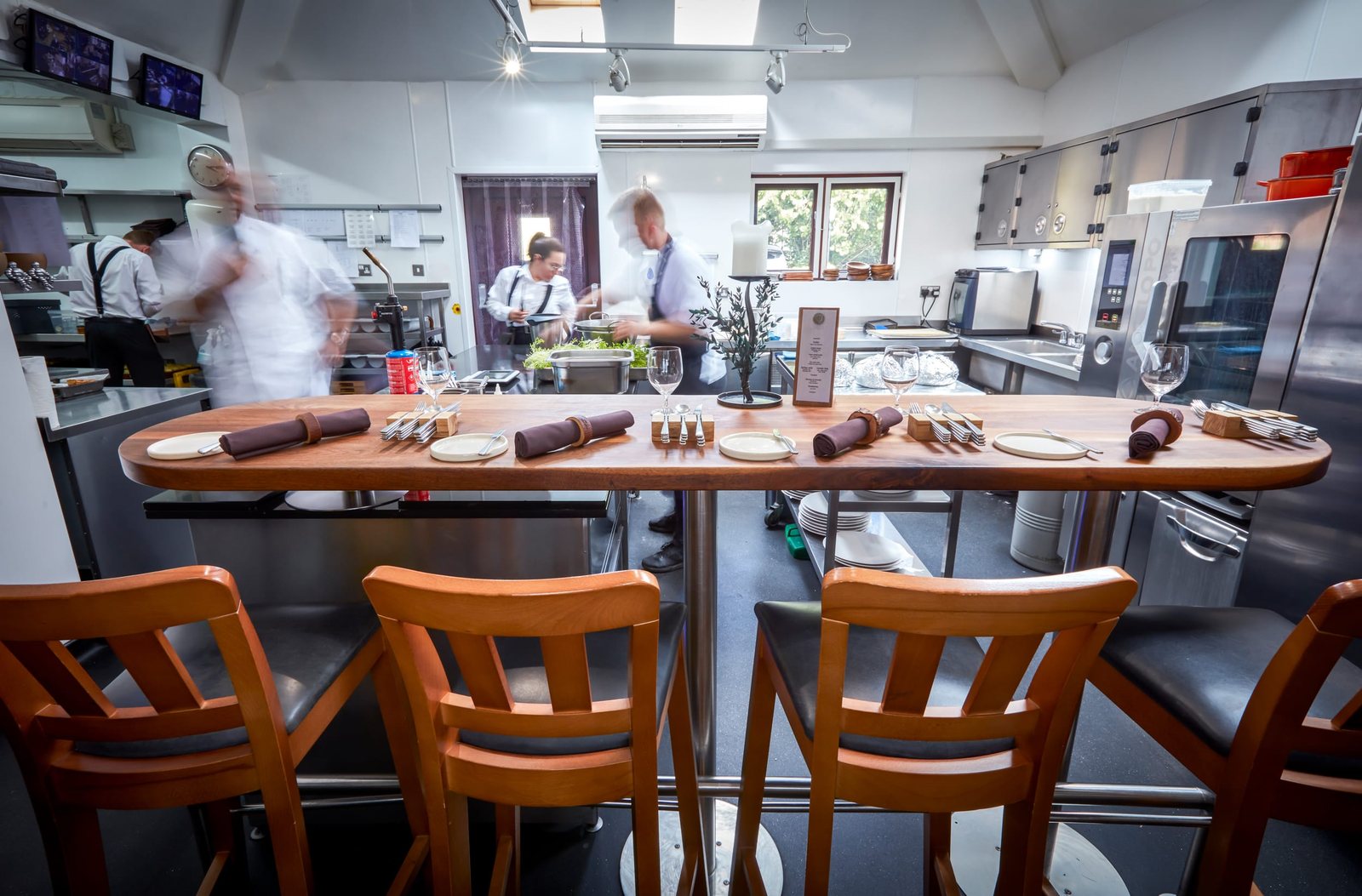
The chairs are empty, but the kitchen is not still. At Restaurant Sat Bains, a long wooden counter has been set with pale plates, water glasses and wine-dark napkins. Behind it, four white jackets cross the stainless-steel room quickly enough to blur. A branch stands upright in the center of the counter, improbably calm.[1]
This is what fine dining’s four-day week looks like from the guest side: concentration disguised as ease. The restaurant does not produce less precision because its public week is shorter. It asks a smaller number of service windows to carry more of the business, then asks one brigade to arrive rested enough to make the compression invisible.
That distinction matters because “four-day week” can describe several different things. It may mean four long shifts with the same total hours, a genuine reduction in paid time, a restaurant that opens only four days, or a seven-day business that rotates individual days off. The number alone says almost nothing about recovery. In Britain, the usual legal ceiling is an average 48-hour week, and an adult can voluntarily opt out in writing.[6] Four 12-hour days fit exactly inside that ceiling. An extra day off can be transformative; it does not automatically make the first four gentle.
The most interesting movement in ambitious restaurants is therefore not a calendar trick. It is a redesign of the product. The dining room goes dark on purpose. Reservations become scarcer. Prep, lunch, dinner and recovery are made to agree. When that architecture works, the closed door is not lost hospitality. It is one of the conditions that lets hospitality feel fully present when the door opens.
The Nottingham wager became an operating system
Sat and Amanda Bains made the clean version of that bet in 2015. Restaurant Sat Bains would open from Wednesday through Saturday and close for three consecutive days. Pay would not fall. The owners expected the lost day to cost six figures, but later reported that the loss never arrived; they moved covers into four busier days and kept lunch in the pattern.[3]
The continuous break was as important as the count. In the schedule described by The Caterer, staff finished around 1 a.m. on Sunday and did not return until 7 a.m. Wednesday. That gap contains a recovery night plus two days that are not fractured by a prep call, a delivery or the knowledge that tomorrow’s double shift starts at dawn. Average retention reportedly lengthened from roughly two years to three.[3]
That was not the end of the redesign. After the pandemic and Sat Bains’s 2021 heart attack, the restaurant narrowed again. A December 2024 account says the main dining room fell from about 50 covers to 28, service consolidated into five services per week, and the old peak of nearly 100 Saturday covers disappeared. Turnover fell, but by less than the reduction in seats because menu prices rose; headcount came down through attrition rather than redundancies, while the annual wage bill still exceeded £800,000.[2]
The restaurant’s current site preserves the 28-cover room but now offers three depths rather than one compulsory marathon: Interlude at £149, Prelude at £199 and Overture at £259 in the main dining room. For the longer Prelude and Overture sequences, the Chef’s Table and Kitchen Bench carry a premium for the closest view of the work.[1] Those live prices are not proof that four-day scheduling caused the menu architecture. They show something more defensible: the house now manages demand with seat type, menu length and price, not with extra open days.
The current calendar also marks the limit of the older snapshot. Dinner runs Wednesday through Saturday and lunch Thursday through Saturday, but breakfast extends through Sunday.[1] The four-day dinner pattern persists; the public schedule does not prove that every department still shares the 1 a.m.-Sunday-to-Wednesday break reported in 2021.
This is why calling the policy a staff perk misses half the story. Restaurant Sat Bains changed capacity, service count, menu lanes and revenue per guest around the same promise. The protected dinner pattern survives because the busy services were rebuilt to pay for it.
One brigade makes the room legible
Manchester’s Skof used a related idea when it opened in 2024. Its business plan fixed dinner from Wednesday through Saturday and lunch from Thursday through Saturday: seven services across four days. On a full night, eight kitchen staff and six front-of-house staff served 36 covers, with as many as 15 courses per tasting menu.[4]
The advantage was not merely three days off. Chef Tom Barnes wanted the same team present every day. In a tasting room, that continuity reaches the plate. The cook who saw Wednesday’s sauce split can correct Thursday’s batch. The server who noticed a lull between two courses can report it to the same pass. A young commis does not have to learn two chefs’ versions of the garnish depending on the rota. Repetition accumulates inside one group instead of being handed between shifts.
The guest feels the result as memory. A napkin returns without being requested. The second pour reaches the table before the next sauce. An allergy note does not have to be rediscovered by a different combination of people. Fine dining often markets these moments as intuition; stable staffing reveals the rehearsal underneath.
The same design creates a sharp weakness. Barnes acknowledged that when everybody is already scheduled, illness leaves no spare person to call in. The brigade must shuffle.[4] A lean, whole-team model can produce beautiful continuity right up to the moment one absence turns continuity into fragility. Three closed days do not solve that by themselves. Cross-training, humane cover and enough staffing slack decide whether the benefit survives flu season.
Four days can contain five days of fatigue
The restaurant week fails when it compresses pain but not work.
A useful counterexample comes from Singapore’s wider food-and-beverage trade. CNA reported on one restaurant that ended a four-day experiment after staff found staggered days off more tiring. Employees still worked 44 hours; because the business opened five days and could not give everyone the same continuous break, their three days off started and stopped irregularly. Other operators estimated that maintaining opening hours under a shorter rota could require 20 to 30 percent more staff.[5]
That is not a direct comparison with a small tasting room. It exposes the mechanism. There are two basic ways to create a real break: close the business with the team, or hire enough people to rotate coverage without quietly lengthening everyone else’s shift. A restaurant that does neither may advertise four workdays while preserving every old hour, every open service and every interruption.
Even the cleanest model needs careful language. In 2024, Sat Bains said he personally still worked 50 to 60 hours a week, about three quarters of them in the kitchen.[2] The business was closed for three days; the owner’s labor did not fit neatly inside a 32-hour promise. That boundary should not be treated as a gotcha. Owners, head chefs, pastry teams, gardeners and administrators may carry different calendars. It is a reason to ask what a policy covers before admiring its headline.
A live recruitment page at two-star Restaurant Create in the Netherlands makes the movement’s new public language visible. Its head-sommelier role offers a four-day week on a Wednesday-to-Saturday schedule.[7] A decade after the Bainses presented their change as a risky answer to retention, the pattern can now appear in the benefits section of a senior dining-room job. That is progress—but a job ad still cannot reveal the shift length, the paid hours or who answers messages on Sunday.
The guest gives up availability and buys attention
Four-day fine dining asks something of diners too. The table that would have been available on Tuesday no longer exists. Demand bunches into the back half of the week. A special-occasion guest may accept that easily; a local who wants spontaneous access may not. Hotels, city-center restaurants and rooms that depend on seven-day footfall face a much harder equation than a destination tasting menu.
The exchange is worthwhile only if scarcity returns as attention. Fewer services should mean the garden can be picked closer to the meal, the same server knows the new menu by its second night, and the kitchen’s corrections carry through the whole week. It should not simply mean fewer reservations at a higher price.
Restaurant Sat Bains makes that bargain unusually visible. Its official site releases the booking diary one month at a time. The current main room holds 28 diners; the Kitchen Bench sells proximity to the pass itself.[1] The restaurant is not pretending to be continuously available. It is selling access to a concentrated system.
That system also explains the most revealing detail in the photograph. The chairs are waiting while the chefs are already moving. A four-day dining room is not a room in which everyone works less at every moment. It is a room in which intensity has an edge. The service begins; the whole team crosses that edge together; then, crucially, it ends.
The movement needs four numbers, not one
“Four days” becomes meaningful only beside the rest of the schedule. How many services does the restaurant run? How many paid hours fill those days? Does pay stay level? Are the days off continuous and shared, or staggered around an unchanged opening week?
Restaurant Sat Bains’s answer has force because its changes can be traced rather than flattened into one slogan. The 2021 account records four opening days and a long collective break; the 2024 account records five weekly services and a 28-cover room; the current site still lists 28 covers, four dinner days and a Sunday breakfast.[1][2][3] Skof’s answer is different but equally legible: seven services, one brigade, three days off, and admitted vulnerability when a person is missing.[4] The failed Singapore experiment matters because it shows what happens when the days change but the hours and coverage problem do not.[5]
This remains a small movement, not a universal cure for restaurant work. A compressed week can still be punishing. Closure can strain revenue. Lean staffing can transfer pressure to the people who show up. And no rota repairs a kitchen culture built on humiliation or unpaid labor.
But the best four-day rooms make a serious proposition: excellence does not require permanent availability. A restaurant can decline additional dinner services in order to protect the people responsible for the four it keeps. When the lights return, the diner does not taste a day off. The diner tastes the concentration it made possible.
The empty room, in other words, is not outside the meal. It is where the next service begins.
Sources
- Restaurant Sat Bains, official site — current 28-cover main room, menu formats and prices, team structure, booking rhythm, Kitchen Bench description and source page for the official kitchen photograph.
- Joe Lutrario, “Staying power: Sat Bains on his near-death experience and marking 25 years of his Nottingham restaurant,” Restaurant (December 18, 2024) — post-pandemic cover and service reductions, staffing economics, four-day continuity and owner working hours.
- Ben Walker, “Can hospitality move to a four-day week?” The Caterer (February 26, 2021) — Restaurant Sat Bains’s 2015 schedule change, pay, feared revenue loss, compressed covers, continuous break and reported retention outcome.
- Joe Lutrario, “Skof: the star-chasing restaurant for a city that likes to party,” Restaurant (June 6, 2024) — seven-service plan, 36-cover staffing, whole-team continuity and sick-cover tradeoff.
- Koh Wan Ting, “4-day work week tough for some F&Bs, but other benefits on offer to attract workers,” CNA (August 21, 2022; updated December 15, 2025) — Singapore trials, weekly-hour comparisons, staggered-rest fatigue and operators’ staffing estimates.
- UK Government, “Maximum weekly working hours” — official guidance on the average 48-hour limit and voluntary written opt-outs.
- Restaurant Create, “Head Sommelier” — current primary recruitment page listing a four-day working week and Wednesday-to-Saturday schedule for the two-star Dutch restaurant.